
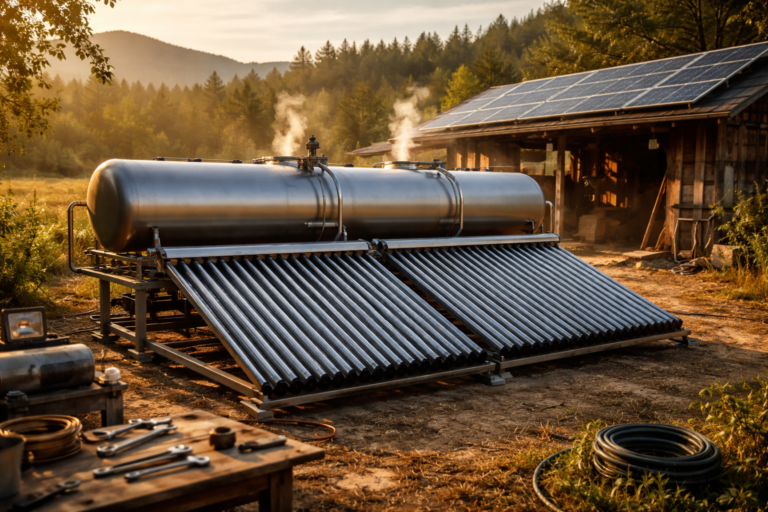
Imagine producing enough hot water for a small community without a single kilowatt from the grid, a liter of oil, or a cubic meter of gas. That’s exactly what one inventive tinkerer demonstrated: a hybrid, passive system that reliably delivers 3,000 liters of hot water a day using only sunlight, thermodynamics, clever storage, and a bit of DIY ingenuity.
The basic idea
The system relies on two simple truths: solar thermal is highly efficient at converting sunlight to heat, and heat is easiest to manage when you store it. By combining a large solar collector field with well-insulated buffer tanks and passive circulation (thermosiphon), the tinkerer avoided pumps and external power. Redundancy comes from a biomass backup and smart plumbing that prioritizes hot water flow where it’s needed.
Short, robust components and conservative design choices make the difference between a flaky prototype and a reliable daily workhorse.
How the system works
Solar thermal array and collectors
The heart of the setup is a field of evacuated-tube collectors and flat-plate panels sized to capture enough insolation to heat large volumes. Evacuated tubes are favored for their high performance in variable weather and ability to reach higher temperatures quickly.
Collectors are installed at optimal tilt and oriented to maximize daily energy capture. No electrical trackers are used—simplicity increases reliability.
Passive circulation: thermosiphon and gravity
Rather than relying on pumps, the tinkerer used thermosiphon loops where hot water naturally rises and cold water sinks. Carefully routed piping and elevation differences ensure continuous flow during daylight hours.
Thermosiphon loops remove the need for electric controls and reduce maintenance. They do require attention to pipe layout, air traps, and a reliable expansion arrangement to avoid cavitation and freezing.
Massive insulated storage
Providing 3,000 liters/day is as much a storage problem as a generation problem. The system uses several insulated tanks totalling a few cubic meters, staged so incoming heated water preheats the next tank down the line. High-performance insulation (polyiso, vacuum panels where affordable, or thick spray foam) reduces overnight losses.
Staging allows a steady supply of hot water at usable temperatures even when clouds pass or solar input dips.
Heat exchange and distribution
To keep potable water safe and to simplify maintenance, a plate heat exchanger transfers heat from the solar loop to the domestic water circuit. This prevents stagnation in potable lines and allows the collector loop to operate at higher temperatures without risking scaling or bacterial growth in household plumbing.
Distribution is prioritized: first supply goes to domestic hot taps, then showers, then laundry and other uses. If demand exceeds supply, the system gracefully provides warmed water rather than cold surprises.
Backup without fossil fuels
For very cloudy stretches, a biomass-fired tank (a small rocket-mass heater or efficient wood boiler) provides supplemental heat. Combined with storage, this backup ensures continuity without electricity, oil, or gas. The design includes simple safety mechanisms (thermostatic vent valves, reliefs) to prevent overheating.
Key design tips from the tinkerer
- Insulate everything. The single biggest performance gain is reducing losses from storage and piping.
- Size collectors conservatively but add storage generously. More storage smooths daily variability.
- Avoid complexity: passive circulation beats small pumps for reliability in off-grid systems.
- Use heat exchangers for potable safety and easier maintenance.
- Build redundancy: multiple smaller tanks and collector groups are more serviceable than one giant unit.
Practical performance and real-world results
On clear days the array easily surpasses the energy needed to raise 3,000 liters by 30–40°C, roughly the heating needed for showers, laundry, and sanitation. With well-sized storage and good insulation, the system meets demand reliably through most seasons. During prolonged overcast periods, modest biomass backup covers remaining needs.
Operational costs are low after construction: occasional biomass fuel, routine inspections, and periodic replacement of sacrificial parts (valves, sensors if present).
Is this for you?
A project like this suits DIYers comfortable with plumbing, welding or tank assembly, and solar fundamentals. It pays off where energy costs are high or grid access is limited. For urban installations or regulated jurisdictions, check local codes and water-safety regulations before commissioning.
The tinkerer’s achievement—3,000 liters of hot water a day: tinkerer needs no electricity, oil or gas—shows what thoughtful design and durable materials can do. With patience and careful planning, off-grid hot water at scale is practical, sustainable, and remarkably satisfying to build.