
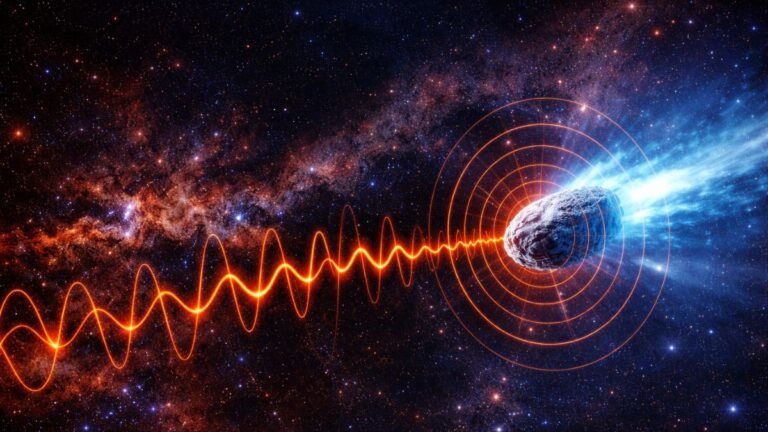
Astronomers around the world were surprised when a candidate radio emission appeared to be associated with 3I/ATLAS, an interstellar comet passing through our Solar System. The report — brief, cautious, and immediately flagged for follow-up — sparked a flurry of interest across observatories, amateur radio astronomers, and the public.
Below I summarize what we know so far, how such detections are handled, and the plausible explanations for a mysterious radio signal apparently coming from an object not bound to the Sun.
A brief overview of the detection
The initial notice described a narrow-band radio feature coincident with the sky position of 3I/ATLAS during a short observing window. Narrow-band signals are unusual in natural radio emission from comets, so the detection stood out. The observing team emphasized that the signal is a candidate — it requires confirmation, cross-checking, and careful vetting for terrestrial interference.
Because 3I/ATLAS is an interstellar visitor, any unusual signal associated with it draws extra attention. Interstellar objects are rare opportunities to study material formed around other stars, and an unexpected radio feature adds a layer of mystery.
How radio signals from space are observed
Radio astronomers use large dish antennas and arrays to scan the sky for both natural and artificial sources of emission. Key steps in detecting and validating a signal include:
- Multiple observations with different instruments to rule out local interference.
- Checking signal properties: bandwidth, modulation, polarization, Doppler shift, and repeatability.
- Cross-referencing with known satellite transmissions and terrestrial radio sources.
- Verifying that the signal’s sky position tracks with the moving target (in this case, 3I/ATLAS) rather than being fixed.
Because many human-made transmitters can mimic celestial signals, rigorous procedures exist to avoid false positives.
Possible explanations for the signal
At this early stage, several explanations are plausible:
Terrestrial radio frequency interference (RFI)
- Commercial satellites, aircraft, and ground transmitters can contaminate observations. RFI is the most common cause of spurious detections.
Instrumental artifacts
- Electronics, software glitches, or sidelobe responses in the telescope can create apparent signals.
Natural cometary radio emission
- Comets interacting with the solar wind can produce radio emissions, though narrow-band, persistent features are atypical.
Reflection or scattering of Earth-based signals
- A cometary nucleus or coma could reflect or scatter a human-made signal, making it appear to originate from the comet’s location.
Rare or unexpected astrophysical phenomena
- Uncommon plasma processes in the comet’s coma might generate surprising radio signatures.
At present there is no verified evidence to support the more extraordinary notion that the signal is artificial in origin. Responsible scientific practice demands exhausting the mundane explanations first.
Why this matters
Even if the signal turns out to be interference or an instrumental quirk, following up matters for several reasons:
- Interstellar objects are scientific gold mines. Any unusual measurement helps refine our models of composition and behavior.
- The event tests protocols for rapid, multi-observatory verification of transient signals — a useful exercise for future targets.
- Public interest in interstellar visitors and potential signals boosts engagement with astronomy and funding for follow-up facilities.
Most importantly, the scientific method requires skepticism: claims need reproducible evidence and independent confirmation before they change textbooks.
What happens next
Teams of astronomers and signal analysts will take concrete steps to resolve the detection:
- Re-observe 3I/ATLAS with multiple radio telescopes at different geographic locations.
- Search archival data for similar features at the comet’s trajectory.
- Coordinate optical, infrared, and radar observations to better characterize the comet’s activity and environment.
- Release data to other groups for independent analysis and peer review.
If the feature persists and is confirmed, a broader community of researchers will investigate deeper. If it does not repeat or is traced to interference, the note will still contribute to lessons learned.
Conclusion
The headline “3I/ATLAS: a strange radio signal was detected from the interstellar comet” captures why the astronomy community paused: an odd candidate signal from a rare interstellar visitor deserves attention. But extraordinary claims require extraordinary evidence. For now, the detection is a call to observe, check, and collaborate — the very processes that turn surprises into scientific understanding.