
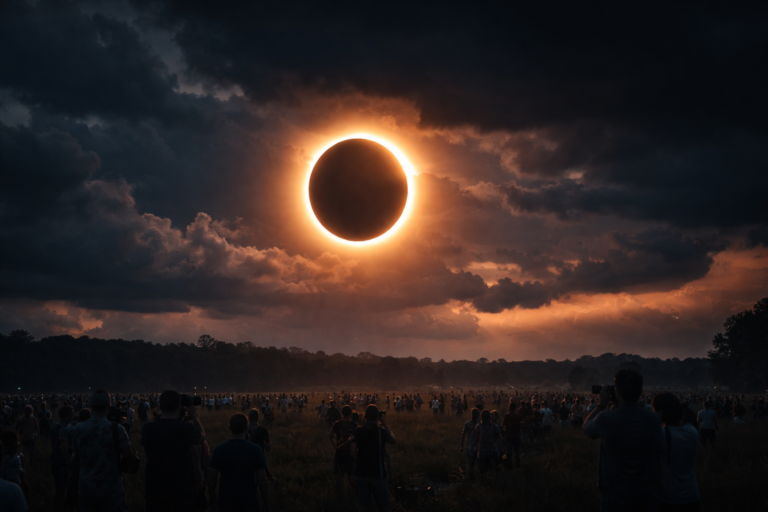
A total solar eclipse is one of nature’s most dramatic spectacles. For a few precious minutes, the Moon perfectly blocks the Sun and daytime briefly becomes night. This coming event — expected to deliver up to six minutes of totality in places along its path — promises to be one of the longest and most memorable eclipses of the century. If you plan to witness it, now is the time to prepare.
What to expect during totality
Totality is the brief period when the Sun is completely obscured by the Moon. Before and after totality you’ll experience dramatic changes in light and temperature, a 360-degree sunset glow on the horizon, and often heightened animal activity.
- Sky darkens rapidly; stars and planets become visible.
- Temperature can drop several degrees in minutes.
- The Sun’s corona — a glowing halo — becomes visible around the dark disk of the Moon.
- Wind shifts and wildlife may behave as if nightfall has come.
A maximum of roughly six minutes of totality is exceptionally long. Even shorter durations, however, are unforgettable; the key is to be in the right place at the right time.
How to prepare: travel and timing
Eclipse paths are narrow. Only observers within the path of totality will experience the full blackout.
- Check the official path map from trusted astronomical sources and choose a viewing spot inside the path.
- Plan travel and lodging well in advance; popular towns along the path fill up early.
- Monitor long-range weather forecasts; clear skies are essential. Have a backup viewing location within a reasonable driving distance.
- Arrive at your chosen site the day before, or early the morning of the eclipse, to avoid last-minute traffic.
Timing is precise. Totality can last minutes or seconds depending on location. Know the exact local times for first contact, totality start, peak, and end.
Safety: protect your eyes
Never look at the Sun without proper protection except during the brief period of complete totality. Even a fraction of the Sun’s disk can cause permanent eye damage.
- Use ISO 12312-2 certified solar viewing glasses for all partial phases.
- Use solar filters on cameras, binoculars, and telescopes. Do not look through optical devices while wearing eclipse glasses; the concentrated sunlight can damage eyes.
- Only remove filters and glasses when totality begins and the Sun is entirely blocked. Replace them immediately when totality ends.
- Supervise children strictly to ensure safe viewing.
Photography and gear tips
If you want to photograph the eclipse, plan and practice ahead of time.
- Bring a DSLR or mirrorless camera with a telephoto lens (200mm or longer preferred).
- Use a sturdy tripod and a remote shutter release to reduce blur.
- For partial phases, use a proper solar filter. Remove the filter only during totality.
- Bracket exposures during totality to capture the corona’s range of brightness.
- Consider wide-angle shots to capture the landscape and crowd reactions during totality.
- Practice manual focusing on a distant object before the day, and pre-program settings if possible.
Making the most of the six minutes of darkness
Six minutes can feel both fleeting and luxurious compared to typical totality lengths. Here are ways to savor it:
- Prepare a short list of moments you want to experience: silence, the corona, the horizon glow, and star visibility.
- Record audio on your phone to capture the reactions and sounds around you — these make powerful memories.
- Take a moment to look up and truly observe the corona without screens for at least part of totality.
- If you’re in a group, coordinate a shared countdown to the start and end of totality.
Cultural and emotional significance
Eclipses have inspired awe across cultures and centuries. Many communities host festivals, scientific outreach events, and nightwatch gatherings. Whether you treat the event as a scientific opportunity or a personal, almost spiritual experience, planning ahead ensures it becomes one of the most vivid memories of your life.
Quick checklist
- Confirm viewing location inside the path of totality.
- Pack ISO-certified solar glasses and camera solar filters.
- Bring tripod, spare batteries, snacks, water, and warm clothing.
- Download local eclipse timing and weather apps.
- Arrive early and have a backup plan for clouds.
This rare window of six minutes of darkness will literally turn day into night for observers lucky enough to be in the right place. With careful planning, safe viewing practices, and a dash of curiosity, you’ll be ready to witness one of the most extraordinary sky shows of the century.