
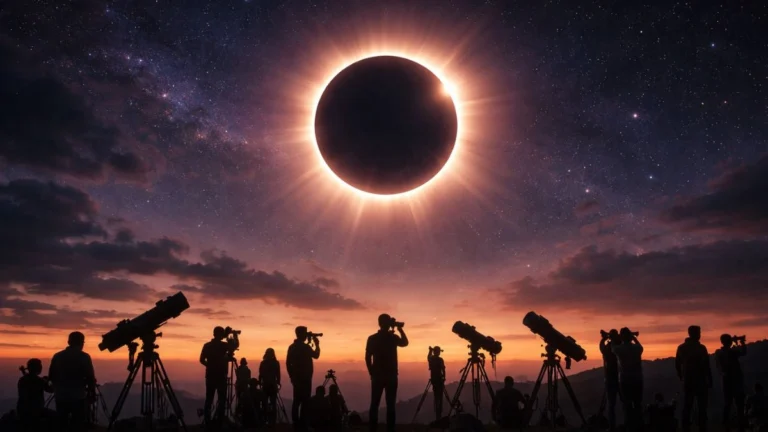
A breathtaking astronomical phenomenon is approaching—a total solar eclipse bringing nearly 6 minutes of darkness to parts of Earth. Astronomers are calling it a once-in-a-lifetime event, not only because of its extraordinary duration but also because such long eclipses are extremely rare and may not be visible again in some regions for decades.
This rare event is expected to peak on August 2, 2027, delivering up to 6 minutes and 23 seconds of totality, making it the longest total solar eclipse of the 21st century.
What Is a Total Solar Eclipse
A total solar eclipse occurs when the Moon passes directly between the Earth and the Sun, completely blocking sunlight and casting a shadow on Earth.
During this brief moment:
- Daylight turns into deep twilight or near-night
- Stars and planets become visible
- The Sun’s corona (outer atmosphere) appears as a glowing halo
Why This Eclipse Is So Special
Unusual Duration
Most total solar eclipses last only 2 to 3 minutes, but this event will stretch beyond 6 minutes, which happens only a few times per century.
Longest of the Century
- Peak duration: 6 minutes 23 seconds
- Longest eclipse visible from land between 1991 and 2114
Perfect Cosmic Alignment
This rare length is due to:
- The Moon being closer to Earth (perigee)
- The Sun being farther from Earth (aphelion)
This alignment makes the Moon appear larger, allowing it to fully cover the Sun for longer.
Where Will the Eclipse Be Visible?
The path of totality will cross multiple continents, offering millions a chance to witness it.
Key Regions of Visibility
- Southern Spain
- Morocco, Algeria, Tunisia
- Libya, Egypt (best viewing spot)
- Saudi Arabia, Yemen
- Parts of East Africa
At its peak, locations near Luxor, Egypt will experience the longest duration of darkness.
Outside these regions, people will only see a partial eclipse, meaning the Sun will not be fully covered.
Eclipse Facts At a Glance
| Feature | Details |
|---|---|
| Event Type | Total Solar Eclipse |
| Date | August 2, 2027 |
| Maximum Duration | 6 minutes 23 seconds |
| Visibility | Europe, North Africa, Middle East |
| Longest Point | Near Luxor, Egypt |
| Rarity | Longest eclipse of the century |
| Next Similar Event | Not until after 2100 |
Why It May Be the Last Visible for Decades
Although solar eclipses occur somewhere on Earth every 1–2 years, seeing a total eclipse from a specific location is rare.
- Some regions may not experience another total eclipse for decades
- The path of totality is very narrow, often only about 100–200 km wide
- Missing this event could mean waiting 20–50 years or more
This is why astronomers emphasize planning ahead—it may be the only opportunity in a lifetime for many observers.
What Will Happen During the 6 Minutes of Darkness
During totality, observers will experience dramatic changes:
Visual Phenomena
- Sky turns dark like sunset or night
- Bright stars and planets become visible
- The Sun’s corona shines clearly
Environmental Changes
- Temperature can drop by 5–10°C
- Animals may behave as if it’s nighttime
- Winds may shift suddenly
Rare Effects
- Diamond Ring Effect just before and after totality
- Shadow bands flickering on the ground
Upcoming Eclipse Timeline (2026–2027)
The 2027 eclipse is part of a sequence of major celestial events:
- February 17, 2026 – Annular “Ring of Fire” eclipse
- August 12, 2026 – Total solar eclipse across Europe
- August 2, 2027 – Longest total eclipse of the century
This period is often described as a “golden age of eclipses.”
How to Prepare for the Event
Travel Planning
- Book early for prime locations like Spain or Egypt
- Expect high demand and limited accommodation
Safety Measures
- Use certified eclipse glasses
- Never look at the Sun directly without protection (except during totality)
Best Viewing Tips
- Choose locations with clear skies
- Arrive early to avoid crowds
- Use cameras with solar filters
Future Impact and Scientific Importance
This eclipse is not just a spectacle—it’s also a scientific opportunity:
- Study of the solar corona
- Observation of solar flares and magnetic activity
- Data collection for improving space weather predictions
Such long-duration eclipses allow scientists extended observation time, which is extremely valuable.
Conclusion
The 6 minutes of darkness expected in 2027 is more than just an astronomical event—it is a rare cosmic alignment that will not be easily repeated. With its record-breaking duration, wide visibility, and dramatic effects, this eclipse stands out as one of the most significant sky events of our lifetime.
For many regions, missing it could mean waiting decades for another chance. If you have the opportunity, this is one celestial event truly worth planning for.