
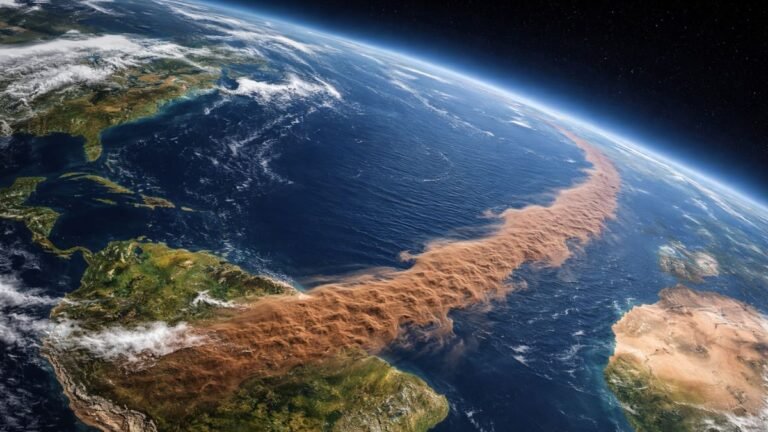
A massive, floating carpet of brown seaweed—stretching thousands of kilometers—has become a seasonal feature across the tropical Atlantic. Known as the Great Atlantic Sargassum Belt, this drifting “brown ribbon” links the coast of West Africa with the Caribbean and Gulf of Mexico. What looks like a miracle of nature is increasingly a warning sign: for coastal communities, marine ecosystems, and the wider health of the ocean.
What is the brown ribbon?
Sargassum is a genus of brown macroalgae that normally drifts on the ocean surface. In recent years, however, blooms have exploded in size and frequency. The Great Atlantic Sargassum Belt appears each year as a continuous, mat-like accumulation of algae spanning a distance comparable to that of entire continents.
This is not just a visual phenomenon. The belt alters ocean chemistry, blocks sunlight, and changes the food web where it settles or washes ashore. Satellite monitoring from agencies like NASA and NOAA now tracks the belt’s formation, movement, and intensity because of its broad ecological and socio-economic impacts.
Why it’s happening
Multiple human-driven and natural factors combine to fuel these blooms:
- Warmer sea-surface temperatures and changes in currents related to climate change create favorable growing conditions for Sargassum.
- Increased nutrient inputs from river runoff—carrying fertilizers, sewage, and other pollutants—feed blooms far from shore. The Amazon and West African rivers are often implicated as nutrient sources.
- Iron and phosphorus delivered by Saharan dust can act as fertilizers in surface waters.
- Shifts in ocean circulation can concentrate and transport Sargassum across vast distances, enabling the formation of extensive belts.
Together, these drivers point to an ocean increasingly shaped by human activities on land and by a warming climate.
Impacts on people and marine life
The consequences of the Sargassum belt are wide-ranging.
Coastal economies and communities
When large mats reach beaches, they rot and produce a foul smell from hydrogen sulfide and ammonia. That smell, along with visual blight, hits tourism hard. Coastal cleanup costs can run into millions annually for affected islands and nations, while small-scale fishers face lost catches and damaged gear.
Human health
Decomposing Sargassum releases gases that can irritate eyes and lungs, trigger asthma attacks, and cause headaches or nausea—especially for vulnerable populations living near affected shorelines.
Marine ecosystems
While Sargassum in open water can serve as habitat for juvenile fish and sea turtles, excessive accumulations smother coral reefs, seagrass beds, and benthic habitats where it sinks. Decay depletes oxygen locally, creating hypoxic conditions that stress or kill marine life. Sargassum can also ferry invasive species and pathogens across ocean basins.
Fisheries and food security
Commercial and artisanal fisheries suffer when Sargassum mats foul nets, clog engines, or alter fish distributions. In regions where communities depend on the sea for food and income, repeated Sargassum invasions threaten livelihoods.
Why it’s not a standalone problem
The Sargassum belt isn’t simply an algal bloom to be tolerated or cleaned up locally; it’s symptomatic of a broader set of environmental stresses. It ties together agricultural runoff, river management, atmospheric dust, warming seas, and altered ocean currents. In short, Sargassum exposes how land-use practices and climate change ripple into ocean health.
What can be done
Addressing the brown ribbon requires local, regional, and global responses:
- Improve monitoring and early warning using satellites and ocean sensors to help communities prepare.
- Reduce nutrient runoff by adopting better agricultural practices, improving wastewater treatment, and protecting wetlands that filter pollutants.
- Support research into safe, scalable removal and disposal methods. Some pilot projects explore turning Sargassum into fertilizer or biofuel, but care is needed because it can concentrate heavy metals and pathogens.
- Strengthen support for affected communities through emergency funding, health advisories, and livelihood programs.
- Tackle climate change: persistent reductions in greenhouse gas emissions will help limit the warming and circulation changes that favor extreme blooms.
Conclusion
The brown ribbon of Sargassum spanning the Atlantic is more than an inconvenient nuisance—it’s an ecological red flag. It signals how interconnected our land and ocean systems have become and how human actions amplify natural processes into costly, harmful events. Addressing it demands sustained monitoring, smarter land and ocean management, and collective action on climate. Otherwise, this drifting belt may only be the beginning of more serious marine disruptions to come.