
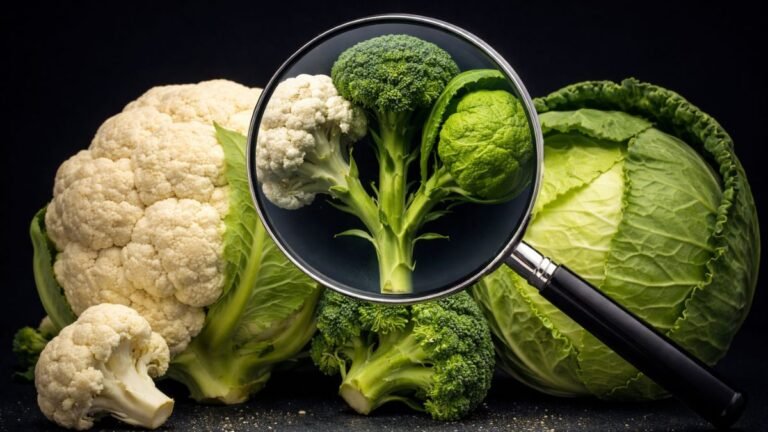
Say that sentence out loud and it sounds like a conspiracy theory. The reality is far less dramatic but still eye-opening: cauliflower, broccoli and cabbage (along with kale, Brussels sprouts and kohlrabi) are all cultivated forms of the same species — Brassica oleracea. Framing that botanical fact alongside how nutrition research and media coverage behave helps explain why dietary advice often feels inconsistent, confusing, or even manipulative.
The botanical truth: one species, many faces
Botanically speaking, cauliflower, broccoli and cabbage are not different species. They are varieties (cultivars) of Brassica oleracea that humans have selectively bred for distinct traits:
- Cabbage (var. capitata) was bred for a dense leafy head.
- Broccoli (var. italica) for its flower clusters.
- Cauliflower (var. botrytis) for its compact, sterile inflorescence.
- Kale (var. acephala), Brussels sprouts (var. gemmifera), and kohlrabi (var. gongylodes) are other members of the same family tree.
Through centuries of selection, breeders emphasized different plant parts — leaves, stems, buds — and produced strikingly different vegetables from the same genetic root. They’re the agricultural equivalent of changing a recipe to make bread, cake, and crackers from the same basic ingredients.
Why this makes nutrition science look inconsistent
Knowing that these vegetables share a species helps explain several recurring frustrations with nutrition science and coverage:
- Different parts, different nutrients: Broccoli florets, cabbage leaves and cauliflower curds aren’t identical in nutrient content. Fiber, vitamin C, sulfur compounds and phytochemicals vary by tissue and cultivar, so studies that compare “broccoli” to “cauliflower” can easily produce different headlines.
- Varietal and growing differences: Soil, season, cultivar, harvest time and storage change nutrient profiles. Two studies using “broccoli” grown in different places can yield different results.
- Cooking matters: Boiling, steaming, roasting and fermenting change bioavailability of vitamins and phytochemicals. Headlines rarely note whether a vegetable was eaten raw or cooked.
- Reductionist headlines: Nutrition reporting loves simplified claims — “eat X to prevent Y” — that ignore context, dose, and population differences. When a later study nuances or contradicts the claim, readers feel misled.
- Industry and marketing noise: Agricultural and food industries have incentives to promote particular crops or products. That can amplify selective findings while crowding out nuance.
- Study design limitations: Many nutrition findings come from observational studies, which show associations, not causation. Randomized controlled trials in nutrition are hard and expensive, so nuance gets lost between press release and headline.
All of the above means that the same family of vegetables can alternately be hailed as a miracle food, dismissed as irrelevant, or used to prove conflicting points — making the whole field feel like a confidence trick to anyone trying to keep up.
What to take away as a practical eater
Rather than try to parse every conflicting headline, use a few simple, resilient principles:
- Eat a variety of vegetables. Since many Brassica cultivars share beneficial compounds, rotating among cauliflower, broccoli, cabbage, kale and Brussels sprouts is sensible and reduces the risk of missing something important.
- Pay attention to preparation. Steaming preserves vitamin C better than boiling; fermenting cabbage (sauerkraut) adds probiotics. Little shifts in cooking can change nutrition.
- Favor whole foods over single-nutrient fixes. A focus on isolated “superfoods” tends to generate the juiciest headlines and the most transient claims.
- Ask about study type. Is the story based on a large randomized trial, a small lab study, or population associations? That matters for how confident you should feel about a claim.
- Remember context and dose. Nutrients work as part of a dietary pattern. One serving of broccoli won’t offset a generally poor diet.
Conclusion
The headline-grabbing riff — “Cauliflower broccoli and cabbage are secretly the same plant and it is making nutrition science look like a confidence trick” — is provocative but useful. It highlights how botanical reality and the messy, context-dependent nature of nutrition research collide with media simplification and marketing. Understanding that many vegetables are just different expressions of the same species helps explain contradictory advice, and it points to a practical, low-drama solution: eat broadly, cook thoughtfully, and treat sensational nutrition headlines with a healthy dose of skepticism.