
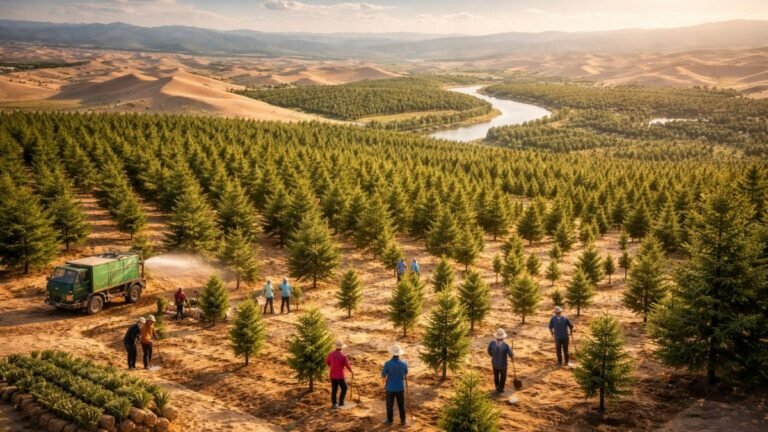
Since the 1990s China has pursued an unparalleled afforestation effort. By planting more than one billion trees since the 1990s, China has slowed desert expansion and helped restore vast areas of degraded land. The programs behind this push are large-scale, state-led and varied in approach, and they have produced measurable environmental and social benefits alongside important challenges.
Ambitious programs driving the change
Multiple national programs account for the bulk of China’s tree-planting and land-restoration work:
- The Three-North Shelterbelt Program (often called the “Great Green Wall”) aims to create a protective belt of trees across northern China to block wind and sand from expanding deserts.
- The Grain for Green Program converts marginal cropland back to forest and grassland by paying farmers to plant trees or restore vegetation.
- Natural Forest Conservation and other local initiatives support reforestation, soil conservation, and the restoration of degraded watersheds.
These initiatives combine heavy investment, policy incentives, and long-term planning. Planting has been concentrated in areas prone to desertification and soil erosion, where restoring vegetation provides the greatest benefit.
Environmental impacts
The scale and focus of planting efforts have produced clear environmental outcomes:
- Slowed desert expansion: Vegetation belts and restored land have reduced the advance of sand and dust in several regions, lowering the frequency and intensity of sandstorms affecting cities and agricultural areas.
- Stabilized soils: Tree roots and shrub cover help bind topsoil, reducing erosion and improving land resilience against wind and water.
- Carbon sequestration: New forests and restored grasslands capture atmospheric carbon, contributing to climate mitigation efforts at national scale.
- Habitat recovery: In many places, planting and protection of native vegetation have helped restore habitat for local wildlife and increased biodiversity relative to bare, degraded land.
Remote sensing and ground surveys indicate that many degraded areas have seen greening trends since the 1990s. This greening, when well-planned, translates into tangible ecosystem services for communities and the nation.
Socioeconomic benefits
Restoration has also delivered social and economic dividends:
- Improved livelihoods: Payments and incentives for planting under programs like Grain for Green have provided income alternatives for rural households, sometimes lifting pressure to overexploit fragile lands.
- Reduced sand damage: Cities and farmlands downwind of restored areas experience fewer dust incursions, lowering health risks and infrastructure wear.
- Water and food security co-benefits: Healthier watersheds and more stable soils can improve agricultural productivity over time, although outcomes depend on species choice and management.
Challenges and lessons learned
Large-scale planting is not a panacea. China’s experience highlights several caveats:
- Species choice matters: Early efforts sometimes favored fast-growing monocultures that poorly matched local ecology, resulting in low survival rates, reduced biodiversity and, in some cases, greater water stress.
- Water trade-offs: In arid zones, extensive tree cover can increase evapotranspiration and strain scarce water resources if species and density aren’t chosen to match local hydrology.
- Maintenance and survival: Planting is only the first step. Long-term survival requires follow-up care, protection from grazing, and community engagement—components that add cost and complexity.
- Integrated landscape planning: The most successful outcomes come from combining trees with grasslands, shrubs and sustainable agricultural practices, rather than single-purpose tree belts.
Key lessons for other restoration efforts include prioritizing native species, matching planting strategies to local climates and soils, ensuring long-term funding for maintenance, and involving local communities in planning and management.
Looking ahead
China’s achievement—by planting more than one billion trees since the 1990s, China has slowed desert expansion and helped restore vast areas of degraded land—demonstrates how coordinated policy, large public investment and targeted planting can reverse land degradation at scale. Continued emphasis on ecological suitability, biodiversity and local participation will determine whether these gains endure. For other nations facing desertification, the Chinese experience offers both inspiration and practical caution: scale matters, but so do the details of species selection, water balance and long-term stewardship.