
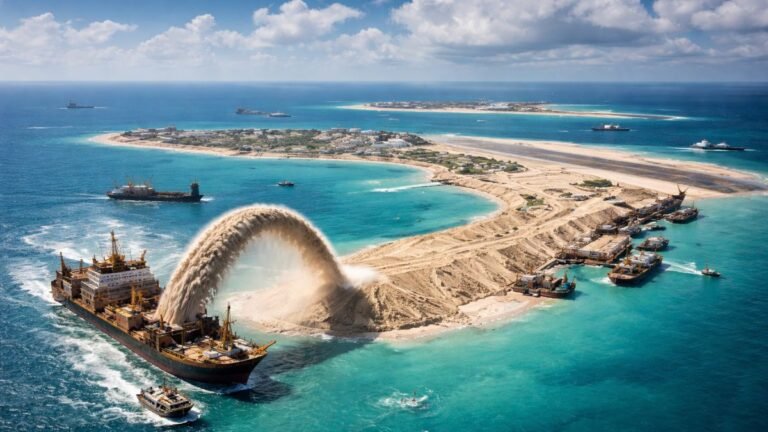
Over the past decade-plus, large-scale land reclamation projects have transformed tiny coral outcrops and submerged reefs in the South China Sea into sizeable, above-water landmasses. By dumping tonnes of sand into the ocean for more than 12 years, China has succeeded in creating entirely new islands from scratch—altering marine ecosystems, regional geopolitics, and the strategic balance in one of the world’s busiest waterways.
How these islands are created
The process is technically straightforward but environmentally destructive. Steps typically include:
- Dredging sand and sediment from seabeds or nearby shoals.
- Pumping that material onto exposed reefs and submerged features.
- Compacting and shaping the fill to form a stable platform.
- Building infrastructure—airstrips, harbors, radars, and bunkers—on top.
Massive dredgers and land-based construction equipment accelerate reclamation. In some cases, features that were once barely above sea level at low tide are now several kilometers across and can host runways and multi-story buildings.
Environmental consequences
The ecological cost of creating islands from scratch is severe:
- Coral reef destruction: Dredging buries corals and eliminates the complex habitats they provide.
- Sediment plumes: Fine particles spread across extensive areas, smothering filter-feeders and juvenile fish.
- Loss of biodiversity: Species dependent on reef ecosystems decline or disappear locally.
- Altered hydrology: New land changes currents and sediment transport, with knock-on effects beyond the immediate site.
Marine scientists warn that these changes are often irreversible on human timescales. Reefs regrow slowly, if at all, and many species displaced by reclamation cannot reestablish in altered environments.
Strategic and geopolitical implications
Creating new islands has tangible strategic benefits, which helps explain the motivation behind such projects:
- Militarization: Larger, permanent landmasses allow for airstrips, missile systems, radar arrays, and docking facilities—extending power projection.
- Sovereignty claims: Physically altering maritime features can be used to strengthen territorial claims in disputed waters.
- Resource control: Control over reclaimed features can enable tighter oversight of fishing grounds and potential seabed resources.
These developments have heightened tensions with neighboring countries—some of which claim parts of the same archipelagos—and drawn criticism and concern from extra-regional powers focused on freedom of navigation.
Legal and diplomatic fallout
The legal status of artificially expanded features is complicated. Under the United Nations Convention on the Law of the Sea (UNCLOS), naturally formed islands generate maritime zones; artificial islands do not change baseline entitlements in the same way. In 2016, an international arbitration tribunal ruled against broad historical claims in the South China Sea, but the ruling has not resolved on-the-water disputes.
Diplomatically, reclamation and construction have prompted protests, patrols, and calls for restraint. Multilateral mechanisms remain strained, and bilateral negotiations have had limited success in easing tensions.
What this means for the future
The creation of new land in contested seas raises several questions going forward:
- Environmental recovery: Can mitigation or restoration techniques meaningfully reduce damage, and who will enforce them?
- Risk of escalation: With military-capable facilities in place, miscalculation or accidents could have outsized consequences.
- Governance solutions: Will regional dialogue or international law evolve to address artificial alterations of maritime features?
Monitoring technologies—satellite imagery, independent scientific surveys, and open-source intelligence—will keep the world informed. Civil society and scientific communities continue to document environmental impacts, while diplomats and militaries watch for strategic shifts.
Conclusion
By dumping tonnes of sand into the ocean for more than 12 years, China has succeeded in creating entirely new islands from scratch—actions that have reshaped both seascapes and strategic realities in the South China Sea. The environmental toll has been steep, and the geopolitical implications remain unsettled. How states, institutions, and the international community respond will shape the region’s ecological health and security for decades to come.