
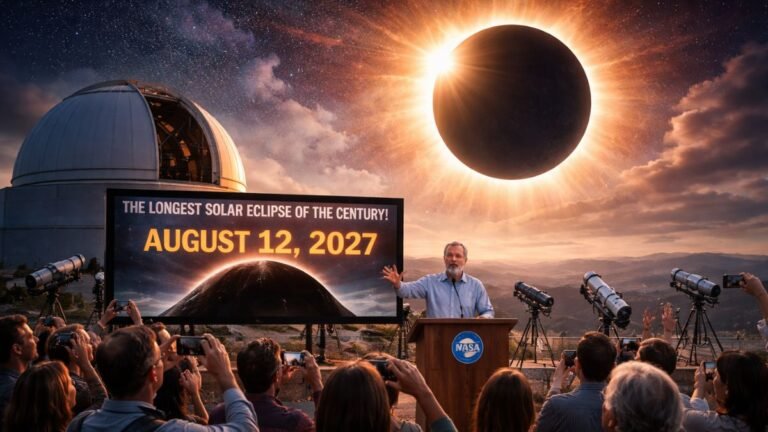
Astronomers announce the official date of the century’s longest solar eclipse, promising an unprecedented day-to-night spectacle for observers. The scientific community and skywatchers worldwide are already buzzing with plans, predictions, and safety reminders as the rare event draws nearer.
What makes this eclipse the century’s longest?
Not all solar eclipses are created equal. The length of totality depends on the Moon’s distance from Earth, the Earth’s distance from the Sun, and the geometry of the eclipse path. When conditions align perfectly, totality can last longer than usual, casting a lingering twilight across the landscape. This particular event is expected to produce a stretch of total darkness that eclipses others seen this century, creating more time for both public awe and scientific measurement.
Where and when to watch
The official announcement included a clear map of the path of totality and a precise date. Observers inside that narrow corridor will experience full day-to-night transition; those outside it will see a partial eclipse. Major cities and accessible viewing locations along the path are already planning festivals, public viewings, and temporary observatories.
If you hope to witness totality:
- Confirm whether you are inside the official path of totality.
- Check local astronomy groups and municipal event pages for viewing locations.
- Plan travel well in advance—hotels and campsites along the path often fill quickly after such announcements.
What you’ll see during totality
The progression to totality is dramatic: a deepening shadow, the Sun’s crescent thinning to a sliver, and then an instant of total darkness during which the solar corona becomes visible. Expect:
- Rapid drop in temperature and changes in wildlife behavior.
- The Sun’s corona shimmering with streamers and loops.
- Bright stars and planets becoming visible in daytime.
The extended duration of this eclipse means viewers will have more time to absorb the spectacle, photograph the phenomenon, and watch atmospheric changes that usually occur only briefly.
Scientific and cultural significance
Long total eclipses are scientific goldmines. Extended darkness gives astrophysicists more opportunity to:
- Study the solar corona and magnetic field dynamics.
- Search for faint emission lines and coronal features.
- Calibrate instruments and test observational techniques.
Culturally, eclipses have always inspired art, folklore, and public gatherings. This century’s longest eclipse will likely spawn large-scale cultural events, educational programs, and collaborations between artists and scientists to capture the awe of the day-to-night transition.
Safety first: viewing the Sun responsibly
Viewing an eclipse safely is essential. Never look directly at the Sun without proper protection except during the brief phase of totality and only when the Sun is completely covered.
- Use ISO-certified solar viewing glasses or solar filters for any optics.
- Regular sunglasses are NOT safe for eclipse viewing.
- Use pinhole projectors or filtered telescopes to view partial phases.
- When totality begins, only then may you remove filters—replace them immediately as soon as the Sun begins to reappear.
Tips for photographers and amateur astronomers
This extended eclipse offers unique opportunities for imaging and observation.
- Bring a tripod and remote shutter release to minimize shake.
- Plan exposures in advance: bracket settings to capture the corona and the sky background.
- Consider wide-angle shots for landscape coupled with the eclipse, and longer focal lengths for detailed solar features.
- Scout your location ahead of time for composition, lighting, and access to power or shelter.
How to prepare as an observer
Start preparing months ahead:
- Reserve travel and accommodation early.
- Join local astronomy clubs or online communities for updates and group viewing plans.
- Pack warm layers, snacks, water, and a first-aid kit—weather and conditions can change quickly.
- Check weather forecasts and have contingency plans nearby in case of clouds.
Final thoughts
Astronomers announce the official date of the century’s longest solar eclipse, promising an unprecedented day-to-night spectacle for observers — and with that announcement comes a rare chance to witness one of nature’s grandest displays. Whether you go for scientific curiosity, photographic ambition, cultural experience, or simple wonder, careful planning and safe viewing will make this once-in-a-lifetime event unforgettable. Keep your calendar ready, your eclipse glasses handy, and prepare to watch day become night.