
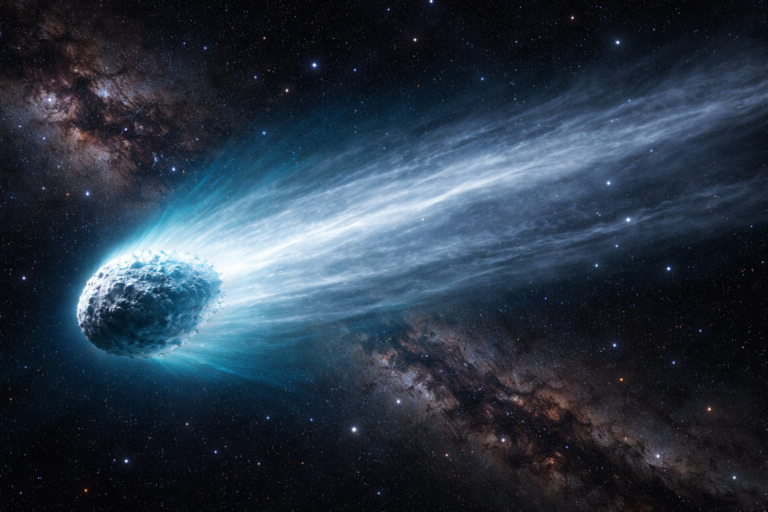
A recent release of spacecraft images has turned heads across the astronomical community. The interstellar comet 3I ATLAS—an object that traversed our solar system from the depths between the stars—was captured in unprecedented detail, revealing structures and behaviors that challenge our assumptions about cometary formation and evolution.
What the images show
At first glance, the new frames look like dramatic portraits: a bright, irregular nucleus, arcs of material spiraling away, and sharply defined jets punching through a diffuse coma. Instead of a smooth, icy rock surrounded by a hazy glow, the imagery reveals:
- A nucleus with a highly irregular shape and rugged terrain.
- Multiple active jets emanating from localized vents.
- Stratified dust shells and filamentary tails that suggest complex ejection mechanics.
- Tiny fragments or boulders being shed from the surface, forming transient mini-satellites.
These features were visible at resolutions far higher than earlier telescopic observations, allowing scientists to study the comet’s surface morphology and immediate environment in a way previously possible only for comets native to our solar system.
Surprises that defy expectations
Scientists had some baseline expectations for interstellar visitors based on the handful we’ve observed before. The images of 3I ATLAS, however, introduced several surprises:
- Localized activity hotspots: Rather than uniform sublimation across the surface, activity appeared concentrated in discrete vents. This suggests layering or compositional inhomogeneity not predicted by simple models.
- Complex dust dynamics: The tails and dust shells display interactions with the solar wind and the spacecraft’s relative motion, producing surprisingly sharp filamentary structures.
- Rapid fragmentation: High-resolution frames captured fragments detaching from the nucleus—an indicator of structural weakness or thermal stresses amplified by rapid passage through the inner solar system.
- Unusual albedo variations: Bright and dark patches suggest a mix of fresh ice and refractory materials exposed by outgassing, hinting at a more complicated thermal history.
Each of these observations carries implications for how interstellar bodies form and what processes they undergo during long voyages between stars.
Why this matters
Studying an interstellar comet at high resolution gives astronomers a rare sample of material that formed around another star. The data from 3I ATLAS can:
- Inform models of planetesimal formation in different stellar environments.
- Constrain theories about the composition of protoplanetary disks beyond our system.
- Help us understand how comets survive—or break apart—during interstellar travel and perihelion passages.
Because interstellar objects likely represent a wide range of conditions from their birthplaces, each one offers a unique window into the diversity of planetary system formation.
How the spacecraft captured such detail
The images were taken during a coordinated campaign involving a deep-space probe optimized for close approach imaging. Key factors that made the detail possible include:
- Close flyby geometry, reducing angular smearing and increasing effective resolution.
- High-frame-rate imaging to track rapidly evolving jets and fragment motions.
- Multi-wavelength filters that separated dust-scattering from emission features.
- Onboard processing to stack short exposures and extract faint structures without motion blur.
Combining these technical capabilities with targeted observation planning allowed mission teams to capture the comet at critical moments of activity.
What comes next
The newly exposed details raise many follow-up questions. Researchers will focus on:
- Spectral analysis of ejected material to search for exotic volatiles or isotopic signatures.
- Dynamical studies of fragment trajectories to estimate nucleus strength and rotational state.
- Comparative studies with 1I/’Oumuamua and 2I/Borisov to map the diversity among interstellar visitors.
- Modeling efforts to recreate observed jet structures and tail morphologies under different thermal and compositional assumptions.
Future missions may prioritize rapid-response reconnaissance probes with flexible trajectories to intercept and study the next interstellar visitor at similarly close range.
A glimpse into the galactic neighborhood
The interstellar comet 3I ATLAS images are a reminder that our solar system is not isolated. Objects from other stars can—and do—pass through, carrying with them clues about distant environments. Each high-resolution observation peels back another layer of the cosmos’s complexity, and 3I ATLAS has handed scientists a rare, detailed chapter to read and interpret.
As analyses continue and teams around the world scrutinize the data, we can expect new insights into how planetary systems form, evolve, and occasionally shed fragments into interstellar space—fragments that may one day visit our neighborhood and reveal more of the galaxy’s untold story.