
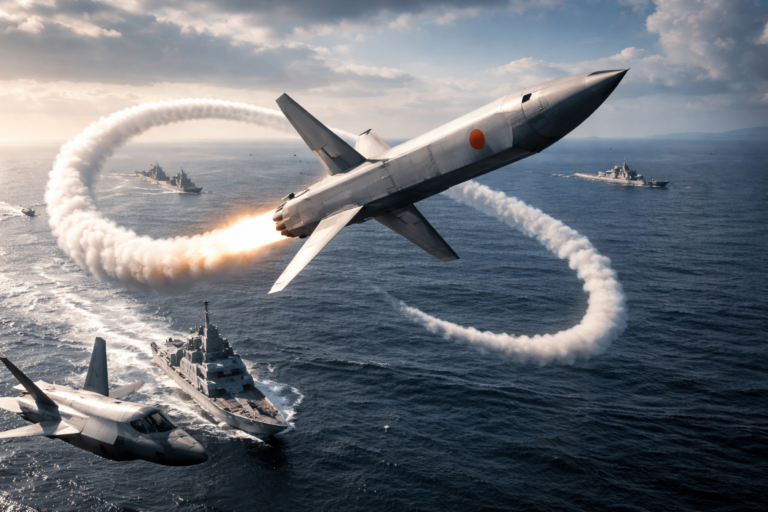
Reports that “Japan crosses a strategic red line with a new stealth missile capable of mid-air corkscrew maneuvers to evade defenses and strike targets beyond 1,000 km” have prompted urgent debate across diplomatic, military, and public spheres. Whether presented as a technical leap or a political provocation, this development—if accurate—reshapes regional deterrence, arms dynamics, and alliance calculations in East Asia.
What makes this missile different?
The combination of stealth shaping, advanced propulsion, and highly agile flight profiles marks a departure from conventional ballistic or cruise missiles. Key claimed attributes include:
- Low observable design to reduce radar cross-section.
- Mid-air “corkscrew” or tumbling maneuvers that complicate tracking and interception.
- Extended range purportedly beyond 1,000 km, allowing strikes from deeper territory.
- Possible integration with precision guidance to hit fixed or mobile targets.
Taken together, these features could allow a launch platform to hold distant targets at risk while making interception more difficult for existing missile defense architectures.
Strategic implications for the region
This kind of capability would have ripple effects across several strategic dimensions:
- Deterrence posture: A longer-range, harder-to-intercept strike option strengthens Japan’s ability to impose costs on an adversary at a distance, shifting calculations about coercion and escalation.
- Crisis stability: Highly maneuverable warheads complicate early warning and decision timelines, increasing the risk of miscalculation during crises.
- Arms dynamics: Neighbors may feel compelled to accelerate their own offensive or defensive programs, sparking a new round of qualitative and quantitative arms competition.
- Alliance politics: The United States and other partners will reassess force posture, basing, and integrated missile defenses in response to evolving capabilities.
Legal and political red lines
Characterizing this development as “crossing a strategic red line” reflects more than technical capability; it signals a shift in norms and expectations. For decades, Japan’s postwar security posture has been constrained by legal, political, and cultural limits on offensive weaponry. A capability that blurs the line between defensive deterrence and offensive strike power raises questions about:
- Japan’s constitutional and policy boundaries on collective security and force projection.
- Transparency and signaling: whether Tokyo frames this as purely defensive or as an assertive deterrent.
- Regional perceptions of intent: neighbors will interpret the deployment through the lens of threat, not technical nuance.
Risks and escalation pathways
The introduction of an advanced, low-observable, highly maneuverable missile increases several risks:
- False alarms: More sophisticated flight profiles can be mistaken for attack vectors, potentially triggering rapid escalatory steps.
- Arms race: Rival states may rush to field countermeasures or similar offensive systems, eroding stability.
- Proliferation concerns: The technologies involved (stealth shaping, advanced guidance and propulsion) have spillover potential that could complicate non-proliferation efforts.
Possible responses and mitigations
Policymakers have options to manage the security and political fallout:
- Transparency measures: Confidence-building steps such as notifications, data exchanges, or limited demonstrations can reduce misperception.
- Diplomatic engagement: Multilateral or bilateral talks aimed at crisis communication and restraint can stabilize the region.
- Defense integration: Allies might deepen sensor and interceptor cooperation to cope with more challenging threats.
- Arms control dialogues: Restarting conversations on limits for deployable offensive capabilities could be explored, though obstacles are substantial.
What to watch next
Observers should monitor several indicators to assess the development’s trajectory and impact:
- Official statements from Tokyo clarifying intent and deployment plans.
- Reactions from neighboring capitals—particularly Beijing, Seoul, and Moscow.
- Changes in alliance posture, including US deployments and exercises in the region.
- Evidence of countermeasures or accelerated programs by other states.
Conclusion
If the reports are accurate, the described missile represents more than a technical milestone: it is a strategic signal that reverberates across deterrence doctrines, legal norms, and regional stability. Managing the consequences will require careful diplomacy, enhanced transparency, and renewed focus on crisis channels. Absent those steps, what begins as a capability designed to deter could become a catalyst for greater insecurity across East Asia.