
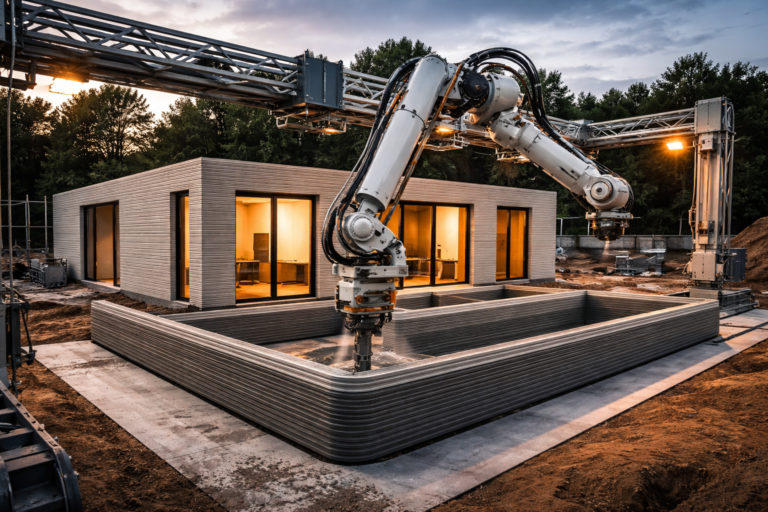
Construction has long been one of the slowest, most labor-intensive industries. So when news spread that a robot can now build a 200 m² home in just 24 hours, people in housing, urban planning, and technology sat up and took notice. This development isn’t just a flashy demo — it points to a future where homes are faster, cheaper, and more consistent in quality.
How the technology works
Robotic construction combines several existing technologies into a coordinated system:
- Autonomous mobile platforms that move materials and equipment across the site.
- Robotic arms or gantries that perform tasks like bricklaying, welding, or applying finishes.
- Additive manufacturing (3D printing) for walls and structural components.
- Advanced sensors, computer vision, and building information modeling (BIM) for precision and coordination.
In recent demonstrations, these systems operate around the clock with minimal human intervention. Pre-programmed sequences and real-time adjustments allow robots to lay foundations, erect walls, install prefabricated modules, and even handle basic interior finishes. The key advantage is repeatability: robots do the same task the same way, reducing errors and rework.
Why this is a breakthrough
Speed is the headline, but the implications run deeper:
- Dramatically reduced construction time lowers financing and labor costs.
- Consistent quality and precision can improve building performance and durability.
- Automation reduces on-site hazards and the physical strain on human workers.
- Integration with modular and prefabricated components makes mass housing programs more feasible.
A robot building a full 200 m² home in 24 hours demonstrates that automation can handle not just small tasks but entire assembly workflows. That scale matters for addressing urgent needs such as disaster recovery and rapid urban expansion.
Potential to ease the housing crisis
Many regions face chronic housing shortages driven by rising demand, limited labor, and increasing material costs. Robotic construction could help on several fronts:
- Speeding delivery of new homes reduces backlog and shortens wait times for affordable housing.
- Lower labor requirements can make projects viable in places with skilled-worker shortages.
- Economies of scale through standardized robotic processes may lower overall unit costs.
- Mobile robotic systems can be deployed to remote or disaster-affected areas where traditional construction is challenging.
By enabling faster, more predictable delivery of housing, robotic construction offers a powerful tool for cities and governments struggling to meet demand.
Challenges and limitations
Despite the promise, several hurdles remain before robotic homebuilding becomes widespread:
- Regulatory and building-code compliance varies widely and can slow approvals.
- Upfront capital costs for robotic systems and specialized equipment are high.
- Integration with existing supply chains and trades requires rethinking workflows.
- Labor displacement concerns must be managed through retraining and new roles.
- Site variability, ground conditions, and complex architectural designs can still require human expertise.
Robotic systems excel at repetitive, well-defined tasks. Complex customization, historic preservation, or dense urban infill projects may continue to rely on traditional crafts and human judgment for the foreseeable future.
What this means for workers and the industry
Automation will change job roles rather than simply eliminate them. New opportunities will arise in robotics operation, maintenance, programming, and quality assurance. Skilled tradespeople may shift toward supervision, complex installations, and finishing work that requires human dexterity and decision-making.
Industry players will need to invest in training programs and collaborate with policymakers to ensure transitions are equitable and that the benefits of efficiency are broadly shared.
Looking ahead
The demonstration that a robot can now build a 200 m² home in just 24 hours is a milestone — not the finish line. Expect incremental adoption: prefabricated panels and modular units produced by robots, robot-assisted crews on traditional sites, and specialized teams for rapid-deployment housing.
As costs come down and regulations adapt, robotic construction could become a core tool in the effort to close housing gaps, speed disaster recovery, and modernize the built environment. The promise is clear: faster delivery, higher quality, and new ways to design and inhabit our cities. The next decade will tell how quickly this promise turns into everyday practice.