
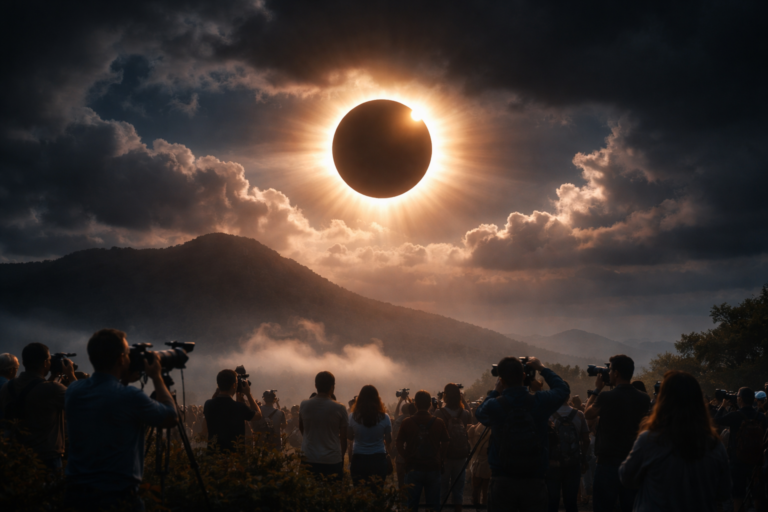
Astronomers have confirmed that later this decade Earth will experience what is expected to be the century’s longest total solar eclipse. For observers located along the narrow path of totality, daylight will collapse into an eerie, brief night as the Moon completely obscures the Sun—offering both a spectacular sight and a rare scientific opportunity.
What “the century’s longest eclipse” means
A total solar eclipse occurs when the Moon passes exactly between Earth and the Sun, casting a shadow that briefly darkens a narrow swath of the planet. The phrase “century’s longest” refers to the eclipse’s maximum duration of totality—how long the Sun is entirely hidden at any one location. Astronomers use precise orbital calculations to predict when and where totality will be longest; this confirmed event is expected to eclipse all other totalities between 2001 and 2100.
Totality plunges the sky into twilight, reveals the solar corona, and can last for several minutes—significantly longer than the fleeting moments typical of partial eclipses. For those inside the path, the experience can feel surreal: stars and planets become visible, temperatures drop, and animals often behave as if night has arrived.
Where and when (planning basics)
The path of totality is narrow—typically only a few dozen miles wide—and sweeps across the globe as Earth and the Moon move. Because the path is geographically specific, many people travel to locations with the best weather forecasts and viewing infrastructure.
If you plan to witness totality:
- Book travel and lodging early; eclipse events draw large crowds.
- Choose an observing site with a historically high chance of clear skies.
- Check local guidance and any permits or temporary road restrictions in the path.
Note: precise dates and paths are determined years in advance; consult official astronomy organizations and eclipse maps for exact coordinates and timing as the event approaches.
Safety: protect your eyes and gear
Never look directly at the Sun without proper protection except during the brief phase of totality when the Sun is fully covered. Eye safety rules include:
- Use ISO 12312-2-compliant solar viewing glasses for partial eclipse phases.
- Use solar filters on binoculars, telescopes, and cameras; never look through optical devices without a certified filter.
- Remove filters only when the Sun is completely and identifiably eclipsed (totality), and replace them as soon as the bright photosphere reappears.
For photography:
- Use a dedicated solar filter for shots during partial phases.
- Practice timing and composition beforehand; exposures change dramatically as you pass into and out of totality.
Scientific and observational opportunities
Long totalities are prized by scientists because they extend the window to study rare solar phenomena:
- Corona and magnetic field studies: The Sun’s outer atmosphere becomes visible and can be imaged across wavelengths to study magnetic structures and heating mechanisms.
- Solar wind and plasma research: Longer observations improve data on how the corona feeds and shapes the solar wind.
- Chromosphere and prominence dynamics: Extended totality allows more time to capture fast-evolving prominences and surface features.
- Atmospheric effects: Researchers can measure rapid changes in temperature, wind, and ionospheric conditions caused by the sudden loss of solar illumination.
Citizen scientists and amateur astronomers often contribute valuable data—time-synced photos, temperature logs, and animal behavior notes—so coordinated campaigns are common for major eclipses.
What you’ll notice during totality
Expect a sequence of dramatic changes:
- Rapid darkening and a fall in temperature.
- Bright stars and planets becoming visible in the daytime sky.
- The Sun’s corona forming a ghostly halo around the Moon.
- A 360-degree sunset effect near the horizon.
- An emotional, often breath-taking communal silence or cheer among observers.
Totality lasts only minutes, but the memory can last a lifetime.
Cultural and social impact
Eclipses have inspired myths, science, and travel for millennia. Major total solar eclipses stimulate tourism, educational outreach, and media attention. Communities along the path often host festivals, lectures, and viewing events that make the phenomenon accessible to families and students.
Final thoughts
A confirmed century-class total solar eclipse is a rare and evocative event. Whether you go to study the Sun, to capture unforgettable photographs, or simply to experience the shock of daytime turning to night, preparation is key: plan early, prioritize eye safety, and monitor official astronomy updates for exact timing and path maps. When the Moon aligns and day becomes night, you’ll witness one of nature’s most profound spectacles.