
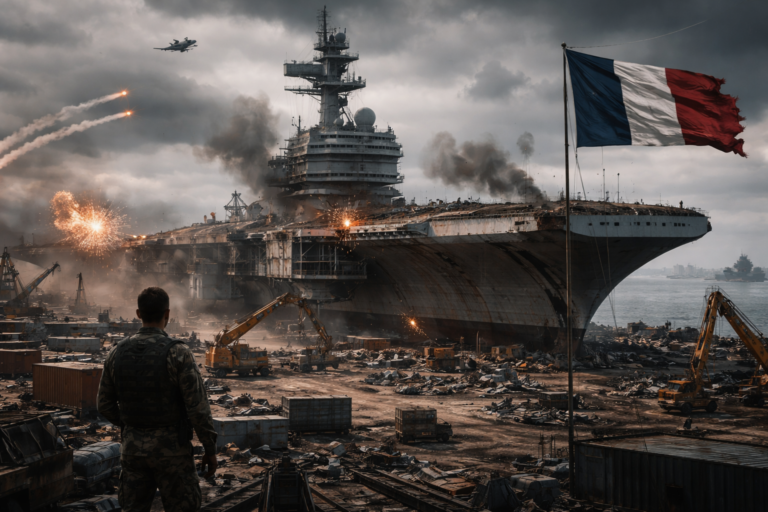
France’s decision to rely on a single, billion‑euro aircraft carrier as the cornerstone of its naval power has suddenly appeared far more fragile than planners assumed. France sacrificed its billion-euro flagship aircraft carrier – and is now paying dearly as Russian missiles redraw the balance of power. That blunt formulation captures a strategic truth: advances in long‑range, highly accurate anti‑ship weapons have dramatically increased the risk and cost of carrier-centric power projection.
The carrier’s changing role in a missile age
For decades carriers symbolized unchallenged sea control and the ability to project air power anywhere in the world. The French carrier Charles de Gaulle has long been Paris’s visible demonstration of strategic autonomy — a mobile sovereign airbase able to support strikes, reconnaissance, and deterrence missions.
But modern Russian missile systems — including cruise missiles like Kalibr, supersonic anti-ship missiles such as P‑800 Oniks, and hypersonic systems like Zircon and Kinzhal — change the calculus. These weapons can be launched from ships, submarines, aircraft, and coastal batteries at ranges that put carriers and their escorts in direct danger well beyond the horizon.
Why one carrier is no longer enough
Relying on a single flagship creates several vulnerabilities:
- Concentration risk: A single loss or incapacitation removes Paris’s most visible tool for rapid intervention.
- High escort burden: Carriers require layered defense — destroyers, frigates, submarines, airborne early warning, and electronic warfare — multiplying operational cost and complexity.
- Limited redundancy: Maintenance cycles or technical issues can put the carrier out of action, creating strategic gaps.
- Targeting attractiveness: Adversaries prioritize high‑value targets; a single carrier is a lucrative prize for anti‑ship strikes.
These weaknesses are amplified by Russian doctrine and capabilities that emphasize anti‑access/area‑denial (A2/AD), forcing Western navies to operate under the constant threat of long‑range standoff attacks.
How Russian missiles are redrawing the balance
Russian missile advances influence the balance of power in several ways:
- Stand‑off lethality: Cruise and hypersonic missiles can hit moving maritime targets at long distances, reducing the safe operating envelope for carriers.
- Saturation attacks: Modern arsenals and networked launch platforms enable salvo launches designed to overwhelm ship defenses.
- Multi‑domain integration: Missiles are integrated with satellites, over‑the‑horizon targeting, and electronic warfare, improving accuracy and survivability of attack systems.
- Cost asymmetry: A few relatively inexpensive missiles can threaten a billion‑euro ship and an entire carrier strike group, shifting cost-exchange dynamics in favor of missile attackers.
These developments force naval planners to reassess the viability of classic carrier strike groups in contested littorals and to adapt NATO force posture accordingly.
Practical responses and strategic options
France and its allies can adopt several practical measures to mitigate the threat:
- Strengthen layered defenses: Invest in improved shipborne and land‑based interceptors, radar networks, and airborne early warning to detect and defeat incoming missiles.
- Distribute maritime power: Shift from single large platforms to more numerous, survivable assets — frigates, corvettes, unmanned surface and subsurface vessels — to complicate enemy targeting.
- Integrate strike and defense: Enhance cooperation with NATO allies for shared targeting, missile defense, and anti‑submarine warfare to plug gaps when the carrier is unavailable.
- Emphasize hardening and deception: Deploy decoys, electronic warfare suites, and passive hardening to reduce kill probability.
- Invest in intelligence, surveillance, reconnaissance (ISR): Over‑the‑horizon targeting and networked ISR make defensive and offensive operations more resilient.
What this means for French strategy
France faces a choice: double down on carrier capabilities with heavier defensive investments, or adapt toward a more distributed, missile‑resistant navy. Either path requires political will and substantial funding. The rhetoric of “sacrificing” a flagship masks deeper trade‑offs between prestige, deterrence, and survivability.
In practical terms, Paris must reconcile its desire for strategic autonomy with the reality that carriers no longer guarantee uncontested maritime dominance. A balanced approach — combining updated air defenses, diversified platforms, and closer NATO integration — offers the best chance to preserve French influence at sea without exposing a single asset to disproportionate risk.
Conclusion
The phrase “France sacrificed its billion‑euro flagship aircraft carrier – and is now paying dearly as Russian missiles redraw the balance of power” is a stark reminder: modern missile technology has altered naval warfare. For France, the lesson is clear — maintaining influence requires adaptation, not nostalgia. Investing in resilience and distributed capabilities will determine whether Paris can continue to project power safely in a world where missiles, not just fleets, decide the outcome.