
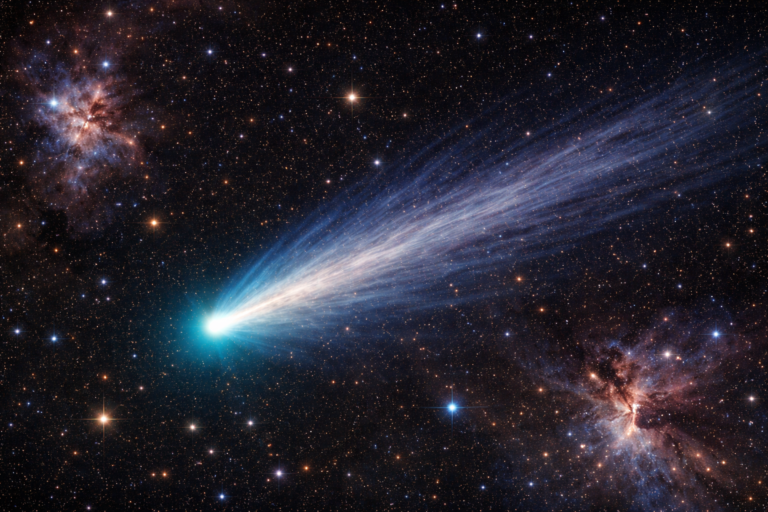
Astronomers release stunning new images of the interstellar comet 3I ATLAS, captured across multiple observatories with unprecedented clarity. The images — a blend of visible-light snapshots, near-infrared frames, and millimeter-wave maps — provide the clearest view yet of an object that originated beyond our solar system. For researchers and skywatchers alike, 3I ATLAS has once again become a source of fascination and fresh scientific opportunity.
A coordinated observing campaign
What makes this release special is the coordination. Observatories around the world joined forces, pooling time on space telescopes and large ground-based facilities to observe 3I ATLAS across many wavelengths. Contributors included major instruments sensitive to different parts of the electromagnetic spectrum:
- Space telescopes capturing high-resolution visible and infrared imagery.
- Millimeter and radio arrays mapping cold gas and dust.
- Large optical telescopes using adaptive optics to sharpen ground-based views.
- Amateur and smaller professional observatories providing wide-field context and continuous monitoring.
This multi-observatory approach produces complementary views: high-detail images of the inner coma and nucleus together with extended maps that reveal the comet’s wider tail and trailing dust.
What the images show
The new imagery reveals several striking features:
- A compact, bright coma surrounding a small nucleus, suggestive of active sublimation as 3I ATLAS warms.
- Multiple narrow jets emanating from the nucleus, indicating localized active regions rather than uniform outgassing.
- A complex, curved tail composed of both dust and gas, shaped by solar radiation pressure and the solar wind.
- Color differences across the coma and tail in infrared and visible bands, hinting at compositional variations in released material.
High-resolution frames allow astronomers to track changes in jet direction and brightness over days, giving clues about the comet’s rotation and the distribution of volatile ices on its surface.
Early scientific insights
While analysis is still ongoing, early interpretations point to several intriguing possibilities:
- The presence of fine dust grains mixed with larger particles, implying a diverse grain-size distribution that affects how the tail develops.
- Spectroscopic signatures consistent with common cometary volatiles — such as water and simple organics — though the exact abundances require follow-up.
- Jet morphology and timing that help constrain the nucleus’s rotation period and surface activity patterns.
Because 3I ATLAS is interstellar, these findings offer a rare chance to compare material from another stellar system with comets native to our own. Differences in composition or structure could reflect the conditions under which the object formed, providing indirect clues about planetesimal formation around other stars.
Why this matters
Interstellar visitors are exceedingly rare. Before 3I ATLAS, only a handful of objects with confirmed extrasolar origins had been observed in detail. Each new visitor expands our empirical sample and sharpens our ability to interpret what we see.
The recent images matter for several reasons:
- They deliver crucial context for spectroscopy and dynamical studies, helping to tie compositional data to specific regions on the comet.
- They improve models of dust emission and radiation-pressure effects for high-velocity interstellar objects.
- They enable contemporaneous comparisons with prior interstellar visitors, like 1I/‘Oumuamua and 2I/Borisov, refining hypotheses about how common various formation pathways might be.
In short, these observations help turn a fleeting skywatching event into a robust dataset that will inform cometary science for years.
How to follow along
Observatories and research teams typically release processed imagery and technical papers over the weeks and months following such campaigns. For those interested in seeing the images and reading the scientific analyses:
- Check the press pages and social accounts of participating observatories and space agencies.
- Watch for preprints from the teams involved in archives used by astronomers.
- Local planetariums and astronomy clubs often host public talks or image releases when big datasets become available.
Looking ahead
The coordinated effort to image 3I ATLAS showcases how rapidly the astronomical community can mobilize when an unusual target appears. As researchers continue to analyze the data, we can expect refined models of the comet’s nucleus, better estimates of its composition, and possibly surprises that challenge our current understanding of small bodies. For now, the stunning new images offer a rare and beautiful glimpse at a visitor from another star — and a reminder of how much remains to be learned about the wider cosmos.