
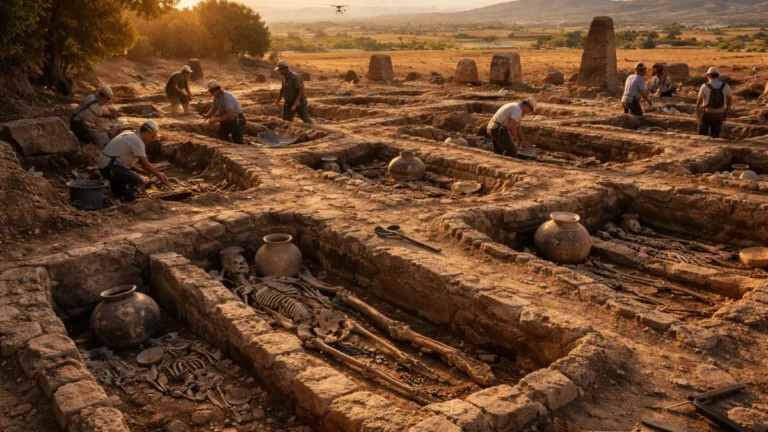
The newly discovered necropolis is located near Seville in southern Spain, within the Guadalquivir Valley region. Archaeologists identified a large burial complex consisting of multiple graves, tombs, and stone-built burial chambers.
- The site dates between 1880 BC and 1300 BC, placing it firmly in the Bronze Age
- It includes both individual and collective burials, a rare combination for the region
- Some tombs were reused over generations, indicating long-term ritual significance
This necropolis is considered one of the most complete Bronze Age burial sites ever discovered in southern Spain.
Key Facts About The Discovery
| Feature | Details |
|---|---|
| Location | Near Seville, Guadalquivir Valley |
| Time Period | Approx. 1880–1300 BC |
| Age | 3,500–4,000 years old |
| Burial Types | Individual & Collective |
| Structures | Stone cists, pits, burial chambers |
| Notable Finds | Pottery, bronze tools, human remains |
| Cultural Significance | Advanced funerary traditions |
Unique Burial Practices Uncovered
One of the most fascinating aspects of this discovery is the diversity of burial methods. Archaeologists found:
1. Individual Burials
- Bodies placed in crouched positions, often on their sides
- Minimal grave goods in some cases, suggesting social variation
2. Collective Tombs
- Contained remains of 20 or more individuals
- Bones layered over time, indicating repeated use
- Suggests strong family or community burial traditions
3. Stone-Constructed Chambers
- Carefully built using slabs
- Sometimes included corridors or entrances
These findings reveal that Bronze Age communities practiced complex and evolving funerary rituals, rather than simple burials.
Artifacts And Materials Found
Excavations have uncovered a variety of objects that provide insight into daily life and beliefs:
- Ceramic vessels used in rituals or offerings
- Bronze tools such as awls
- Jewelry and ornaments indicating social identity
- Fragments of pottery showing evolving artistic styles
These artifacts highlight the existence of organized societies with craftsmanship, trade, and symbolic traditions
What Human Remains Reveal
The human remains found at the site are equally important. Preliminary analysis shows:
- Evidence of tooth wear and cavities, suggesting diet patterns
- Signs of physical stress and joint degeneration
- Indicators of childhood health issues, such as enamel defects
These details provide a glimpse into the health, lifestyle, and challenges faced by Bronze Age populations.
Connection To Ancient Trade And Culture
This necropolis is not an isolated discovery. It ties into broader Bronze Age networks:
- Southern Spain was rich in metals like copper, silver, and lead, essential for Bronze Age economies
- Trade routes likely connected Iberia to other parts of Europe
- The site may be linked to early cultures that later evolved into civilizations like Tartessos
The discovery strengthens the idea that Spain was a key hub in ancient trade and cultural exchange.
Why This Discovery Matters
This find is considered a milestone in archaeology for several reasons:
1. Rare Completeness
Most Bronze Age burial sites in the region are fragmented. This necropolis is unusually well-preserved.
2. Cultural Insights
It reveals how ancient communities viewed death, family, and ancestry.
3. Timeline Clarity
The site shows a gradual cultural evolution, rather than sudden changes.
4. Settlement Connection
The proximity to nearby settlements helps researchers understand how the living and the dead coexisted within the same landscape.
Future Research And Expectations
Archaeologists believe this site is just the beginning. Future studies will focus on:
- DNA analysis to understand family relationships
- Isotope studies to trace diet and migration
- Further excavation to uncover additional tombs and structures
This research could redefine our understanding of Bronze Age societies across Europe.
Conclusion
The discovery of this exceptional Bronze Age necropolis in Seville represents a major leap forward in archaeological research. It not only uncovers the burial customs of ancient communities but also paints a vivid picture of life in prehistoric Spain. From complex tomb structures to evidence of long-distance trade, the site offers invaluable insights into a civilization that thrived thousands of years ago.
As excavations continue, this remarkable find is expected to unlock even more secrets—cementing its place as one of the most important archaeological discoveries in recent years.