
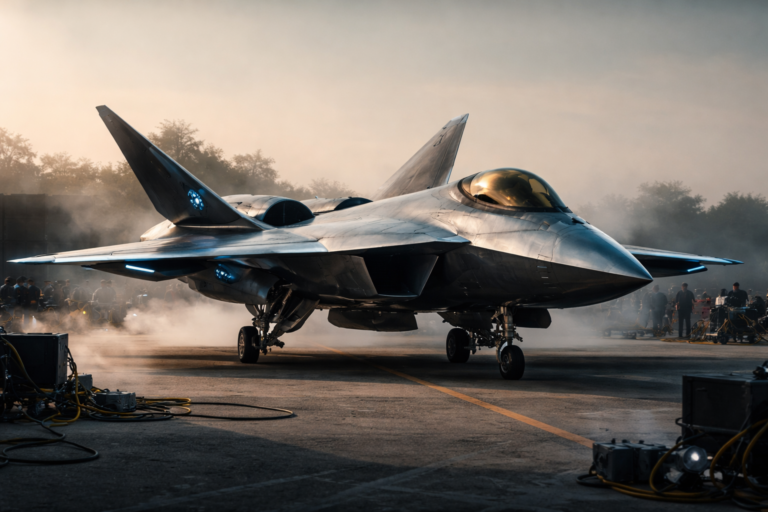
The global race for air superiority has entered a new phase with China unveiling what appears to be a “6th-generation stealth fighter.” Sleek, futuristic, and unlike anything seen before, aircraft such as the J-36 and J-50 prototypes have sparked intense debate.
At first glance, these jets look like they are straight out of a science fiction movie. But as analysts dig deeper, questions arise: is this cutting-edge innovation—or an example of form beating feasibility?
What Defines A 6th-Generation Fighter?
A true 6th-generation fighter jet is expected to go beyond stealth and speed. It should function as a “system of systems,” integrating AI, drones, and advanced sensors.
Key Expected Features:
- Ultra-low radar visibility (stealth)
- AI-assisted combat decision-making
- Drone control (loyal wingmen)
- Hypersonic weapon capability
- Advanced networking and data fusion
China’s prototypes appear to aim for these capabilities, but real-world implementation remains uncertain.
China’s J-36 And J-50: What We Know
China reportedly began testing two advanced prototypes in late 2024:
- Chengdu J-36
- Shenyang J-50
These aircraft represent China’s ambition to challenge Western dominance in next-generation air combat.
Key Specifications And Features
| Feature | Details |
|---|---|
| Aircraft Names | J-36 (Chengdu), J-50 (Shenyang) |
| First Observed | December 2024 |
| Configuration | Tailless stealth design |
| Engines | Up to 3 engines (J-36) |
| Role | Multirole (air superiority, strike, control drones) |
| Estimated Entry | Around 2035 |
| Wingspan | ~19 meters (estimated) |
| Length | ~23 meters (estimated) |
The tri-engine setup is one of the most unusual aspects, potentially offering higher thrust but also increasing complexity and fuel consumption.
The Futuristic Design: Built For Stealth
One of the most striking elements is the tailless diamond-wing design, which reduces radar cross-section and enhances stealth.
Design Highlights:
- No vertical stabilizers → Lower radar visibility
- Smooth, angular surfaces → Deflect radar waves
- Top-mounted air intakes → Conceal engine signatures
- Large internal bays → Carry weapons without external drag
This aligns with modern stealth principles seen in advanced aircraft globally.
Where The Design Raises Red Flags
Despite its impressive appearance, several aspects of the design raise concerns among experts.
1. Tri-Engine Complexity
While three engines may increase thrust:
- It adds weight and maintenance challenges
- Increases fuel consumption
- Complicates stealth due to additional heat signatures
2. Tailless Trade-Offs
Removing tails improves stealth—but:
- Reduces maneuverability
- Requires advanced flight control systems
- May limit dogfighting capability
3. Unproven Technologies
Many features remain speculative:
- AI integration
- Hypersonic weapons
- Drone control systems
These technologies are still evolving globally, making real-world deployment uncertain.
The “Movie Prop” Problem: When Form Beats Feasibility
Some analysts argue the aircraft’s design prioritizes visual impact over operational practicality.
Why It Feels Like A Movie Prop:
- Extremely futuristic shape not yet proven in combat
- Lack of verified performance data
- Heavy reliance on speculation and leaked images
- Limited official disclosures from China
Even the “White Emperor” concept showcased earlier turned out to be partly science-fiction-inspired, highlighting how visuals can blur reality.
Strategic Purpose: More Than Just A Fighter
Despite skepticism, these aircraft serve a broader purpose.
Strategic Goals:
- Demonstrate technological leadership
- Signal military strength to rivals
- Accelerate domestic aerospace innovation
- Compete with U.S. NGAD (Next-Generation Air Dominance) program
China’s rapid prototype updates suggest aggressive development timelines.
Potential Capabilities (If Proven Real)
If these systems mature successfully, they could deliver:
- Long-range strike capability
- Drone swarm coordination
- High-speed penetration of air defenses
- Multi-role battlefield command
The J-36, for instance, is believed to support both air-to-air and air-to-ground missions with extended range.
Challenges Ahead
Turning concept into combat-ready aircraft is a massive challenge.
Key Barriers:
- Engine reliability at high speeds
- Heat management in stealth designs
- AI integration in real-time combat
- Cost and production scalability
Even the Pentagon estimates operational deployment may not occur until around 2035.
Future Outlook
China’s 6th-generation fighter program is undeniably ambitious. Whether it becomes a true battlefield revolution or remains a high-tech showpiece depends on overcoming major engineering hurdles.
The design prioritizes stealth and innovation, but some features may be experimental or conceptual.
Conclusion
China’s so-called 6th-generation fighter represents a bold leap into the future of warfare—but also highlights the gap between design ambition and operational reality.
While its sleek, sci-fi appearance captures global attention, critical questions remain about feasibility, performance, and practicality. In many ways, it symbolizes a new era where perception, technology, and strategy intersect—and where not everything that looks revolutionary is ready for the battlefield.