
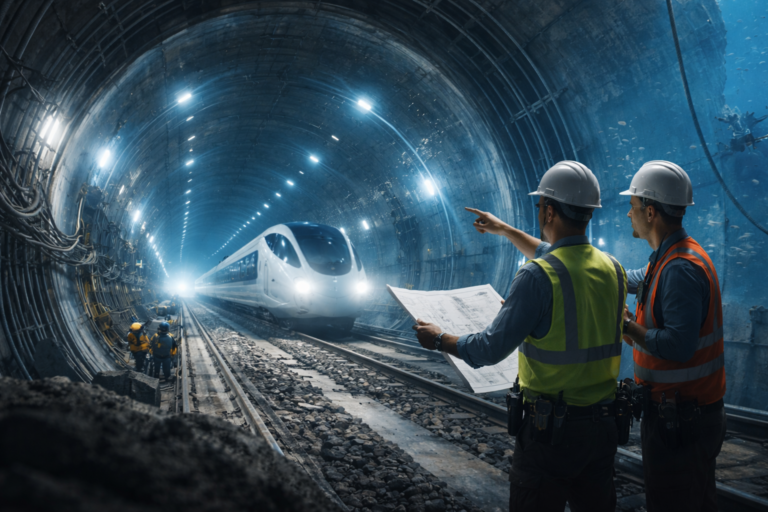
Engineers have confirmed that construction is underway on an ambitious underwater rail line designed to join continents via a deep-sea tunnel. The announcement, made by a multinational consortium of engineering firms and government partners, marks one of the most audacious infrastructure proposals of the 21st century: a continuous rail corridor stretching beneath an ocean basin, linking landmasses that have for millennia been separated by water.
The confirmation does not mean the project is finished—far from it—but it does signal a move from feasibility studies and political discussion into active civil works, surveying, and specialized fabrication.
What engineers have revealed
Project leaders say early works are focused on seabed surveys, pilot tunnels in shallower approach zones, and fabrication of the first pressure-rated tunnel segments. Key elements disclosed include:
- Pre-production tunnel segments being tested in pressure tanks.
- Deployment of deep-water survey vessels and remotely operated vehicles (ROVs) mapping the intended route.
- Construction of onshore assembly yards for prefabricated sections and support infrastructure.
- A phased plan that begins with approach tunnels, followed by the deep-sea crossing.
Engineers emphasize the phased nature of the work. Initial activities are intended to validate design assumptions, environmental safeguards, and construction methodologies before launching full-scale deep-sea excavation or immersion.
How the deep-sea tunnel will work
Several technical approaches are under consideration or already being used in pilot works:
- Immersed tube segments: prefabricated tunnel sections are floated to position and sunk into a prepared trench on the seabed, then sealed and joined.
- Shielded tunnel-boring machines (TBMs): for approach tunnels through rock or softer sediments, specially adapted TBMs will excavate while providing continuous lining segments.
- Pressure-controlled joints and life-safety systems: segments designed to withstand hydrostatic pressure and seismic loading, with redundant pumping and ventilation.
- Rail systems built for high-capacity freight and passenger service, possibly electrified and compatible with high-speed operation.
Redundancy, monitoring, and remote inspection systems are central to the design. Engineers plan continuous fiber-optic monitoring of structural health and environmental parameters along the tunnel route.
Engineering challenges and innovations
A project of this scale faces exceptional technical hurdles. Key challenges include:
- Extreme pressure and sealing requirements at great depth.
- Long-term durability against corrosion, seismic activity, and scouring.
- Logistics of transporting and installing very large prefabricated segments at sea.
- Ensuring safe ventilation, evacuation and emergency response in a submerged environment.
- Integration of rail signaling, power delivery, and maintenance access.
To meet these, engineers are developing innovations such as advanced composite linings, adaptive joint systems that accommodate movement, AI-driven monitoring for predictive maintenance, and modular emergency shelters within the tunnel.
Environmental and geopolitical considerations
An underwater continental rail link touches on more than engineering. Environmental impact assessments are a central part of early works, with focus on:
- Disturbance to seafloor habitats during trenching or anchoring.
- Noise and turbidity effects on marine life during construction.
- Risk mitigation for accidental spills or construction-related pollution.
Geopolitically, the project requires international agreements on maritime jurisdiction, security coordination, and cross-border regulation of transit. Proponents argue that strong multilateral governance and transparent environmental commitments can reduce friction and build public trust.
Timeline, cost, and what comes next
Officials involved with the project describe the timeline as multi-decade. Typical phases include:
- Detailed design and permits (several years).
- Onshore and shallow-water pilot works (early years).
- Full-scale deep-sea construction and segment installation (mid-term).
- Systems integration, testing, and phased opening (later years).
Cost estimates have not been finalized publicly; projects at this scale are measured in tens to hundreds of billions of dollars depending on length, depth, and complexity. Funding models under discussion include public–private partnerships, sovereign-backed financing, and international infrastructure funds.
Why this matters
If realized, a deep-sea rail tunnel joining continents would transform global connectivity. Potential benefits include:
- Faster, lower-carbon freight movement compared with long-haul shipping and air cargo.
- New passenger corridors that reduce travel times and promote regional integration.
- Economic stimulus through construction jobs, technology development, and new trade routes.
- A testbed for advanced marine engineering and environmental monitoring technologies.
The confirmation by engineers that construction is ongoing does not mean certainty of completion, but it does mark a decisive step forward. Over the coming years, technical milestones, environmental reviews, and international cooperation will determine whether this deep-sea vision becomes an operational reality. For now, the world watches as engineering ambition meets the deep ocean.