
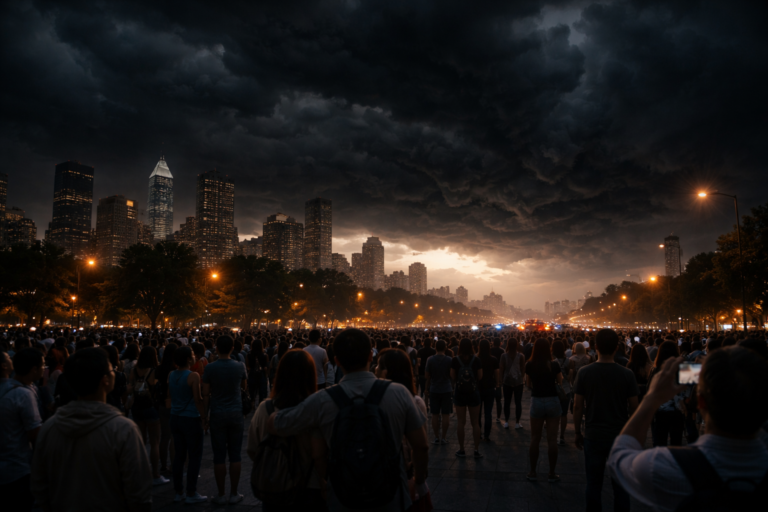
Space agencies around the world have issued an urgent warning that, over the coming days, parts of the globe may experience unusually deep daytime darkness. Day set to turn into night as space agencies warn of unprecedented sky darkness across major population zones — an event with wide-ranging implications for travel, health and infrastructure.
This is not a routine weather forecast. Authorities are monitoring an evolving situation that could cause sustained dimming of sunlight over heavily populated areas. While details are still being confirmed, experts emphasize preparedness and following official guidance.
What might cause this kind of darkness?
Several natural and human-caused scenarios can reduce daylight dramatically. Each carries different probabilities and consequences:
- Volcanic eruptions: Large, explosive eruptions can inject ash and sulfuric aerosols into the stratosphere. These particles scatter and absorb sunlight, causing regional or even global dimming that can last weeks to years, depending on the scale.
- Massive wildfires or dust storms: Intense, widespread fires or large dust storms can lift fine particulates into the atmosphere, producing heavy haze that blocks sunlight and degrades air quality.
- Atmospheric debris from an impact event: A significant meteor or comet impact (rare) could loft dust into the upper atmosphere, temporarily reducing sunlight.
- Unusual space-weather interactions: Strong solar phenomena generally affect electronics and communications more than visible light, but complex interactions can produce uncommon atmospheric effects in some scenarios.
- Large-scale industrial accidents or releases: Unprecedented man-made pollution events could also contribute to regional darkening, though global-scale blocking would be unlikely without additional factors.
Experts caution that while some scenarios are plausible, others remain speculative. Investigations are ongoing to identify the principal cause and likely duration of any dimming.
Likely impacts
Reduced daylight on a large scale can have immediate and cascading effects:
- Transportation: Aviation and surface traffic will be affected by low visibility, cloud cover and potential ash or particulate hazards. Expect delays and route changes.
- Power and infrastructure: Solar power generation will drop. If the event coincides with extreme temperatures, demand for heating or cooling may strain grids.
- Health: Particulate matter increases respiratory risk, especially for those with asthma or heart conditions. Psychological impacts from prolonged darkness can also affect vulnerable populations.
- Agriculture: Reduced sunlight can stress crops and reduce yields if the dimming persists for an extended period.
- Communications and navigation: Depending on the cause, satellite operations and radio communications could be disrupted, complicating emergency response.
How to prepare right now
Authorities advise the public to take practical steps to stay safe and comfortable during the event:
- Stay informed: Use official channels (national meteorological agencies, civil protection, emergency alerts and reputable news outlets) for real-time updates.
- Prepare an emergency kit: Include masks that filter fine particles (N95 or equivalent), water, nonperishable food, flashlights and extra batteries, a battery-powered radio, and necessary medications.
- Protect your respiratory health: If particulate levels rise, stay indoors with windows and doors closed. Use HEPA filters if available. When outside, wear a properly fitted respirator rather than a cloth mask.
- Plan for power variability: Charge devices, have backup power options, and limit non-essential electricity use if grid operators issue warnings.
- Adjust travel plans: Postpone non-essential travel. If you must travel, check airline and rail advisories and expect delays.
- Look out for vulnerable people: Check on elderly neighbors, those with respiratory or cardiovascular illness, and families with young children to ensure they have necessary supplies.
How authorities are responding
Space and atmospheric agencies are pooling satellite imagery, ground observations and atmospheric models to track the extent and composition of the haze or debris. Emergency management agencies are coordinating logistics for shelters, medical support and critical infrastructure protection. International cooperation is critical when major population zones across countries are affected.
Staying calm and informed
Moments like these can feel frightening, but measured preparation reduces risk. Follow reputable sources, heed official instructions, and help neighbors who may need assistance.
If you have to act now: assemble basic supplies, limit outdoor exposure if the air looks visibly hazy, and keep communication lines open. Officials will update the public as new data becomes available.