
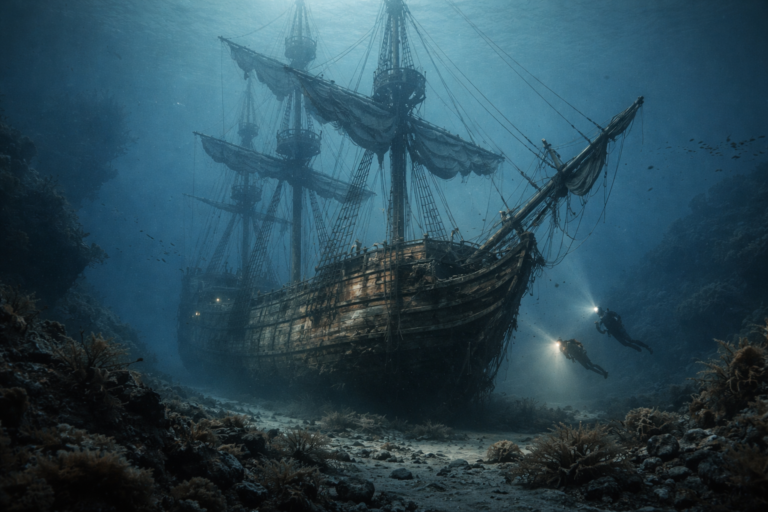
When archaeologists announced that “After 250 years, a lost explorer’s ship is found perfectly preserved off Australia’s coast, a true time capsule from another era,” the world paused. Discoveries like this are rare: a vessel sealed by the sea, its timbers, contents and human traces held in a suspended moment. The find promises fresh insight into navigation, colonial contact, and daily life aboard an 18th-century exploration ship.
How the ship was found
The wreck was identified during a targeted survey using multibeam sonar and remotely operated vehicles (ROVs). Modern techniques allowed researchers to map the seafloor and then visually confirm the hull and artifacts without disturbing them. Key factors in the discovery:
- High-resolution sonar to locate anomalies on the seabed
- ROVs for non-invasive visual documentation and sampling
- Collaboration between marine archaeologists, oceanographers, and local authorities
The site lies in relatively deep water, where cold temperatures and a protective blanket of silt and low-oxygen conditions helped preserve organic materials that would otherwise have decayed.
Why preservation is extraordinary
Shipwrecks typically deteriorate quickly once exposed to oxygen, shipworm, and currents. This wreck’s preservation is remarkable because:
- Anoxic (low-oxygen) sediments dramatically slow decay of wood and textiles.
- Fine silt sealed many compartments, limiting biofouling and mechanical damage.
- Depth and limited wave action minimize physical disturbance.
As a result, delicate artifacts—paper, leather, cloth, and even food residues—remain intact enough for scientific study, offering a direct window into the past.
What the wreck can tell us
The ship is a time capsule in the truest sense. Researchers expect to learn about:
- Navigation and shipbuilding: hull design, rigging traces, and any remaining instruments can clarify construction techniques and technological exchange between cultures.
- Daily life at sea: personal items such as clothing, cutlery, hair combs, and journals reveal routines, diet, health, and social structures aboard the vessel.
- Trade and contact: recovered cargo and biological remains (seeds, animal bones) can indicate trade routes, provisioning, and encounters with Indigenous peoples.
- Historical chronology: dendrochronology (tree-ring dating) and material analysis will help fix the ship within a precise time frame, confirming accounts of lost voyages.
Ethical and legal considerations
Maritime finds raise complex issues. Responsible excavation follows best practices:
- Prioritize in situ preservation where possible rather than full recovery.
- Consult and involve Indigenous communities, whose histories and waters are affected.
- Adhere to national and international laws on underwater cultural heritage.
- Ensure recovered artifacts are conserved in laboratory conditions and made accessible to the public through museums and digital archives.
Researchers have already reached out to local Indigenous groups and heritage authorities to establish a partnership framework that respects cultural values and knowledge.
Scientific methods in play
Extracting knowledge from a wreck of this age requires multidisciplinary science:
- Conservation labs to stabilize wood, textiles, and metals once recovered.
- Isotope and DNA analysis to identify origin of organic materials and human remains, if present.
- Microbial studies to understand the unique preservation environment.
- 3D photogrammetry and virtual reality reconstructions to share the site with the public without further disturbance.
These tools allow scientists to reconstruct not just objects, but stories—of voyages, weathering, and human experience.
Why this matters beyond archaeology
A find like this captures the public imagination, but its value extends further. It provides an empirical anchor for historical narratives, challenging or confirming written records. It informs maritime conservation strategies and enriches cultural heritage. And, perhaps most importantly, it reconnects us to the people who built and sailed these ships—individuals whose lives were shaped by exploration, peril, and curiosity.
Looking ahead
Conservation and study will take years. The initial phase focuses on documentation and minimal, targeted recovery of the most at-risk items. Public engagement—through museum exhibits, lectures, and digital media—will follow, giving communities a chance to learn from and reflect on the discovery.
Finding this ship is more than a headline; it’s a rare opportunity to handle the past with care and scientific rigor. As research unfolds, those preserved timbers and objects will tell their stories, offering a vivid, tangible connection to an era that shaped the world we live in today.