
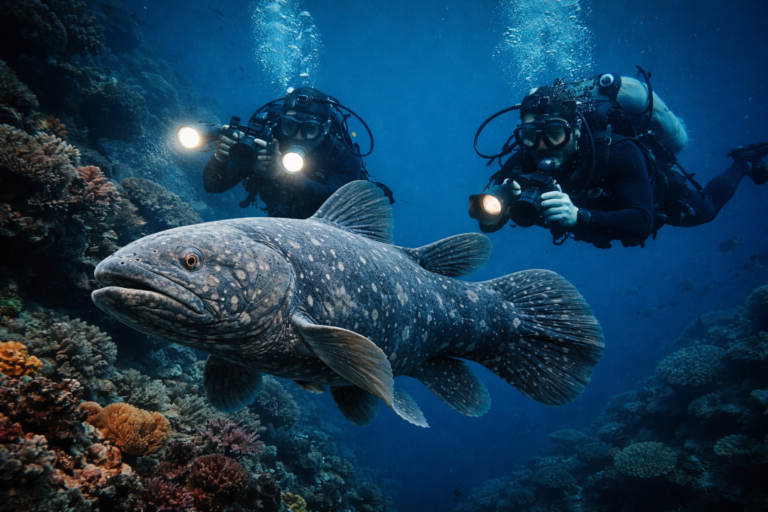
A recent underwater expedition has returned with images that feel like a time capsule. French divers have, for the first time in this context, captured rare photographs of an emblematic species long dubbed a “living fossil” in Indonesian waters. The images have reignited public fascination with one of the ocean’s most mysterious survivors and underscored the urgent need to protect its fragile habitat.
Meet the living fossil
The term “living fossil” is often used to describe species that appear little changed over millions of years. These organisms carry evolutionary stories written in their anatomy and DNA, offering scientists a window into deep time.
One such species is the coelacanth, a large, lobe-finned fish thought to have vanished with the dinosaurs until its dramatic rediscovery in the 20th century. Coelacanths are slow-moving, deep-water dwellers with distinctive limb-like fins and a lineage that dates back some 400 million years. Their rarity and ancient heritage make any new observation—especially clear photographic evidence—an event of global interest.
The images: why they matter
Photographs and video from divers do more than satisfy curiosity. They provide:
- Visual confirmation of presence and behavior in specific locations.
- Non-invasive data on size, coloration, and physical condition.
- Context about habitat—depth, substrate, and co-occurring species.
- Material for public engagement and conservation messaging.
For scientists, even a handful of high-quality frames can inform population assessments and help prioritize areas for protection. For the public, images bring an animal out of obscurity and into the collective imagination, which can drive support for conservation.
What these sightings tell us
While single or occasional encounters don’t resolve population-size questions, they do offer important clues:
- Distribution: Confirming presence in Indonesian waters supports the picture that these fishes occupy discrete deep-water refuges across the western Pacific and Indian Oceans.
- Behavior: Photographs taken in natural settings can hint at feeding, resting, or social behaviors that are otherwise difficult to observe.
- Human impact: Location images can reveal proximity to fishing activity, pollution, or habitat disturbance—factors central to conservation planning.
Taken together, such evidence helps scientists and policymakers build more accurate, targeted strategies to safeguard these animals and their ecosystems.
Conservation challenges
The coelacanth and other ancient species face multiple threats, many stemming from human activities:
- Bycatch: Deep-water trawling and longline fishing can unintentionally capture slow-reproducing species.
- Habitat degradation: Pollution, sedimentation from coastal development, and destructive fishing practices change the deep-sea environments these animals rely on.
- Climate change: Altered ocean temperatures and oxygen levels can shift prey distributions and stress vulnerable populations.
- Limited data: Rarity and remote habitats make monitoring and population estimates difficult, hampering conservation action.
A single set of photos cannot solve these problems, but it can catalyze attention—often the first step toward meaningful protection.
What comes next
Images like these typically spark a series of follow-up actions:
- Scientific survey planning — targeted expeditions to assess distribution and numbers.
- Genetic sampling — when feasible and ethical, to understand population structure and connectivity.
- Local engagement — working with Indonesian communities and fishers to reduce bycatch and protect key habitats.
- Policy measures — advocating for marine protected areas, fishing restrictions, and habitat safeguards.
International collaboration is essential. Species that inhabit transboundary waters benefit from coordinated research and management across nations.
How you can help
Even if you’re not a diver or marine biologist, there are ways to support these ancient survivors:
- Support reputable conservation organizations working on marine protection.
- Advocate for sustainable seafood and fishing practices.
- Share verified information and images to raise awareness—accurate storytelling fuels conservation momentum.
- Encourage local and national leaders to prioritize marine protected areas and sustainable coastal development.
A reminder from the deep
Rare images of a “living fossil” are more than a striking photo op; they are a reminder that Earth’s natural history persists alongside the modern world. Each sighting offers scientists new data and the public a renewed sense of wonder. If we want these ancient lineages to continue their long journey through time, discovery must be followed by stewardship.