
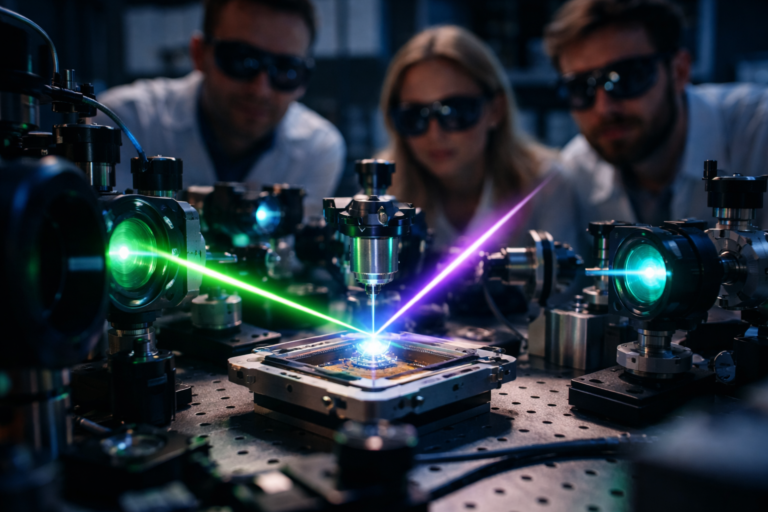
A German research team has achieved a world first in quantum physics by recreating a Josephson junction using a laser. This milestone blends decades-old superconducting concepts with the flexibility of light-based control, opening new paths for studying quantum coherence, tunneling phenomena, and next-generation quantum devices.
What is a Josephson junction?
A Josephson junction is a quantum device formed by two superconductors separated by a thin barrier. Even though the barrier prevents normal electrical conduction, pairs of electrons (Cooper pairs) can tunnel through it coherently. That tunneling gives rise to the Josephson effects:
- A DC supercurrent that flows without voltage, driven by the phase difference of the superconducting wavefunctions across the barrier.
- An AC current that oscillates if a constant voltage is applied, with a frequency proportional to the voltage.
Josephson junctions are foundational in quantum technologies. They power superconducting qubits (transmons), ultrasensitive magnetometers (SQUIDs), and precision voltage standards. Recreating this physics with light rather than conventional superconducting materials offers a different set of advantages.
How a laser can reproduce Josephson behavior
Instead of relying on metal superconductors and insulating barriers, the German team used tightly controlled laser light to create a tunable potential landscape that mimics the two superconducting regions and the intervening barrier. In plain terms:
- Laser beams sculpt two quantum “reservoirs” and a thin barrier between them.
- Quantum particles (or quasiparticles) in these reservoirs can tunnel across the light-made barrier, showing the same phase-dependent current and oscillatory dynamics characteristic of a Josephson junction.
- The laser parameters—intensity, shape, and timing—allow the researchers to tune tunneling rates, barrier height, and other key properties on the fly.
Using light to emulate a Josephson junction lets experimenters probe the same fundamental physics with far greater flexibility than fixed solid-state devices.
Why this is significant
Recreating a Josephson junction with a laser is important for several reasons:
- Reconfigurability: Laser-created junctions can be reprogrammed in real time. Researchers can change geometry, coupling strength, and disorder without fabricating new devices.
- Clean, controllable environment: Optical platforms often reduce unwanted sources of decoherence present in solid-state systems, making it easier to study intrinsic quantum dynamics.
- New measurement modalities: Light enables novel measurement techniques—noninvasive imaging, time-resolved control, and single-particle sensitivity in some platforms.
- Cross-platform insights: Optical analogues provide a bridge between condensed-matter superconductivity and atomic, molecular, and optical (AMO) physics, helping theorists validate models across domains.
These advantages make the laser-Josephson platform a versatile testbed for fundamental quantum mechanics and for prototyping ideas relevant to quantum computing and sensing.
Potential applications and impact
While still early-stage, the approach suggests several promising directions:
- Quantum simulation: Emulate complex superconducting circuits and many-body dynamics that are hard to engineer in solids.
- Device prototyping: Quickly test junction behaviors and arrangements before committing to fabrication of superconducting hardware.
- Quantum sensors: Explore light-based SQUID analogues or interferometers with enhanced tunability.
- Education and outreach: Demonstrate Josephson physics in tabletop optical setups that are easier to visualize and modify.
List of near-term research objectives:
- Improve coherence and stability over long timescales.
- Scale from single junctions to arrays and networks.
- Interface optical junctions with electronic or superconducting components.
- Map out the limits of tunability and control in different optical platforms.
Challenges ahead
Optically recreated Josephson junctions are not a drop-in replacement for established superconducting circuits. Key challenges include:
- Matching the extreme low-temperature environments where superconducting qubits operate.
- Ensuring the same levels of integration and miniaturization needed for scalable quantum processors.
- Managing interactions and losses unique to the chosen optical platform.
Nevertheless, the flexibility and precision offered by laser control make this a compelling complementary route for both fundamental experiments and early-stage device design.
Conclusion
The announcement that a German team has recreated a Josephson junction using a laser marks a creative convergence of photonics and superconducting physics. By demonstrating a world first in this direction, researchers now have a new, highly controllable platform to study phase-coherent tunneling and to explore applications that bridge quantum simulation, sensing, and device prototyping. As the technique matures, it could reshape how we test and iterate on quantum hardware concepts—using beams of light rather than etched metal.