
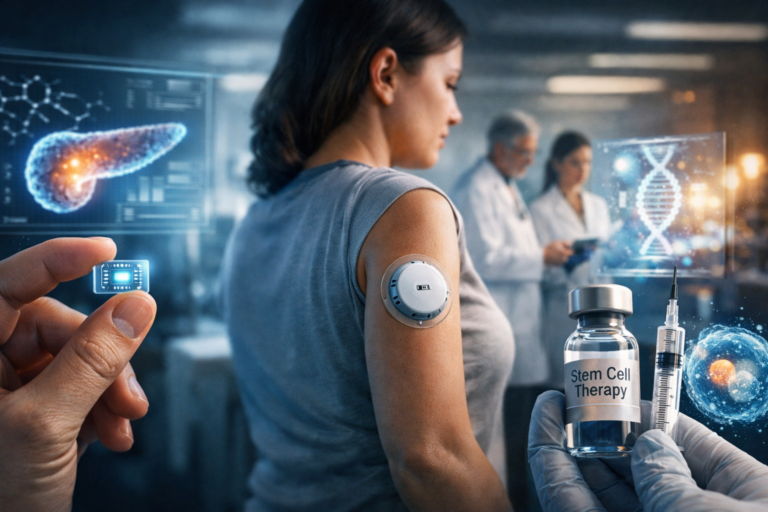
The last decade has brought an extraordinary convergence of technologies and biological discoveries. Together they are reshaping how we think about diabetes management and raising the real possibility that “Breakthroughs in diabetes care signal a turning point that could soon render today’s treatments obsolete.” That statement is provocative — but increasingly defensible when you look at what’s now possible.
What’s changing right now
Two parallel shifts are driving momentum: precision monitoring and smarter biology. Continuous glucose monitors (CGMs) and closed-loop insulin delivery systems have already transformed daily life for many people with diabetes. At the same time, advances in cell therapy, gene editing, and immunology are tackling the disease at its root rather than only treating symptoms.
Short, practical gains:
- CGMs provide real-time data and reduce fingersticks.
- Automated insulin pumps and hybrid closed-loop systems substantially improve time-in-range.
- Telemedicine and remote monitoring make care more proactive and personalized.
These improvements have meaningfully raised quality of life. But the next wave of breakthroughs could go further—moving from management toward durable remission or functional cures.
Breakthrough therapies on the horizon
Researchers and companies are pursuing several distinct approaches that, individually or together, could displace many aspects of current care.
- Cell replacement and encapsulation
- Stem-cell–derived beta cells can produce insulin in response to glucose.
- Encapsulation devices aim to protect transplanted cells from immune attack without lifelong immunosuppression.
- Immunotherapies that halt autoimmunity
- Treatments designed to retrain the immune system could stop the destruction of insulin-producing cells in type 1 diabetes.
- Early trials show promise in delaying disease progression when administered at diagnosis or pre-symptomatic stages.
- Gene therapy and gene editing
- Gene-editing tools (like CRISPR) may correct genetic contributors or modify cells to resist autoimmune attack.
- Gene therapies could also enable non-pancreatic cells to secrete insulin in a regulated way.
- Smart insulins and oral formulations
- Glucose-responsive insulins release hormone only when glucose is high, reducing hypoglycemia risk.
- Advances in delivery science aim to make non-injectable insulin feasible.
- AI-driven care and digital therapeutics
- Machine learning improves insulin dosing, predicts glycemic excursions, and personalizes lifestyle interventions.
- Digital tools help scale expert-level decision support to more people.
Why today’s treatments might become obsolete
There are a few reasons these innovations could supplant current standards:
- Root-cause focus: Therapies that prevent autoimmune attack or replace lost beta cells address the underlying problem rather than treating downstream effects.
- Durability: A successful cell or gene therapy could provide years or decades of disease control, reducing reliance on daily insulin management.
- Safety and convenience: Smart insulins and noninvasive delivery reduce injection burden and hypoglycemia risk, making older regimens less attractive.
When multiple approaches converge—immunotherapy to protect cells plus stem-cell replacement for lost capacity, for example—the combined effect could be transformational.
What still stands in the way
Despite excitement, barriers remain that temper the timeline and scope of change.
- Safety and long-term efficacy: Early clinical successes must translate into durable, safe outcomes over years and across diverse populations.
- Immune protection: Encapsulation and immune modulation need to work without lifelong immune suppression.
- Cost and access: Cutting-edge biologics and devices are expensive; equitable global access is a major challenge.
- Regulatory and manufacturing scale-up: Producing cell therapies and personalized medicines at scale is complex.
- Behavioral and health-system adoption: Technology only helps if people and systems can use it effectively.
A realistic outlook
We are at a true inflection point. Some patients will benefit from incremental innovations this year, while others may be candidates for transformative therapies in clinical trials over the next several years. It’s unlikely that today’s treatments will vanish overnight, but the phrase “Breakthroughs in diabetes care signal a turning point that could soon render today’s treatments obsolete” captures the plausible trajectory: management-first approaches may increasingly be replaced by durable, biology-based solutions.
For patients, clinicians, and caregivers, the best stance is hopeful realism: stay informed about clinical trials, maintain excellent baseline care, and plan for a future where diabetes care looks very different — and, for many, substantially better.