
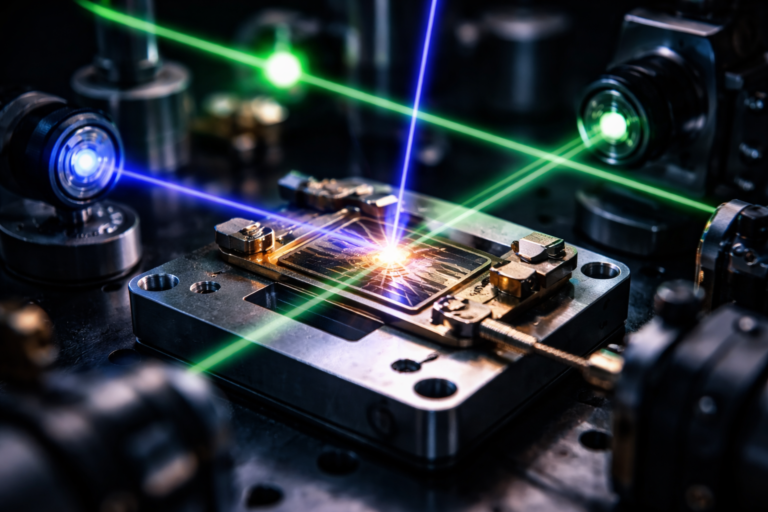
A German research team has reported a world first in quantum physics: they recreated a Josephson junction using a laser. This achievement opens a new route to building and studying superconducting-like devices with unprecedented tunability and control, and it could accelerate progress in quantum simulation, sensing, and device engineering.
What is a Josephson junction?
A Josephson junction is a quantum device formed by two superconductors separated by a thin barrier through which pairs of electrons (Cooper pairs) can tunnel. The junction supports a supercurrent that flows without voltage up to a critical value, and its phase-dependent behavior underpins technologies like superconducting qubits, SQUID magnetometers, and sensitive metrological standards.
In practical terms, Josephson junctions are cornerstones of many quantum technologies because they translate microscopic quantum phase differences into measurable macroscopic signals. Recreating that behavior in a different, highly controllable platform extends experimental access to the same physics in new ways.
How can a laser recreate a Josephson junction?
Lasers are versatile tools for shaping potentials and controlling particles at the quantum level. By creating a precisely controlled barrier or potential landscape, a focused laser can separate two quantum reservoirs while allowing coherent tunneling between them—mimicking the essential physics of a Josephson junction.
There are several experimental strategies that use light to emulate superconducting effects:
- Optical potentials for neutral atoms, where lasers trap and shape ultracold atoms into two regions connected by a tunable barrier.
- Photo-induced changes to materials, where laser pulses modify local electronic properties and create transient junction-like behavior.
- Coherent driving of engineered nanostructures to produce phase-coherent coupling between regions.
The German team’s laser-based approach provides a controllable, reconfigurable platform to recreate Josephson dynamics without relying on a conventional superconducting fabrication process.
Why this counts as a world first
Traditional Josephson junctions are fabricated from superconducting materials with a fixed geometry. Recreating the same quantum coherent tunneling behavior using a laser rather than a solid-state barrier is novel for several reasons:
- Tunability: Laser parameters (intensity, shape, frequency, timing) can be adjusted in real time, allowing dynamic control of the junction’s properties.
- Reconfigurability: Optical setups can create, modify, and erase junctions on demand without nanofabrication.
- New measurement possibilities: Optical access and the ability to manipulate internal degrees of freedom open complementary probes of phase dynamics and coherence.
Together, these features represent a conceptual and technical advance that broadens how researchers can study Josephson physics and related phenomena.
Potential applications and impact
This laser-based recreation of a Josephson junction could influence several areas:
- Quantum simulation: Emulating superconducting circuits in alternative platforms gives researchers a new testbed for many-body and non-equilibrium quantum phenomena.
- Quantum sensing: Tunable, optically defined junctions may yield sensitive, compact detectors for magnetic fields or currents.
- Quantum information: Insights into coherence and noise in reconfigurable junctions might inform qubit design and control strategies.
- Materials research: Laser-defined junctions can probe interfaces and phase transitions without permanent sample alteration.
Key advantages include rapid prototyping of junction behaviors, flexible parameter sweeps, and the possibility to couple optical control directly to other quantum degrees of freedom.
Challenges and next steps
While promising, laser-created Josephson junctions face challenges before they can be widely adopted:
- Stability and coherence: Maintaining long-lived, low-noise phase coherence in an optically defined system is essential for practical applications.
- Integration: Interfacing laser-defined junctions with existing cryogenic or on-chip platforms will require engineering work.
- Scalability: For quantum computing use, multiple junctions must be controllable and reproducible at scale.
Next steps for the field will likely include benchmarking coherence times against traditional junctions, exploring networked or multi-junction geometries, and integrating optical control with electrical readout methods.
Conclusion
The announcement that a German team has achieved a world first in quantum physics by recreating a Josephson junction using a laser marks an exciting development. By combining the rich physics of Josephson dynamics with the flexibility of optical control, researchers gain a powerful new tool for exploring quantum coherence, building sensors, and prototyping quantum devices. If the technical hurdles can be addressed, laser-defined junctions may become a valuable complement to conventional superconducting technology.