
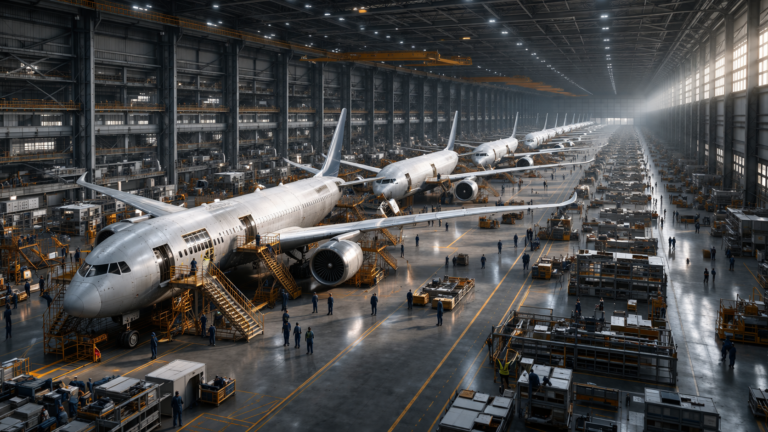
Walking into a building the size of a small city is an experience few get to have. The world’s largest factory employs 30,000 people and can build eight jets at once — a headline that captures both the scale and the ambition of modern aerospace manufacturing. That factory, known for its immense volume and humming activity, is a study in engineering, logistics and human coordination.
A giant under one roof
The factory’s sheer size is staggering: millions of square feet of assembly space under one roof, cranes moving fuselage sections like toys, and production bays large enough to park multiple widebody airliners. The layout is optimized for flow. Subassemblies arrive from suppliers, are mated on the floor, then trundled down the line for systems installation, testing and final paint.
This concentrated approach reduces transit time between stages, helps maintain quality control, and enables simultaneous work on multiple aircraft. For a company building dozens of commercial jets every year, that efficiency is essential.
People, machines and processes
At peak operation the plant relies on about 30,000 employees — engineers, machinists, technicians, logistics coordinators, quality inspectors and support staff. Many roles are highly specialized, from avionics integration to composite assembly. Apprentices and long-tenured workers pass knowledge along in real time, while automation handles repetitive or dangerous tasks.
Key features of the operation include:
- Large-scale assembly jigs and rails that move major sections into alignment.
- Specialized tooling for composite materials and precision metalwork.
- Extensive test stations for electrical systems, hydraulics and flight control checks.
- Paint hangars with environmental controls to ensure finish quality.
- On-site logistics hubs to manage components arriving from a global supplier network.
Together these elements allow the factory to build up to eight widebody jets at once during its busiest periods — a testament to coordinated scheduling and enormous physical capacity.
Economic and regional impact
A facility of this magnitude drives local and regional economies. It supports thousands of direct jobs on site and many more in the supply chain: component manufacturers, logistics firms, maintenance providers and service businesses. Tax revenues, vocational training programs and technology partnerships with universities are common benefits for nearby communities.
The factory also draws visitors. Guided tours give the public a glimpse of aircraft being assembled and help inspire future engineers and technicians.
Challenges and opportunities
Operating the world’s largest factory is not without difficulties. Key challenges include:
- Supply chain disruptions: With thousands of parts sourced globally, delays ripple quickly through the line.
- Workforce skills: Recruiting and retaining technicians with the right expertise is an ongoing effort.
- Balancing automation and human labor: Deciding where to invest in robotics versus skilled hands is strategic.
- Environmental impact: Large factories consume energy and resources, pushing companies to adopt greener practices.
At the same time, opportunities are abundant. Digital transformation — using data analytics, digital twins and predictive maintenance — improves throughput and reduces defects. Investments in sustainable manufacturing and alternative fuels align production with industry decarbonization goals.
What the future might hold
As commercial aviation evolves, so will the factories that produce its aircraft. Modular manufacturing approaches, more extensive use of advanced composites, and even flexible assembly lines could increase capacity without expanding footprint. Workforce development programs and apprenticeships will be crucial to ensure a pipeline of skilled workers.
Sustainability efforts will also shape future operations, from energy-efficient buildings to recycling and reduced waste in production.
Why the scale matters
The fact that the world’s largest factory employs 30,000 people and can build eight jets at once is more than a trivia point — it’s a window into how complex modern manufacturing has become. Large-scale facilities concentrate expertise, enable high-volume production, and provide resilience through redundancy and flexibility. They are where aerospace innovation meets real-world logistics.
For anyone fascinated by engineering, logistics, or industrial strategy, these enormous assembly plants are living laboratories showing how people and technology come together to build the machines that connect the world.