
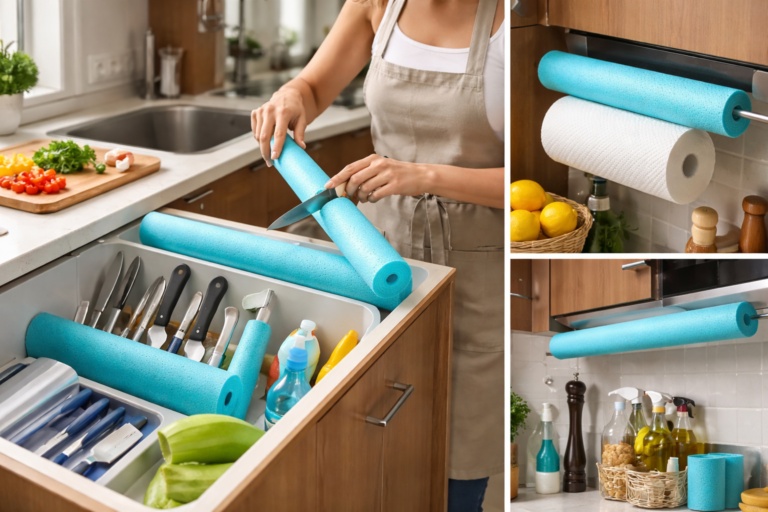
You read that right. A pool noodle—yes, the brightly colored foam cylinder you use for summer floaties—can transform everyday kitchen chores into faster, safer, and more organized tasks. Affordable, lightweight, and endlessly adaptable, a pool noodle will change your life in the kitchen if you let it.
Why a Pool Noodle Belongs in Your Kitchen
Pool noodles are made of closed-cell foam that’s buoyant, flexible, and easy to cut. Those characteristics make them perfect for improvised kitchen solutions: protecting surfaces, stabilizing items, cushioning sharp edges, and creating custom helpers. Best of all, a pool noodle is inexpensive and easy to replace.
Below are practical, safe, and simple ways to use a pool noodle in the kitchen.
Top Kitchen Uses for a Pool Noodle
1. Jar Opener and Grip Enhancer
Slide a short piece of pool noodle around a stubborn jar lid to create traction and leverage. The foam conforms to your hand and the jar, making lids easier to twist—great for people with limited grip strength.
2. Knife Blade Protector
Cut a pool noodle lengthwise and slip it over knife blades when storing in a drawer. It cushions the blade and protects your fingers when digging for utensils.
3. Cabinet and Drawer Bumpers
Mount thin slices of pool noodle along cabinet doors or on the inside edges of drawers to silence slams and protect fragile items from rough impacts.
4. Shelf Spacers and Bottle Holders
Slice a noodle into rings and use them as spacers between stacked plates or as holders for tall bottles to prevent tipping. Rings can also keep wine bottles from clinking.
5. Cutting Board Non-Slip Feet
Cut small pieces and glue them to the underside of a cutting board to keep it from sliding while you chop.
6. Tray and Baking Support
For long trays or cooling racks, cut a pool noodle in half lengthwise and place the flat side down to act as a cradle—this stabilizes trays and prevents tipping when carrying multiple items.
7. Oven Door Cushion
Attach a short piece of pool noodle along the handle area where the oven door meets cabinetry to prevent pinched fingers and cushion the door’s closure. Avoid placing foam directly on hot surfaces.
Quick DIY Projects (5–10 Minutes)
- Jar Opener Loop: Cut a 6-inch tube, slice it once along the length, and slip over a stubborn lid.
- Knife Guard: Make a lengthwise slit long enough to slide a blade through and secure with tape.
- Bottle Coasters: Slice into 1-inch thick rings to protect countertops from condensation.
Safety and Maintenance Tips
- Avoid direct contact with open flames, hot pans, or heating elements—pool noodles will melt or deform under high heat.
- Don’t use pool noodle pieces that touch raw food directly. Use them for tools, protectors, or structure—not as foodware.
- Clean with mild soap and water; avoid harsh chemicals that can degrade the foam.
- Replace when cracked, stained, or smelly—these are inexpensive to swap out regularly.
What to Look for When Buying
- Choose closed-cell polyethylene foam for durability.
- Thicker noodles offer more structural support; thinner ones are easier to manipulate.
- Bright colors make them easy to spot in drawers or behind appliances.
Why This Simple Hack Matters
A pool noodle will change your life in the kitchen because it encourages a mindset of creative problem-solving. Instead of expensive specialty gadgets that occupy counter space, one inexpensive foam tube solves many small frustrations: noisy cabinets, slippery cutting boards, stubborn jars, and unstable trays. It’s a small tweak that adds convenience, safety, and efficiency—especially for busy households, seniors, or anyone with limited hand strength.
Try It Today
Pick up a pool noodle on your next grocery run or from a dollar store and experiment. Start with one quick fix—like a jar opener or knife guard—and see how many other uses you discover. You’ll be surprised how often you reach for that colorful foam helper.
A pool noodle will change your life in the kitchen—not by replacing tools, but by making everyday tasks easier, safer, and more pleasant. Give it a try and let your kitchen creativity flow.