
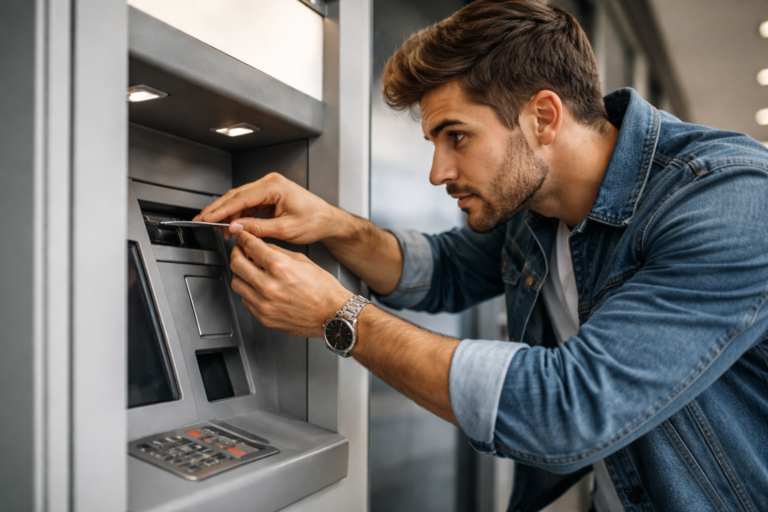
Finding your bank card trapped inside an ATM is stressful. Panic, the fear of fraud, and the thought of being stranded without access to cash can make you want to act quickly. The good news: there’s a safe, legal, and often effective “fast technique” you can try immediately that frequently results in the machine ejecting your card — long before bank staff or roadside help arrives.
Below I’ll explain what to do step-by-step, why each step works, and what to avoid so you protect your money and personal information.
Stay calm and secure the scene
The first priority is your safety and protecting your PIN.
- Don’t leave the ATM unattended.
- Keep your body between the keypad and any onlookers; shield the keypad as you type.
- Note the ATM location, time, and any visible ID numbers on the machine (often printed on the front).
- If you’re alone and feel unsafe, step away and call for assistance (bank, police, or a friend).
The fast technique: Cancel, wait, and try again
This simple sequence often solves the problem without forcing the machine or calling help.
- Press the “Cancel” or “Clear” button on the ATM.
- Many machines are programmed to eject the card when a transaction is cancelled.
- Wait 10–30 seconds.
- Some ATMs hold the card for a moment to prevent fraud or allow the user to finish a transaction. Give the machine a short time to respond.
- If nothing happens, press “Cancel” repeatedly (2–3 times).
- Repeated cancel commands can trigger a reset in the transaction logic, prompting ejection.
- Try a gentle nudge with your fingertip at the card slot edge (only if a portion of the card is visible).
- Do NOT force, pry, or insert tools. A small, gentle nudge sometimes helps if the card is catching on the slot edge.
Why this works: ATMs typically retain cards only during an active transaction or when the machine detects a problem. Canceling the transaction and allowing the internal software to timeout often triggers an automatic eject sequence.
If the technique doesn’t work: next steps
If you’ve tried the fast technique and the card is still retained, follow these measures to protect yourself and escalate help appropriately.
- Call the bank’s number on the ATM screen or printed on the machine. Most machines display a customer service number for immediate assistance.
- If the ATM belongs to a branch that’s open, go inside and speak to staff. They can usually retrieve the card faster and verify your identity.
- If the machine is in a public place and there’s a visible security contact number, call that one too.
- If you suspect tampering (skimming devices, loose parts, suspicious people nearby), leave immediately and contact the bank and local police.
What NOT to do
Some instinctive reactions can make things worse — or even illegal.
- Don’t force the machine open, insert tools, or otherwise tamper with the ATM. That can damage the machine and may be criminally prosecuted.
- Don’t hand over your PIN to anyone who offers to help.
- Don’t leave personal details or ignore the bank’s instructions for canceling the card if it has been retained.
Protect yourself afterwards
- Ask the bank to block the retained card and issue a replacement if necessary.
- Monitor your bank account for any unauthorized transactions and report them immediately.
- Consider using contactless or mobile payments temporarily until you get a replacement card.
Final tips
- If you frequently use ATMs, memorize the bank’s helpline or save it in your phone for emergencies.
- Prefer ATMs inside bank branches or well-lit, monitored locations — they’re less likely to be targeted by fraud and you can get quicker help.
- Keep a backup payment method (another card, mobile wallet) in a separate location for just this sort of situation.
A trapped ATM card is usually a solvable problem. Start with the safe, fast technique — cancel, wait, repeat — and escalate to bank staff or security if needed. Acting calmly and following these steps protects your money and gets you back on track as quickly as possible.