
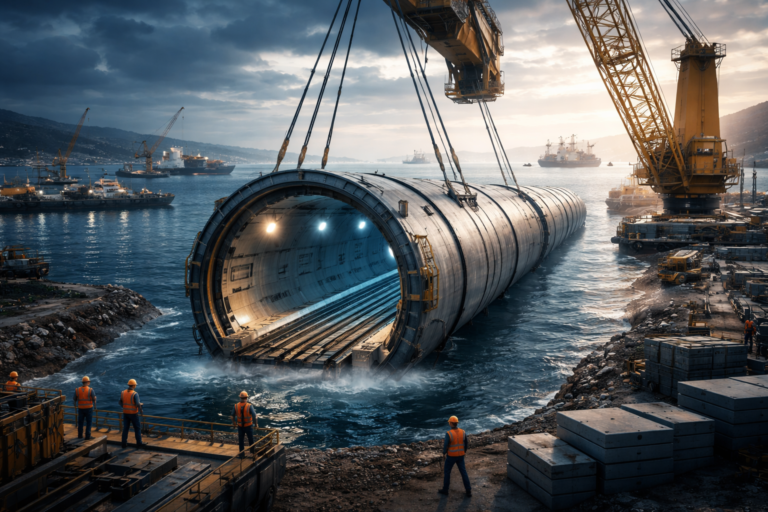
Construction has officially started on a landmark mega engineering project — an underwater rail line designed to link entire continents via a deep-sea tunnel. The announcement marks a new era of long-distance infrastructure, combining advanced tunnelling, high-speed rail technology, and international cooperation on an unprecedented scale.
What is the project?
The project aims to build a continuous deep-sea tunnel carrying high-speed rail between two continents, enabling direct passenger and freight rail services across oceanic distances. Unlike existing undersea links that span tens of kilometers, this underwater rail line will traverse much longer stretches of ocean, using a combination of bored tunnel segments, immersed tube sections, and potentially subsea pressure-stabilized passages.
Planners describe it as a hybrid solution: shield tunnel boring machines (TBMs) for hard rock sections, prefabricated immersed tube elements for deep basins, and advanced sealing and ventilation systems to maintain safety and operations under extreme pressures.
Why now? The drivers behind the decision
Several factors converged to make the project feasible:
- Advances in TBM technology and materials science reduce risk and cost.
- Growing demand for low-carbon freight corridors—rail is more energy-efficient than air or road over long distances.
- Geopolitical interest in resilient, independent transportation links.
- Economic ambition: faster trade, tourism, and regional integration.
- Climate concerns pushing investment toward long-lived, low-emission infrastructure.
Key benefits of an underwater rail line
- Faster, more reliable continental connectivity compared with shipping for many cargo types.
- Lower carbon footprint than air transport; potential to run on renewable electricity.
- Economic stimulus through construction jobs, supply chains, and new trade corridors.
- Strategic redundancy: land- and sea-based bottlenecks can be bypassed.
- Technological spillovers into tunnelling, materials, and marine engineering.
Major engineering challenges
Building a deep-sea tunnel at continental scale presents daunting challenges:
- Extreme water pressure and geological uncertainty at depth.
- Long, uninterrupted tunnel sections require robust ventilation, emergency egress, and fire suppression systems.
- Immense logistical coordination to fabricate, transport, and install massive tunnel elements.
- Corrosion resistance and structural durability in saline, high-pressure environments.
- Environmental protection: avoiding harm to marine ecosystems during construction.
Key technical needs include advanced TBMs capable of mixed-ground conditions, high-strength composite linings, modular emergency refuges, and redundant power/communications systems. Continuous monitoring via fiber-optic sensors and autonomous inspection vehicles will be essential.
Environmental and social considerations
Environmental assessments are central to project approval. Potential impacts include seabed disturbance, noise pollution affecting marine mammals, and changes to local currents. Mitigation strategies focus on:
- Careful routing to avoid sensitive habitats.
- Timing construction to minimize disruption to migration and breeding seasons.
- Noise-reduction technologies and real-time monitoring of wildlife.
- Reuse and careful disposal of excavated material.
Socially, the project requires agreements across nations and communities, fair compensation for affected stakeholders, and workforce development to ensure local benefits.
Governance, financing, and geopolitics
A project of this scale demands multinational governance structures, likely a consortium of governments, private investors, and international lenders. Public-private partnership models, phased financing, and infrastructure bonds are all on the table.
Geopolitically, the underwater rail line could reshape trade alignments. Participating countries will need to negotiate tariffs, customs protocols, security frameworks, and shared maintenance responsibilities. Transparency and legal clarity will be vital to avoid disputes.
Timeline and milestones
While initial construction has begun, completion will likely take decades, staged in phases:
- Preliminary works and seabed surveys (already ongoing).
- Launch of TBMs, shaft construction, and prefabrication yards.
- Sequential immersion or boring of tunnel sections.
- Systems installation: electrification, signalling, ventilation.
- Testing, certification, and phased openings for freight then passenger services.
Early segments might open to freight within 10–15 years, with full passenger services following as systems and safety certifications are completed.
What this means for the future
If successful, the underwater rail line will be a transformative piece of infrastructure—reducing travel times, decarbonizing long-distance transport, and demonstrating what coordinated engineering ambition can achieve. The project’s legacy will not only be measured in tunnels and trains, but in the technologies, policies, and international cooperation it inspires.
As construction progresses, keeping a close eye on environmental safeguards, equitable economic benefits, and resilient design will determine whether this mega engineering dream delivers for people, trade, and the planet.