
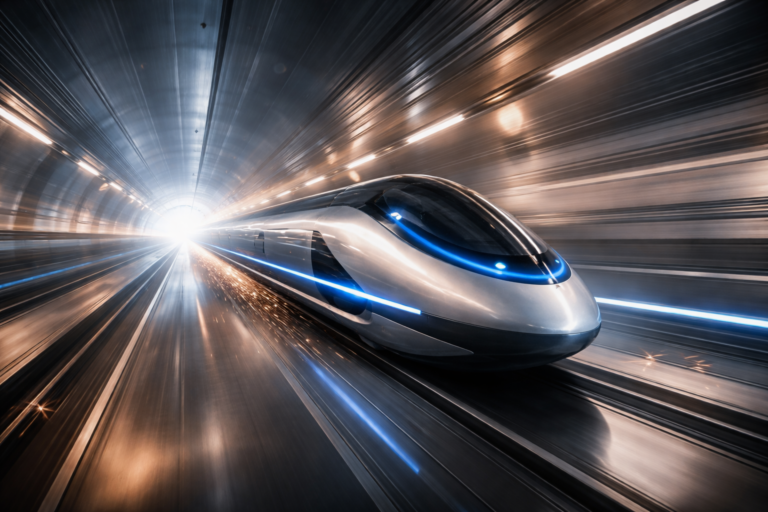
It took just two seconds for China to shatter a Hyperloop world record — a headline that captures both the speed of the test and the potential speed of a transportation revolution. Whether you view Hyperloop as science fiction coming to life or the next logical step after high-speed rail, recent progress in China has accelerated the conversation.
What happened in that two seconds
During a controlled test, a Chinese prototype accelerated so rapidly that observers described the moment as instantaneous. The prototype broke the existing acceleration and speed records for Hyperloop-style pods, achieving its milestone within two seconds of launch.
That rapid achievement matters for two reasons:
- Acceleration and deceleration are as important as top speed for passenger comfort and station-to-station viability.
- Demonstrating repeatable, controlled acceleration in a vacuum-like or low-pressure tube proves core engineering concepts at scale.
Why this breakthrough matters
Hyperloop is more than raw speed. It promises shorter travel times, lower energy use per passenger kilometer compared with airplanes, and the possibility of connecting city pairs that are too close for air travel but too far for convenient driving.
This Chinese test is significant because:
- It validates one of the toughest engineering challenges — reliable, high-G acceleration without compromising safety.
- It signals international competition and collaboration, which tends to accelerate innovation.
- It attracts investment and regulatory attention, both necessary to move from prototype to public deployment.
How Hyperloop differs from high-speed rail
Hyperloop and high-speed rail share the goal of fast, efficient land transport, but they approach it differently:
- Low-pressure tubes reduce air resistance, allowing higher speeds with less energy.
- Magnetic levitation or air bearings eliminate wheel-rail friction.
- Enclosed systems isolate vehicles from weather, reducing delays from conditions that affect conventional rail.
Those differences mean Hyperloop could eventually outpace trains on certain routes — especially medium-range corridors where air travel is inefficient but rail would take too long.
The technical hurdles that remain
Despite dramatic tests, several challenges must be solved before Hyperloop systems become common:
- Infrastructure cost: Building long, straight, evacuated tubes requires large upfront capital and land rights.
- Safety and emergency response: Operators need robust systems for evacuating passengers and handling depressurization, fires, or power failures.
- Comfort: High acceleration must be balanced to ensure passenger well-being over repeated journeys.
- Integration: Hyperloop stations, ticketing, and last-mile connections must work with existing transport networks.
- Regulation and standards: New frameworks are needed for vehicle certification, maintenance, and cross-border service.
China’s record-breaking test addresses one technical constraint but doesn’t erase these broader hurdles.
What this means for the future of high-speed trains
A successful Hyperloop ecosystem would not replace high-speed rail overnight, but it could redefine where and how we build fast corridors. Expect to see:
- Hybrid networks where Hyperloop serves very fast regional routes while HSR covers dense, multi-stop corridors.
- New city-pair markets become viable, reshaping economic geography and commuting patterns.
- Pressure on existing rail operators to innovate on speed, frequency, and customer experience.
Governments and private players will likely pilot mixed systems, assessing where Hyperloop provides clear advantages and where traditional rail remains superior.
Looking ahead
Record-breaking tests capture headlines, but the real test is scaling. Pilots need to move from single runs to frequent, safe operations; from short tubes to long intercity corridors; and from engineering feats to cost-effective public transport.
If China’s breakthrough accelerates development elsewhere, competition could shorten the timeline from prototype to passenger service. That might mean earlier deployments on select corridors, especially in countries willing to invest aggressively in next-generation transport.
Conclusion
It took just two seconds for China to shatter a Hyperloop world record, but turning that moment into everyday travel will take years of engineering, regulation, and infrastructure investment. Still, the test demonstrates that some of the most daunting technical barriers are coming down. For passengers and planners alike, the prospect of redefining the future of high-speed trains has moved from distant possibility toward a nearer, faster reality.