
For decades, scientists have struggled to precisely measure how fast the universe is expanding. This rate, known as the Hubble Constant, is one of the most important values in cosmology. However, different measurement techniques have produced conflicting results, creating what scientists call the “Hubble tension.” Physicists found a new way to measure the universe
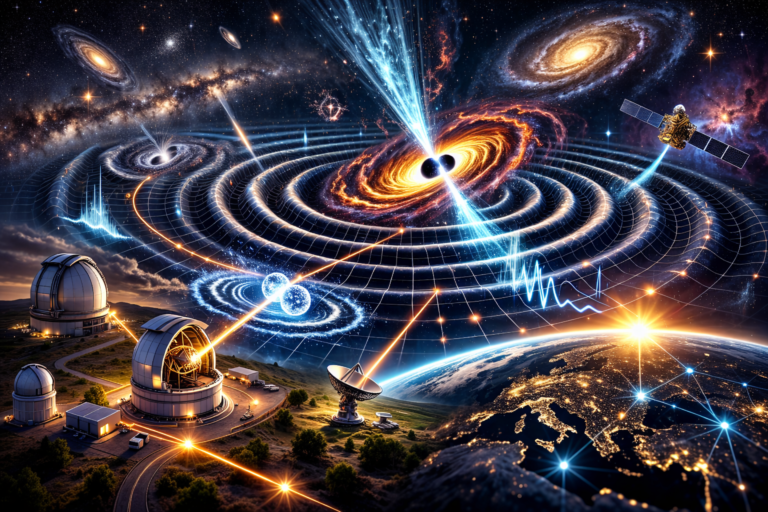
Now, physicists have developed a groundbreaking new method that could finally resolve this cosmic mystery. By using gravitational waves—ripples in spacetime caused by massive cosmic events—researchers have introduced a powerful new way to measure the universe with unprecedented accuracy.
What Is The Problem With Measuring The Universe?
The universe has been expanding since the Big Bang, but measuring its exact expansion rate has proven difficult.
Two Traditional Methods
- Early Universe Method
Uses the cosmic microwave background (CMB)—radiation left over from the Big Bang. - Late Universe Method
Uses supernovae and galaxies as “standard candles” to calculate distances.
The Issue: Hubble Tension
These two methods produce different values for the Hubble Constant, suggesting either:
- Measurement errors, or
- New, unknown physics
This discrepancy is one of the biggest unsolved problems in modern science.
The New Method: Measuring With Gravitational Waves
Physicists from leading institutions have introduced a completely new approach using gravitational waves.
What Are Gravitational Waves?
- Tiny ripples in spacetime caused by black hole or neutron star collisions
- Travel at the speed of light
- First detected in 2015 by LIGO
The “Stochastic Siren” Method
The new technique focuses on something called the gravitational-wave background—a faint “cosmic hum” created by countless unseen black hole mergers. Instead of measuring individual events, scientists analyze this background signal to estimate how fast the universe is expanding.
How It Works
- More expansion → fewer detectable collisions → weaker signal
- Less expansion → more collisions → stronger signal
Even the absence of detection provides valuable data about the universe’s expansion rate.
Key Features Of The New Method
| Feature | Description |
|---|---|
| Technique Name | Stochastic Siren Method |
| Main Tool | Gravitational-Wave Background |
| Data Source | Black hole mergers across the universe |
| Key Advantage | Independent of traditional light-based methods |
| Accuracy | Improves when combined with existing data |
| Future Potential | Expected major improvements within 6 years |
Why This Discovery Matters
1. Independent Measurement Tool
This method provides a third, independent way to measure the universe—separate from light-based observations.
2. Solving The Hubble Tension
By offering a new dataset, scientists can:
- Confirm one of the existing measurements
- Or discover new physics beyond current theories
3. Unlocking Dark Universe Secrets
The method could help explain:
- Dark energy (driving expansion)
- Dark matter interactions
- The universe’s age and composition
Supporting Advances In Cosmology
This discovery comes alongside other cutting-edge techniques:
Gravitational Lensing
- Measures time delays in light from distant quasars
- Offers another way to estimate expansion
Galaxy Motion Studies
- Analyze how nearby galaxies move under gravity and expansion
Large-Scale Cosmic Mapping
- Projects like the Dark Energy Survey map matter distribution across billions of light-years
Together, these methods are helping scientists build a clearer picture of the universe.
Future Potential Of This Method
The gravitational-wave background has not yet been fully detected—but that’s about to change.
What Scientists Expect
- Detection within the next 5–6 years
- More sensitive detectors from global collaborations
- Hundreds of additional gravitational-wave events
Once fully operational, this method could:
- Deliver high-precision cosmological measurements
- Possibly rewrite our understanding of the universe
Challenges And Limitations
While promising, the method still faces hurdles:
- Current detectors lack sensitivity for full background detection
- Requires advanced modeling of black hole populations
- Dependent on future observational data
However, researchers are optimistic that upcoming upgrades will overcome these challenges.
Conclusion
The discovery of a new way to measure the universe using gravitational waves marks a turning point in cosmology. By introducing the stochastic siren method, physicists now have a powerful new tool that could finally resolve the long-standing Hubble tension.
As technology advances and detectors become more sensitive, this method has the potential to unlock deeper insights into the universe’s expansion, composition, and ultimate fate. The coming decade could redefine our understanding of the cosmos in ways we are only beginning to imagine.