
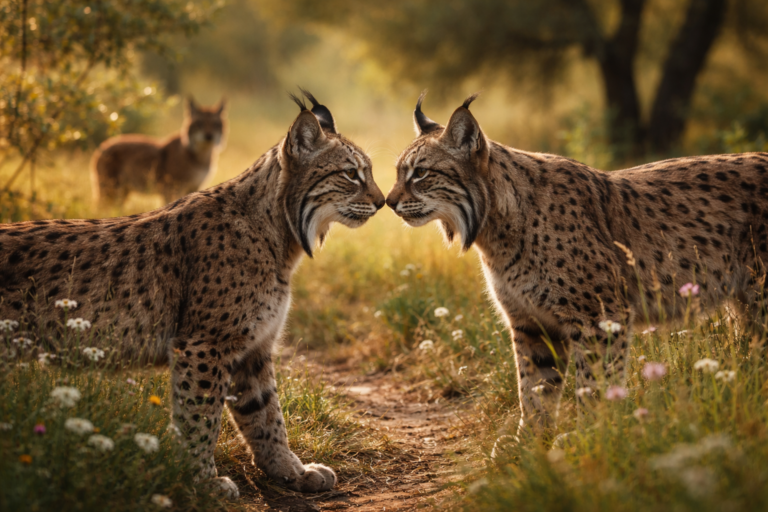
The scientific community is stunned by a groundbreaking development in wildlife conservation: the Iberian lynx (Lynx pardinus) populations in Spain and Portugal are no longer isolated. After decades of fragmentation, these once-separated groups are now mixing, breeding, and expanding across borders, marking a historic turning point in conservation biology.
This transformation is not accidental—it is the result of 20+ years of coordinated conservation efforts, including reintroduction programs, habitat restoration, and genetic management. Today, the Iberian lynx stands as one of the greatest wildlife recovery stories in modern history.
From Near Extinction to Recovery Success
At the beginning of the 21st century, the Iberian lynx was the most endangered feline species in the world, with only around 90–100 individuals left in the wild in 2002.
These animals were confined to two isolated populations in southern Spain, suffering from low genetic diversity and inbreeding.
Key Reasons for Decline
- Habitat destruction due to agriculture and urbanization
- Sharp decline in European rabbit populations (main prey)
- Road accidents and illegal hunting
- Genetic isolation between populations
However, intensive conservation programs reversed this trajectory.
Population Growth and Current Numbers
The latest data reveals an extraordinary rebound:
- 2,401 Iberian lynxes recorded in 2024
- 19% annual population growth in recent years
- 1,557 adults, including 470 breeding females
- 2,047 in Spain and 354 in Portugal
- Over 844 new births recorded in 2024 alone
This rapid increase led to the species being reclassified from “Endangered” to “Vulnerable” in 2024.
Table: Iberian Lynx Recovery at a Glance
| Category | Data / Figures |
|---|---|
| Scientific Name | Lynx pardinus |
| Population (2002) | ~100 individuals |
| Population (2024) | 2,401 individuals |
| Growth Rate | ~19% annually |
| Spain Population | 2,047 |
| Portugal Population | 354 |
| Breeding Females | 470 |
| Births in 2024 | 844 |
| Conservation Status | Vulnerable (IUCN 2024) |
| Reintroduced Lynx Since 2010 | 400+ |
Why Mixing Populations Is a Big Deal
Historically, Iberian lynx populations were genetically isolated, especially in regions like Doñana and Sierra Morena. This isolation caused:
- Inbreeding depression
- Reduced fertility
- Increased vulnerability to disease
Now, scientists confirm that lynxes from Spain and Portugal are dispersing, interacting, and reproducing across regions.
Scientific Importance
This mixing creates:
- Improved genetic diversity
- Stronger disease resistance
- Higher survival rates
- Long-term population stability
In simple terms, the species is no longer surviving—it is thriving as a connected ecosystem.
How Conservation Made This Possible
The success story is built on several strategic interventions:
1. Captive Breeding Programs
Lynxes were bred in controlled environments using genetically diverse pairings, then released into the wild.
2. Reintroduction Across Regions
Over 400 lynxes were reintroduced into suitable habitats across Spain and Portugal since 2010.
3. Habitat Restoration
Thousands of hectares were restored to support:
- Mediterranean scrubland
- Rabbit populations
4. Cross-Border Collaboration
Governments, NGOs, and scientists worked together, ensuring:
- Shared data
- Coordinated releases
- Wildlife corridors
5. Monitoring and Tracking
Advanced tools like GPS collars and camera traps helped track movements and confirm population mixing.
Expansion of Habitat and Range
The Iberian lynx is no longer restricted to a few isolated pockets. It now occupies:
- Andalusia
- Castilla-La Mancha
- Extremadura
- Murcia
- Southern Portugal (Guadiana Valley)
The species now covers over 3,300 square kilometers, a massive expansion compared to its earlier range.
Remaining Challenges
Despite the success, several risks remain:
Ongoing Threats
- Declining rabbit populations due to disease
- Road mortality
- Habitat fragmentation
- Climate change and wildfires
Political and Social Barriers
In some regions, reintroduction efforts face resistance from farmers and hunting groups, which could slow future expansion.
Future Outlook: A Model for Global Conservation
The Iberian lynx recovery offers a blueprint for saving endangered species worldwide. Key lessons include:
- Long-term funding and planning are essential
- Genetic diversity must be prioritized
- International cooperation is critical
- Local communities must be involved
Experts believe that if current trends continue, the Iberian lynx could eventually be fully stabilized across the Iberian Peninsula.
Conclusion
The merging of Iberian lynx populations in Spain and Portugal marks a historic turning point in conservation science. What was once a fragmented, critically endangered species is now genetically connected, expanding, and thriving.
This achievement highlights the power of science-driven conservation, international collaboration, and persistence. While challenges remain, the Iberian lynx stands today as a symbol of hope, proving that even the most endangered species can recover when humanity acts decisively.