
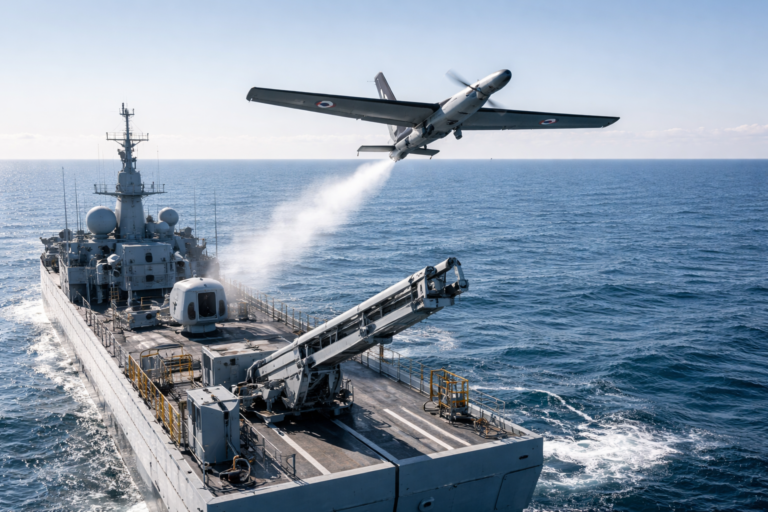
The French Navy is taking a major leap forward in maritime drone operations with the introduction of a new VTOL (Vertical Take-Off and Landing) mini-UAS. This innovation directly addresses one of the biggest operational limitations of shipborne drones: launch and recovery complexity.
Traditionally, mini-embarked UAVs required catapults, nets, or specialized deck setups—making them difficult to deploy on smaller vessels or in rough seas. The new Aliaca VTOL system removes this bottleneck entirely, offering greater flexibility, faster deployment, and reduced logistical burden.
The Achilles’ Heel Of Mini-Embarked UAS
Why Launch Complexity Was A Problem
For years, fixed-wing mini-UAS systems used by navies worldwide faced a critical issue:
- Required catapult launch systems
- Needed net or runway recovery
- Depended heavily on sea conditions and deck space
- Increased crew workload and risk
Earlier versions of the French Navy’s SMDM (Shipborne Mini Drone System) used catapult launch and net recovery, limiting deployment flexibility despite strong ISR capabilities.
This limitation meant:
- Smaller patrol vessels couldn’t deploy drones effectively
- Operations were slower and more complex
- Mission readiness was affected in rough maritime environments
The Breakthrough: Aliaca VTOL Drone
A Hybrid Solution
The new Aliaca VTOL drone, developed by Airbus Helicopters subsidiary Survey Copter, combines:
- Vertical take-off and landing (VTOL)
- Fixed-wing flight efficiency
This hybrid design eliminates the need for launch systems while maintaining performance.
Key Features And Specifications
| Feature | Details |
|---|---|
| Type | Tactical Mini VTOL UAV |
| Weight | ~25 kg |
| Wingspan | 3.5 meters |
| Length | 2.1 meters |
| Endurance | Up to 2 hours |
| Range | ~50 km |
| Launch Method | Vertical (no catapult needed) |
| Payload | EO/IR camera + AIS system |
| Operational Use | ISR, surveillance, SAR |
The drone uses four propellers for vertical lift, then transitions into efficient fixed-wing flight for extended missions.
How It Eliminates Launch Complexity
No Catapults, No Nets, No Constraints
The biggest advantage of the Aliaca VTOL is simple:
It removes the need for any launch-and-recovery infrastructure.
This results in:
- Faster deployment times
- Lower logistical footprint
- Reduced crew requirements
- Greater operational flexibility
According to defense insights, the system enables deployment from ships previously unable to operate UAVs, including smaller patrol vessels.
Operational Advantages For The French Navy
1. Expanded Fleet Integration
The VTOL drone can now operate from:
- Offshore patrol vessels (POM)
- High-sea patrol vessels (PHM)
- Surveillance frigates
- Smaller ships with limited deck space
2. Enhanced Maritime Surveillance
The drone acts as “remote binoculars”, providing:
- Real-time video intelligence
- Long-range identification of vessels
- Monitoring of suspicious maritime activity
3. Multi-Mission Capability
The system supports:
- Illegal trafficking detection
- Search and rescue missions
- Coastal surveillance
- Situational awareness in combat zones
4. Faster Reaction Time
With instant launch capability:
- No setup delays
- Immediate response to threats
Advanced Sensor Capabilities
The Aliaca VTOL carries cutting-edge systems:
- Electro-Optical/Infrared (EO/IR) sensors for day/night imaging
- Gyro-stabilized camera systems for clear maritime observation
- Automatic Identification System (AIS) for tracking vessels
These features allow the drone to:
- Detect ships over long distances
- Identify targets beyond radar range
- Provide actionable intelligence in real time
Deployment Timeline And Scale
- 34 Aliaca systems ordered since 2022
- VTOL version unveiled in 2025
- Operational deliveries begin in May 2026
- Developed in less than one year from an existing system
The rapid development highlights France’s push toward agile defense innovation.
Strategic Importance For Future Naval Warfare
Adapting To Modern Threats
Modern naval operations demand:
- Rapid intelligence gathering
- Flexibility across platforms
- Reduced reliance on large systems
The VTOL mini-UAS aligns perfectly with:
- Distributed maritime operations
- Autonomous warfare trends
- Low-cost, high-efficiency surveillance
Integration With Broader Drone Ecosystem
France is simultaneously developing:
- VSR700 rotary UAVs (8-hour endurance)
- Surface combat drones (DANAE program)
- Underwater autonomous vehicles (AUVs)
This shows a multi-domain unmanned strategy shaping the future fleet.
Future Outlook
The Aliaca VTOL is expected to:
- Expand into coastal land-based surveillance networks
- Support joint operations with NATO allies
- Serve as a model for other navies adopting mini-UAS
Its scalability and simplicity make it ideal for global adoption.
Conclusion
The French Navy’s adoption of the Aliaca VTOL drone marks a decisive evolution in naval aviation. By eliminating the long-standing issue of launch complexity, this system unlocks the full potential of mini-embarked UAS operations.
With improved flexibility, reduced logistical demands, and enhanced mission capability, the VTOL drone is not just an upgrade—it is a transformational shift in maritime surveillance and operational readiness.
As naval warfare increasingly embraces autonomous systems, innovations like this will define the future of efficient, responsive, and scalable naval power.