
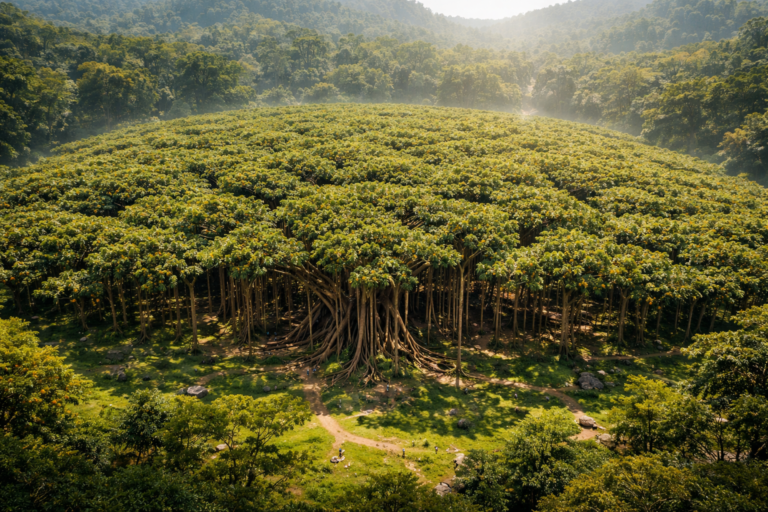
In the world of natural wonders, few phenomena are as astonishing as a tree that looks like an entire forest. This extraordinary banyan tree spreads across 8,500 square meters, rises to 20 meters in height, and produces an incredible 80,000 fruits per harvest.
At first glance, it appears to be a dense woodland. But in reality, it is a single living organism—a botanical marvel that challenges our understanding of trees and ecosystems. This unique tree demonstrates how nature can create complex, interconnected systems from just one organism.
What Makes This Tree Unique?
The tree belongs to the banyan family (Ficus species), known for its ability to grow in unusual and expansive ways.
Key Unique Features
- Single organism that appears like multiple trees
- Covers a massive 8,500 m² area
- Grows up to 20 meters tall
- Produces 80,000 fruits per harvest
- Develops aerial roots that turn into trunks
Unlike typical trees that grow vertically, banyan trees expand horizontally, forming a network of trunks that create the illusion of a forest.
Key Facts And Figures
| Feature | Details |
|---|---|
| Tree Type | Banyan (Ficus species) |
| Coverage Area | 8,500 square meters |
| Height | 20 meters |
| Fruit Yield | 80,000 fruits per harvest |
| Growth Style | Horizontal expansion via aerial roots |
| Lifespan | Hundreds of years |
| Ecosystem Role | Supports wildlife and biodiversity |
How One Tree Becomes A Forest
The secret behind this tree’s enormous spread lies in its aerial root system.
Growth Mechanism Explained
- Branches extend outward over time
- Roots grow downward from branches
- Once they reach the soil, they form new trunks
- These trunks support further expansion
This process repeats for decades or even centuries, allowing the tree to continuously expand its footprint.
As a result, what looks like hundreds of trees is actually one interconnected organism.
Fruit Production: 80,000 Fruits Per Harvest
One of the most remarkable aspects of this tree is its massive fruit production.
Why It Produces So Many Fruits
- Large canopy enables high photosynthesis
- Extensive root network ensures nutrient supply
- Long lifespan supports consistent productivity
The fruits, similar to figs, play a crucial ecological role.
Ecological Importance
- Provide food for birds, bats, and animals
- Help in seed dispersal
- Support pollinators like fig wasps
This makes the tree a central food source in its ecosystem.
A Living Ecosystem Under One Tree
This giant banyan tree is not just a plant—it is a complete ecosystem.
What It Supports
- Birds nesting in branches
- Small animals seeking shelter
- Insects thriving in bark and roots
- Humans benefiting from shade and cultural value
The dense canopy also creates a cool microclimate, reducing temperature and preserving moisture.
Global Context: Giant Banyan Trees Around The World
This tree is part of a group of giant banyan trees, some of the largest living organisms by area.
Examples Of Similar Trees
- Thimmamma Marrimanu (India): Covers over 19,000 m², one of the largest in the world
- The Great Banyan Tree (India): Covers nearly 18,900 m² and has thousands of aerial roots
These examples highlight how banyan trees can grow into forest-like structures over centuries.
Why It Looks Like A Forest
The illusion of a forest is created by:
- Numerous root-formed trunks
- Dense foliage blocking sunlight
- Wide spacing that mimics multiple trees
Visitors often find it hard to believe that all visible trunks are connected to one root system.
Environmental And Future Importance
Environmental Benefits
- Absorbs significant amounts of carbon dioxide
- Prevents soil erosion
- Enhances water retention
Future Significance
- Helps combat climate change
- Supports biodiversity conservation
- Promotes eco-tourism
Such trees are critical for maintaining ecological balance in a changing world.
Conclusion
This incredible banyan tree, covering 8,500 square meters, reaching 20 meters in height, and producing 80,000 fruits, stands as a true marvel of nature. It is more than just a tree—it is a living ecosystem, a natural wonder, and a symbol of resilience.
As environmental challenges grow, preserving such extraordinary organisms becomes increasingly important. They remind us that nature’s design is not only powerful but also deeply interconnected and sustainable.