
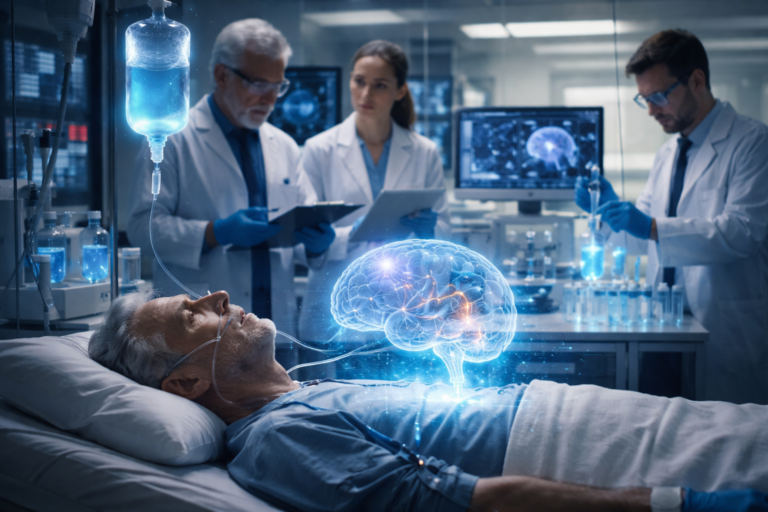
Stroke remains one of the leading causes of disability and death worldwide, affecting millions of people every year. However, scientists are now developing a revolutionary intravenous (IV) therapy that may help repair brain damage after a stroke and significantly improve recovery outcomes. Recent research suggests that this innovative treatment could reduce inflammation, protect neurons, and even stimulate the brain’s natural repair mechanisms.
This breakthrough therapy represents a major step forward in stroke treatment and neuroregeneration, potentially transforming how doctors treat brain injuries in the future.
Understanding Stroke And Why Brain Damage Occurs
A stroke occurs when blood flow to part of the brain is blocked or interrupted. Without oxygen and nutrients, brain cells begin to die within minutes.
There are two primary types of stroke:
- Ischemic Stroke: Caused by a blood clot blocking a brain artery (about 85–90% of cases).
- Hemorrhagic Stroke: Caused by bleeding in the brain.
In ischemic strokes, restoring blood flow quickly is critical. However, the sudden return of blood can trigger secondary damage known as reperfusion injury, which leads to inflammation and further destruction of brain tissue.
Because brain cells have limited ability to regenerate, many stroke survivors suffer long-term effects such as:
- Paralysis
- Speech difficulties
- Cognitive impairment
- Loss of coordination
This is why scientists are exploring therapies that not only restore blood flow but also repair brain tissue.
The Breakthrough IV Therapy That Repairs Brain Tissue
Researchers recently developed a novel nanomaterial-based intravenous therapy designed to protect the brain immediately after a stroke.
This treatment works by crossing the blood–brain barrier, a protective layer that prevents most drugs from reaching brain tissue. Once inside the brain, the therapy reduces inflammation and supports healing of damaged neurons.
In laboratory experiments, scientists administered a single IV dose shortly after restoring blood flow in an ischemic stroke model.
The results were remarkable:
- Brain damage was significantly reduced
- Inflammation decreased
- No toxic side effects were detected in major organs
These findings suggest the therapy could become a powerful new neuroprotective treatment.
Key Information About The New IV Stroke Therapy
| Feature | Details |
|---|---|
| Treatment Type | Intravenous nanomaterial therapy |
| Target Condition | Ischemic stroke |
| Mechanism | Crosses blood–brain barrier and reduces inflammation |
| Administration | Single IV dose after blood flow restoration |
| Early Results | Significant reduction in brain damage in models |
| Safety Findings | No organ toxicity observed |
| Future Stage | Further clinical testing required |
How The Therapy Works Inside The Brain
The new IV therapy is designed to combat the biological processes that worsen brain damage after a stroke.
1. Crossing The Blood–Brain Barrier
The blood–brain barrier blocks most medications from entering the brain. The engineered nanomaterial used in this therapy can penetrate this barrier, allowing it to reach damaged brain regions.
2. Reducing Harmful Inflammation
After blood flow returns, immune responses can trigger inflammation that kills additional neurons. The therapy suppresses these inflammatory pathways.
3. Protecting Brain Cells
The treatment helps preserve neurons and the neurovascular unit, which includes blood vessels and supporting cells essential for brain function.
4. Supporting Brain Plasticity
Recovery from stroke depends heavily on neuroplasticity, the brain’s ability to reorganize neural connections. Emerging therapies aim to enhance this process to improve long-term recovery.
Other Promising IV Stroke Treatments Under Development
The nanomaterial therapy is not the only intravenous treatment being studied.
Researchers are also testing several neuroprotective drugs designed to limit brain damage.
One example is loberamisal, a novel neuroprotective medication currently being evaluated in clinical trials.
Key findings include:
- Treatment started within 48 hours of stroke
- Administered intravenously for 10 days
- Patients showed better functional recovery after 90 days
- No increase in serious side effects compared with placebo
These findings suggest that IV therapies may become an important addition to existing stroke treatments.
Current Standard Treatments For Stroke
Despite new innovations, the main treatments for ischemic stroke today include:
Intravenous Thrombolysis
A drug called tPA (tissue plasminogen activator) is given through IV to dissolve blood clots.
Mechanical Thrombectomy
Doctors insert a catheter into blood vessels to remove clots directly from the brain.
Advances in thrombectomy have extended the treatment window to up to 24 hours in some patients, greatly improving survival and recovery rates.
However, these treatments focus primarily on restoring blood flow, not repairing damage already done to brain tissue.
That is where new IV repair therapies could make a dramatic difference.
Why This Breakthrough Could Transform Stroke Recovery
Stroke is currently the leading cause of long-term adult disability in many countries. Millions of survivors require years of rehabilitation.
The new IV therapy could transform stroke treatment by:
- Preventing secondary brain injury
- Promoting tissue repair
- Improving neurological recovery
- Reducing long-term disability
- Shortening rehabilitation time
If successful in human trials, the therapy could be administered immediately after clot removal, offering a powerful combination of treatments.
Future Of Brain Repair After Stroke
Scientists are exploring several other cutting-edge strategies alongside IV therapies, including:
- Stem cell therapy to regenerate damaged neurons
- Gene therapies that stimulate brain repair
- Neuroplasticity-enhancing drugs
- Nanomedicine targeting injured brain tissue
These approaches aim to transform stroke treatment from simply preventing damage to actively repairing the brain.
Experts believe the next decade could bring major breakthroughs in neuroregenerative medicine.
Conclusion
The development of intravenous therapies that repair brain damage after stroke represents one of the most exciting advances in modern neuroscience. Early research shows that nanomaterial-based treatments and neuroprotective drugs can reduce inflammation, protect neurons, and promote brain recovery.
Although more clinical trials are needed before these treatments become widely available, the results so far offer significant hope. If future studies confirm their effectiveness, IV brain repair therapies could revolutionize stroke care and dramatically improve the lives of millions of patients worldwide.