
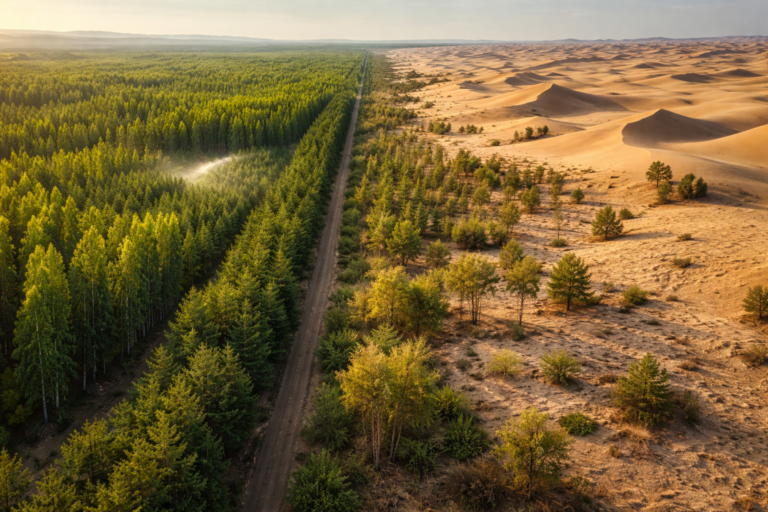
China’s ambitious tree-planting campaign—often called the “Great Green Wall”—is one of the largest environmental projects in human history. With tens of billions of trees planted over four decades, the country has made remarkable progress in slowing desert expansion. However, a growing body of research suggests that this massive effort may also be creating unexpected ecological consequences.
This article explores the facts, figures, benefits, and controversies surrounding China’s billion-tree initiative and what it means for the future of global climate strategies.
Understanding China’s Great Green Wall
China launched the Three-North Shelterbelt Program in 1978 to combat severe desertification across northern regions. The project aims to create a vast green barrier stretching thousands of kilometers to block advancing deserts like the Gobi and Taklamakan.
- Over 66 billion trees have been planted so far
- Forest coverage increased from 10% in 1949 to over 25% by 2024
- More than 30 million hectares of land have been afforested
- The project is expected to continue until 2050
This large-scale intervention targets a critical issue: desertification, which affects nearly 27% of China’s land and impacts hundreds of millions of people
Key Data And Impact Overview
| Category | Key Figures & Facts |
|---|---|
| Trees Planted | Over 66–78 billion trees |
| Project Start | 1978 |
| Forest Coverage | Increased to 25%+ |
| Desertified Land | Around 27% of China |
| Affected Population | Approx. 400 million people |
| Target Completion | 2050 |
| Green Belt Length | Approx. 3,000–4,800 km |
How The Campaign Is Slowing Desert Expansion
1. Reduced Sandstorms
Tree belts act as windbreaks, reducing the intensity and frequency of sandstorms. In some regions, sandstorms have dropped significantly compared to previous decades
2. Soil Stabilization
Tree roots help anchor soil, preventing erosion and stabilizing dunes—critical in desert-edge regions.
3. Carbon Sequestration
Recent studies show that reforested areas around the Taklamakan Desert are now acting as carbon sinks, absorbing more CO₂ than they emit
4. Increased Vegetation Growth
Satellite data reveals improved photosynthesis and vegetation density, especially during wet seasons
Why Some Experts Are Concerned
Despite visible success, scientists warn that planting trees in dry ecosystems is not always beneficial.
1. Water Scarcity Issues
Trees require significant water, especially in arid regions. Studies show that increased vegetation has reduced water availability across large parts of China, including both dry and monsoon regions
- Northern China holds 46% of the population but only 20% of water resources
- Tree plantations can intensify water stress in already dry landscapes
2. Altered Hydrological Cycles
Mass tree planting has changed how water circulates across the country, redistributing rainfall and affecting ecosystems
3. Monoculture Plantations
Many projects rely on single-species planting, which reduces biodiversity and increases vulnerability to pests and disease
4. Low Survival Rates
In harsh desert climates, a significant number of planted trees fail to survive, raising concerns about efficiency and sustainability
5. Overestimated Impact
Some research suggests that tree planting contributes only a small portion of vegetation recovery, with rainfall and land management playing larger roles
The Reality: A Mixed Environmental Outcome
Experts increasingly agree that China’s billion-tree campaign delivers both benefits and risks.
Positive Outcomes
- Slows desert expansion
- Improves air quality
- Enhances carbon capture
- Supports local economies
Negative Trade-Offs
- Strains water resources
- Alters natural ecosystems
- Reduces biodiversity in some areas
- Requires long-term maintenance
As one analysis suggests, the campaign has “real gains but also clear ecological trade-offs”
Future Of China’s Tree-Planting Strategy
China continues to refine its approach by:
- Shifting toward native and drought-resistant species
- Combining grassland restoration with tree planting
- Using satellite monitoring to track ecological changes
- Focusing on quality over quantity in planting strategies
The country also plans to plant and conserve up to 70 billion trees within a decade, reinforcing its climate commitments
Global Implications
China’s experiment offers valuable lessons for global climate initiatives:
- Large-scale afforestation can work, but must be carefully planned
- Ecosystems are complex—more trees do not always mean better outcomes
- Water, biodiversity, and local conditions must guide environmental policies
Conclusion
China’s billion-tree campaign stands as a bold and unprecedented attempt to reshape the environment. It has successfully slowed desertification, reduced sandstorms, and created carbon sinks. However, it also highlights the limits of large-scale ecological engineering, especially in fragile drylands.
The future of this initiative depends on balancing environmental ambition with ecological reality. If managed wisely, it could become a global model. If not, it risks becoming a cautionary tale of how even well-intentioned solutions can disrupt nature.