
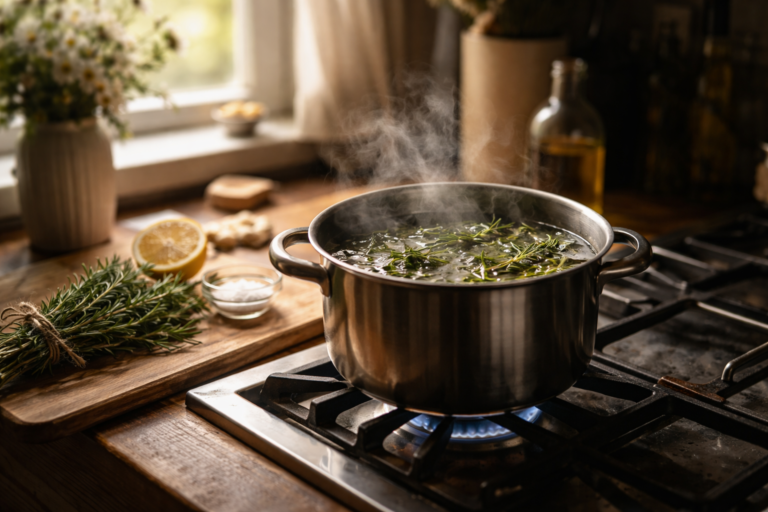
There are home remedies that belong to family lore, passed down with a wink and the scent of herbs. Boiling rosemary is the best home tip I learned from my grandmother: and it completely transforms the atmosphere of your home. It’s simple, effective, and rich with memories—one pot on the stove can lift the mood, freshen the air, and make a house feel like a home.
Why rosemary works
Rosemary has a sharp, clean aroma that wakes the senses without overwhelming them. When gently heated, the essential oils are released into the steam, creating an all-natural fragrance that:
- Clarifies the air and masks cooking smells
- Feels uplifting and mentally clearing
- Acts as a gentle insect deterrent in some cases
My grandmother would say it “cleans the house from the inside out.” There’s something about that herbal steam that feels like a reset—calm, focused, and refreshed.
How to do it: grandmother’s simple method
You don’t need fancy equipment. Here’s the straightforward way my grandmother always used:
- Fill a small pot with 4–6 cups of water.
- Add a handful of fresh rosemary sprigs (or 2–3 tablespoons dried).
- Bring to a gentle boil, then reduce heat to a simmer.
- Let it simmer for 20–30 minutes, uncovered, topping up water if needed.
- Turn off the heat and leave the pot in a safe place where the steam can circulate.
This process releases rosemary’s volatile oils into the air. It’s best done on the stove where the aroma can drift through adjacent rooms.
Variations to personalize the scent
Rosemary pairs beautifully with other pantry and garden items. Try one of these combinations:
- Rosemary + lemon peel: bright and uplifting
- Rosemary + orange slices + cinnamon stick: warm and cozy for winter
- Rosemary + lavender: calming and floral
- Rosemary + eucalyptus: clarifying and helpful for stuffy rooms
Mix and match depending on the mood you want to create.
Practical tips and safety
A few practical points to keep this ritual pleasant and safe:
- Never leave simmering water unattended for long periods. Keep an eye on the pot.
- Use a low simmer to avoid intense, overpowering steam.
- If you have open flames or small children, place the pot where it’s out of reach.
- If anyone in your household has respiratory sensitivities, try a small batch first to ensure the scent is comfortable.
- For pet owners: avoid excessive steam in small, enclosed spaces. Some pets—especially birds and certain small animals—can be sensitive to essential oils and strong fragrances.
Beyond the stovetop: other uses
If you love the scent but don’t want to boil all the time, there are other ways to enjoy rosemary’s atmosphere-transforming qualities:
- Simmer and strain: cool and store the infused water in a spray bottle for a natural room mist.
- Simmer, then reuse: the cooled infusion can be used as a light plant spray (once diluted) or to wipe down counters for a subtle scent.
- Dry bundles: hang rosemary sprigs as decorative bundles in entryways or bathrooms for a slower-release fragrance.
Why this small ritual matters
More than the aroma, boiling rosemary is a tiny ceremony that invites intention into daily life. It slows you down for a few minutes, connects you to tradition, and signals a shift in atmosphere—cleaner, calmer, more cared-for. My grandmother used it before guests arrived or any time the house felt “heavy.” It turned ordinary moments into something quietly special.
If you’re looking for an easy, economical way to brighten your home, try this centuries-old tip. Boiling rosemary is the best home tip I learned from my grandmother: and it truly transforms the atmosphere of your home—one gentle simmer at a time.