
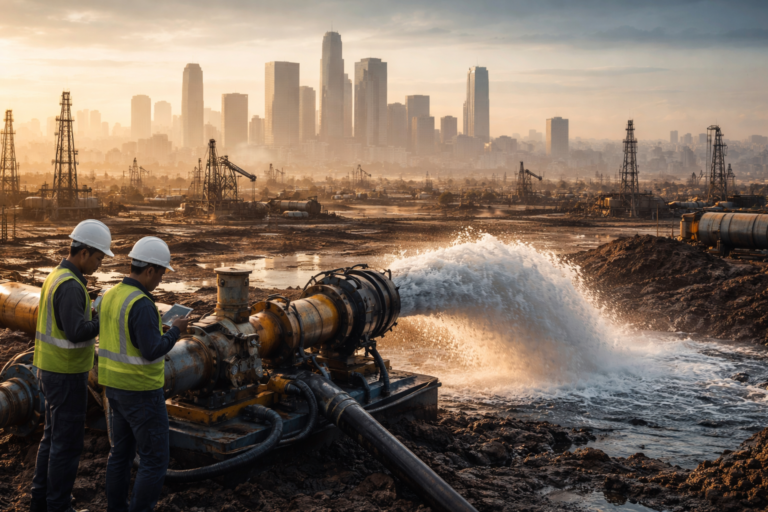
Urban subsidence — the gradual sinking of land — threatens roads, pipelines, buildings and flood protection everywhere people extract fluids from beneath their feet. One engineered response has been straightforward: pump water back into depleted oil reservoirs.
By pumping water into empty oil fields for decades, engineers have managed to delay land subsidence in some of the world’s largest cities, protecting infrastructure while also supporting secondary oil recovery.
How water injection slows subsidence
When oil (and gas or groundwater) is produced, the fluids that once supported the weight of overlying rocks are removed. Reduced pore pressure lets reservoir rock compact, which translates upward as surface subsidence. Injecting water into the same porous formations restores pressure, supports the rock matrix and reduces further compaction.
Two related practices are commonly used:
- Waterflooding: injecting water into reservoir zones to sweep remaining oil toward production wells (secondary recovery).
- Pressure maintenance: injecting water specifically to stabilize pressure and prevent reservoir compaction and surface sinking.
Both techniques can be tailored to balance energy production goals with geotechnical stability.
Real-world examples
The technique has a long history. Regions with intense early oil production showed dramatic subsidence in the 20th century; later, operators introduced water injection programs that reduced ongoing sinking and stabilized infrastructure.
Notable outcomes include:
- Parts of the Los Angeles Basin (Long Beach area) where early 20th-century oil withdrawal caused measurable subsidence. Subsequent pressure maintenance and waterflood practices helped arrest further large-scale sinking.
- Coastal and delta regions with combined oil, gas and groundwater extraction have used injection wells as one element of a broader subsidence-management toolbox.
Other major cities that suffer subsidence from groundwater overuse — such as Mexico City and Jakarta — have pursued various recharge measures rather than oil-field injection specifically. Nevertheless, the principle is similar: restoring fluid pressure in subsurface layers helps support the ground above.
Benefits of long-term injection programs
- Infrastructure protection: stabilizing land levels reduces differential settlement that damages roads, sewers, flood defenses and buildings.
- Dual-purpose use: waterflooding can increase hydrocarbon recovery while also providing geotechnical benefits.
- Predictability: where reservoirs are well-characterized, engineers can model expected pressure responses and design injection schemes to mitigate subsidence before it becomes severe.
Risks, trade-offs and limitations
Water injection is not a perfect or universal remedy. Key concerns include:
- Induced seismicity: changing subsurface pressures can trigger small to moderate earthquakes if faults are present and critically stressed. Careful seismic monitoring and incremental pressure management are essential.
- Water quality and contamination: injected water must be compatible with reservoir chemistry to avoid scaling, mobilizing heavy metals, or contaminating freshwater aquifers.
- Source and sustainability of water: supplying millions of cubic meters of water over decades is logistically and environmentally challenging, especially in arid regions.
- Not a cure-all for groundwater-driven subsidence: where sinking is mainly caused by aquifer depletion in near-surface sediments, direct aquifer recharge or demand reduction may be more effective.
Monitoring and long-term governance
Successful programs combine engineering with robust monitoring and governance:
- Geodetic methods (satellite InSAR, GPS) track subtle surface movement over time.
- Downhole pressure and formation-monitoring tools measure reservoir response directly.
- Cross-agency planning links oil operators, water managers and urban planners to align objectives and share data.
- Regulatory frameworks can require adaptive management to limit seismic risk and protect potable water.
Conclusion
By pumping water into empty oil fields for decades, engineers have managed to delay land subsidence in many (Incomplete: max_output_tokens)