
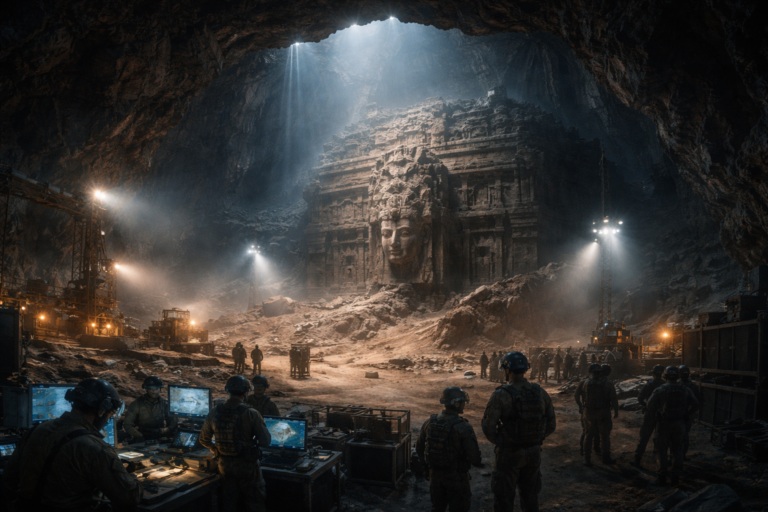
Imagine a discovery made not in a desert or beneath a city, but far below the Earth’s surface — at 2,570 meters. News of a record-breaking subsurface find made during a military operation would be electrifying, and if verified, it could force archaeologists to rethink how and where humanity’s past is preserved. Whether this scenario is real or hypothetical, the implications are worth unpacking.
What such a discovery might look like
Reports of deep subsurface discoveries often point to exceptionally well-preserved contexts. At depths measured in kilometers, stable temperatures, low oxygen, and isolation from surface activity can create conditions that slow decay and protect materials that would otherwise vanish.
If artifacts or structures were indeed found at 2,570 meters, they could include:
- Architectural remains or voids indicating human construction
- Organic materials preserved by anoxic conditions (wood, textiles, plant remains)
- Tools, ceramics, or metals in unusual contexts that challenge existing timelines
- Environmental data trapped in sediments that offer new climate records
Each of these types of evidence would require careful, multidisciplinary study to determine origin, age, and significance.
Why depth matters
Depth is not just a number. At nearly 2.6 kilometers below the surface, pressures, temperatures, and geochemical conditions differ markedly from surface environments. Those differences shape both preservation and interpretation.
- Preservation: Deep, closed systems can protect delicate organic compounds, DNA, and fragile artifacts that rarely survive at the surface.
- Chronology: Materials recovered at depth might be older, younger, or re-deposited, complicating radiometric dating and stratigraphic interpretation.
- Context: Disturbance by tectonics, fluid migration, or human activity (mining, drilling) can move materials from one period to another, so context must be established carefully.
Archaeologists would need to combine geological, geochemical, and archaeological expertise to untangle these factors.
Military involvement: pros and cons
When the military is involved in a discovery, the dynamics change. Military operations can provide access to remote or deep environments using specialized equipment. But they can also raise questions about transparency, stewardship, and priorities.
Benefits:
- Access to advanced drilling, remote sensing, and deep-penetration technology
- Rapid logistical support and safety protocols for hazardous environments
- Immediate recovery that can preserve fragile items
Concerns:
- Chain-of-custody and public access: Military control can limit peer review and independent verification
- Secrecy and classification could delay scientific publication
- Potential for damage if recovery prioritizes security over careful excavation
The best outcome would be a swift transition to collaborative, civilian-led scientific investigation with open data sharing.
How archaeology could be reshaped
A verified deep subsurface archaeological site would have several far-reaching consequences:
- Expanded search horizons: Archaeologists might prioritize deep subsurface surveys alongside surface fieldwork.
- New preservation paradigms: Techniques for handling pressure-sensitive or anoxic materials would grow in importance.
- Revised chronologies: Unexpected finds could prompt rethinking of migration, technology diffusion, or environmental interactions.
- Cross-disciplinary innovation: Collaboration with geologists, microbiologists, and engineers would become routine for excavation and analysis.
Such a discovery could also accelerate non-invasive technologies (deep-penetrating radar, borehole imaging, in situ dating) and foster protocols for ethical intervention in previously inaccessible areas.
Immediate priorities if verified
If authorities confirm a deep military-linked find, responsible next steps should include:
- Securing the site with minimal disturbance
- Convening an independent, international team of archaeologists, geologists, conservators, and legal experts
- Establishing transparent documentation and open data practices
- Prioritizing conservation of perishable materials and controlled sampling for dating and analysis
- Communicating clearly with the public to avoid speculation and misinformation
Challenges and ethical questions
Deep discoveries raise tough questions beyond science: who owns cultural heritage found during military operations? How should the public be informed without jeopardizing conservation? How do archaeologists work ethically in spaces tied to national security?
Resolving these issues requires legal clarity, international cooperation, and a commitment to preserving humanity’s past for future generations rather than treating it as a strategic asset.
Conclusion
A record-breaking discovery at 2,570 meters below the surface — whether actual or hypothetical — forces us to imagine archaeology beyond the familiar horizons of field trenches and cave entrances. It would prompt new methods, stronger interdisciplinary ties, and thorny ethical debates. Above all, it would be a reminder: the story of humanity is still being written in places we seldom look. If such a find exists, the scientific community’s response should be careful, collaborative, and dedicated to uncovering truth rather than headlines.