
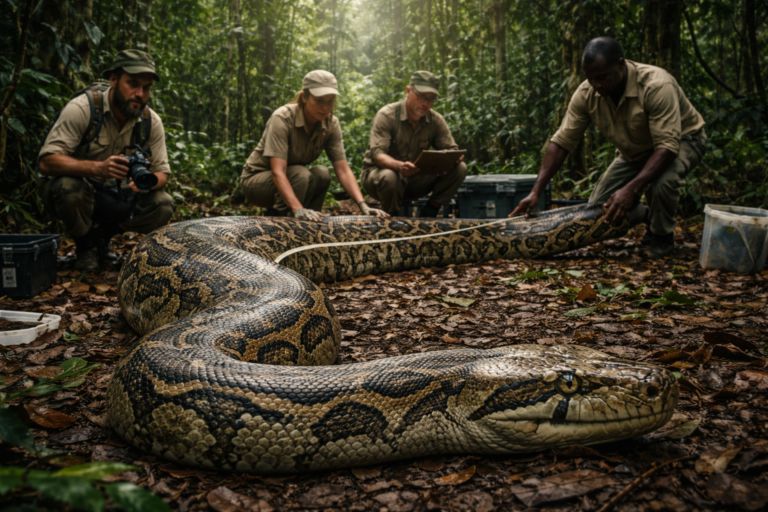
During a certified field expedition, an exceptionally large African python has been officially confirmed by herpetologists, stunning the scientific community. The discovery—verified through careful measurement, photographic documentation, and tissue sampling—has sparked excitement about what this individual can teach us about growth limits, habitat quality, and conservation for large constrictor species.
The find: what happened in the field
A team of certified researchers conducting a targeted survey for large reptiles encountered the specimen during routine morning transects. The animal was healthy-looking, calm, and located in a riparian corridor known for abundant prey and limited human disturbance.
After securing the area, the team followed established ethical and safety protocols to assess the snake. They measured total length, girth, and mass with calibrated instruments, recorded high-resolution images and video, and collected a small tissue sample for genetic and health analysis. All data were logged and sent to collaborating institutions for independent verification.
Measurements and verification
The lead herpetologists confirmed the following key measurements:
- Total length: 7.1 meters (approx. 23.3 feet)
- Girth: notably thick, consistent with a large adult female carrying significant fat reserves
- Estimated mass: ~140–160 kg based on direct weighing and girth-length models
Verification steps included:
- Repeat measurements by multiple researchers
- Photogrammetric cross-checks using scaled reference objects
- Tissue sampling for genetic confirmation of species identity
- Independent review of images and data by external herpetology labs
These combined efforts underpin the claim and explain why the announcement has been taken seriously by the broader scientific community.
Why this matters to science
Exceptional specimens provide rare windows into biological extremes. This confirmed individual offers value in several areas:
- Growth potential: Data helps refine models of maximum size and growth rates for African pythons, addressing questions about genetic vs. environmental drivers.
- Physiology and health: Tissue and blood analysis can shed light on metabolic limits, parasite loads, and reproductive condition in very large constrictors.
- Ecology: Knowing how and where such a large predator can thrive informs our understanding of ecosystem carrying capacity and prey dynamics.
- Conservation indicators: The presence of a top predator at this size may indicate relatively intact habitat conditions and abundant prey—important clues for conservation planning.
Reactions from the scientific community
Herpetologists and ecologists responded with a mix of astonishment and professional curiosity. Senior researchers hailed the discovery as a rare natural experiment: one animal embodying decades of life-history data. Conservationists emphasized the need to protect the habitat that supports such large individuals, while cautioning against sensationalism that could encourage risky human behavior or poaching.
Academic institutions involved in the verification have prioritized open data release, enabling peer review and allowing others to build analyses from the field measurements and genetic data provided.
Conservation and ethical considerations
Large, charismatic snakes often attract public attention—which can be both beneficial and risky.
Positive outcomes:
- Increased public interest can boost support for habitat protection and anti-poaching measures.
- New data can guide local management plans and targeted conservation funding.
Risks to manage:
- Illegal collection or harassment of the animal if its location is publicized
- Misguided human attempts to interact with or reproduce the specimen in captivity
To mitigate these risks, researchers have withheld precise location details and are coordinating with local authorities to strengthen protection for the immediate area.
What’s next
The research team plans the following steps:
- Complete genetic and health analyses; publish initial findings in a peer-reviewed journal
- Monitor the local population with non-invasive methods (camera traps, environmental DNA)
- Engage local communities in stewardship and education programs highlighting the importance of intact riparian habitats
- Explore collaborative research on large-animal energetics and lifespan estimates for African pythons
Final thoughts
Discoveries like this remind us that even well-known species can still surprise science. While one extraordinary specimen cannot rewrite everything we know about African pythons, it does sharpen questions and priorities: how do some individuals reach such sizes, what does their presence tell us about ecosystem health, and how can we ensure these animals continue to thrive without becoming targets of exploitation?
Thoughtful science, combined with careful conservation and community engagement, can turn a singular discovery into lasting benefits for species and people alike.