
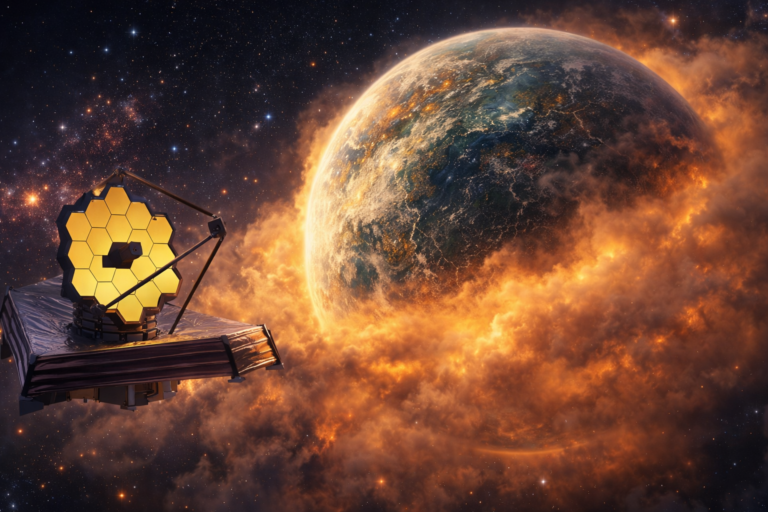
Astronomers using the James Webb Space Telescope (JWST) have made a groundbreaking discovery: an ancient super-Earth with an atmosphere that scientists once thought impossible. The planet, known as TOI-561 b, is an ultra-hot rocky world orbiting extremely close to its star.
Despite intense radiation that should have stripped away its gases billions of years ago, observations suggest that the planet still maintains a dense atmosphere above a molten surface. This discovery is forcing scientists to rethink how planets form, evolve, and retain atmospheres in extreme environments.
Overview Of The Discovery
The James Webb Space Telescope, launched in 2021 as the most powerful infrared space observatory ever built, has been studying distant planets known as exoplanets. Using advanced spectroscopy instruments, scientists analyzed the thermal emissions from the super-Earth TOI-561 b and discovered evidence of a thick atmospheric layer surrounding the planet.
The surprising part is that this planet is extremely hot and very old, conditions that should normally eliminate any atmosphere.
Key Observational Findings
- Planet located about 280 light-years away in the constellation Sextans.
- Classified as a super-Earth, meaning it is larger than Earth but smaller than Neptune.
- Orbital period: approximately 11 hours around its star.
- Surface temperature: about 1,800°C (3,200°F).
- Evidence suggests a volatile-rich atmosphere above a global magma ocean.
Scientists say this discovery provides the strongest evidence yet for an atmosphere on a rocky planet outside our solar system.
What Makes This Atmosphere “Impossible”?
In planetary science, small rocky planets that orbit extremely close to their stars are expected to lose their atmospheres quickly due to intense stellar radiation.
However, TOI-561 b contradicts this expectation.
Reasons Scientists Expected No Atmosphere
- Extreme heat should cause gases to escape into space.
- Powerful stellar radiation would strip away lighter elements.
- Ancient age means billions of years of atmospheric loss.
Despite these factors, the planet appears to have retained a thick envelope of gases, which is why researchers describe it as an “impossible atmosphere.”
Table: Key Facts About The Super-Earth TOI-561 b
| Feature | Details |
|---|---|
| Planet Name | TOI-561 b |
| Planet Type | Super-Earth |
| Distance From Earth | About 280 light-years |
| Size | Around 1.4× Earth’s radius |
| Orbital Period | ~11 hours |
| Estimated Temperature | About 1,800°C |
| Surface Condition | Global magma ocean |
| Discovery Tool | James Webb Space Telescope |
| Scientific Significance | Evidence of unexpected atmosphere |
How Scientists Detected The Atmosphere
The discovery relied on infrared spectroscopy, one of JWST’s most powerful capabilities.
Step-By-Step Method
- Transit Observation
The planet passes in front of its star, allowing scientists to observe how starlight interacts with the planet’s atmosphere. - Spectral Analysis
The NIRSpec instrument measures how different wavelengths of infrared light are absorbed. - Temperature Measurement
By analyzing thermal emission, scientists determine the planet’s surface temperature. - Atmospheric Modeling
Data are compared with computer models to determine whether a rocky surface alone could explain the observations.
Results showed that the planet’s temperature was lower than expected for a bare rock, suggesting that a layer of gases is trapping heat and redistributing energy across the planet.
What The Atmosphere May Contain
Although scientists are still analyzing the data, early models suggest the atmosphere could contain volatile compounds released from molten rock.
Possible atmospheric components include:
- Carbon monoxide (CO)
- Carbon dioxide (CO₂)
- Sulfur compounds
- Vaporized minerals from magma
These gases likely originate from outgassing, a process where molten rock releases trapped gases into the surrounding environment.
This means the planet’s atmosphere may be continually replenished from its magma ocean.
Why The Planet Is Extremely Ancient
Another surprising aspect of TOI-561 b is its age.
The host star belongs to a population of old stars in the Milky Way’s thick disk, meaning the planetary system formed billions of years ago.
Scientists estimate that the planet could be over 10 billion years old, making it one of the oldest rocky worlds ever studied.
Despite such age, the planet still retains an atmosphere — something previously considered highly unlikely.
What This Discovery Means For Planetary Science
The discovery is reshaping several key ideas about exoplanets.
1. Atmospheres Can Survive Extreme Heat
Scientists previously believed that lava worlds near stars would lose all gases, but this planet suggests otherwise.
2. Magma Oceans May Create New Atmospheres
Molten surfaces may release gases that continuously replenish atmospheres.
3. Exoplanet Diversity Is Greater Than Expected
Astronomers are discovering planets with properties that defy traditional classifications.
4. Improved Models Of Planet Evolution
Researchers must now reconsider how atmospheres evolve on rocky planets.
Future Research And Observations
The discovery is only the beginning. Scientists plan to use JWST and other telescopes to:
- Measure the exact chemical composition of the atmosphere.
- Study how lava oceans interact with atmospheric gases.
- Search for similar lava-covered planets with atmospheres.
- Improve models of planet formation in extreme environments.
Future missions such as ARIEL (Atmospheric Remote-sensing Infrared Exoplanet Large-survey) will further analyze exoplanet atmospheres across the galaxy.
Could Such Planets Support Life?
Despite the excitement, TOI-561 b is not habitable.
Reasons include:
- Surface temperatures above 1,800°C
- Global magma oceans
- Possible toxic gases
- Extremely close orbit to its star
However, studying these planets helps scientists understand how planetary atmospheres behave under extreme conditions, which may help identify more Earth-like worlds elsewhere in the galaxy.
Conclusion
The discovery of an “impossible” atmosphere around the ancient super-Earth TOI-561 b is one of the most fascinating findings from the James Webb Space Telescope so far. This ultra-hot world, covered by a molten magma ocean and orbiting its star every 11 hours, was expected to be a bare rocky planet. Instead, scientists have detected strong evidence of a dense atmosphere that challenges long-standing theories about planetary survival and evolution.
As astronomers continue studying distant planets with advanced telescopes, discoveries like this demonstrate that the universe is far more diverse and mysterious than previously imagined. In the coming years, new observations may reveal even more surprising planetary environments, bringing humanity closer to understanding how worlds form across the cosmos.