
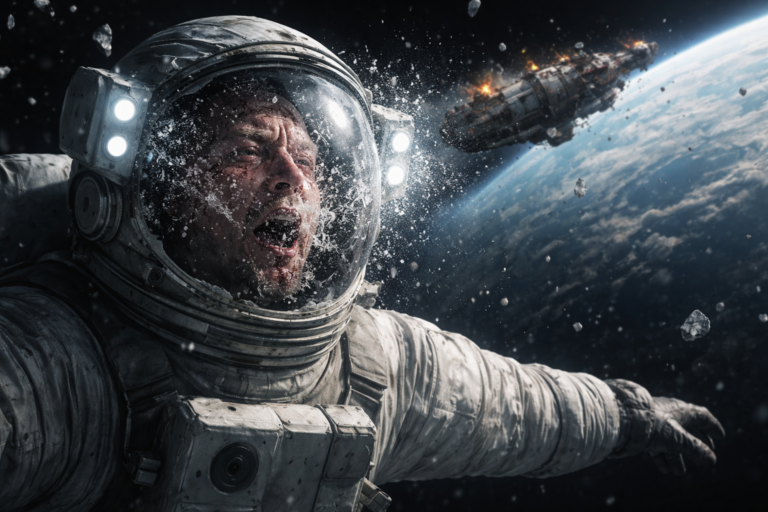
The idea that “you would die in space in 15 seconds” is widely discussed—but is it entirely true? Modern scientific research and real-life experiments reveal a more precise and fascinating reality. While death is not instantaneous, the human body begins to fail within seconds in the harsh vacuum of space.
This article explores the real timeline, biological effects, scientific facts, and future implications of human survival in space without protection.
The 15-Second Rule: What Actually Happens First
The most critical fact is this:
A human exposed to the vacuum of space would lose consciousness within 10 to 15 seconds due to lack of oxygen.
This happens because:
- Oxygen rapidly leaves the bloodstream
- The brain is deprived of oxygen (hypoxia)
- The body cannot sustain consciousness
Even if you try to hold your breath, it would not help—in fact, it could damage your lungs due to rapid pressure changes.
Timeline Of Survival In Space Without A Spacesuit
Below is a scientifically grounded timeline of what happens:
| Time After Exposure | What Happens To The Body |
|---|---|
| 0–5 seconds | Air escapes lungs, pressure drops instantly |
| 10–15 seconds | Loss of consciousness due to oxygen deprivation |
| 15–30 seconds | Body begins swelling (ebullism), confusion sets in |
| 30–60 seconds | Circulation slows, tissues expand, severe damage begins |
| 60–90 seconds | Risk of death increases sharply |
| 90+ seconds | Death becomes highly likely without rescue |
Studies show that although unconsciousness happens quickly, rescue within 60–90 seconds may still be possible in controlled conditions.
Why Space Is So Deadly For Humans
1. Lack Of Oxygen (Hypoxia)
The biggest threat is the absence of breathable air.
Within seconds, the brain shuts down due to oxygen starvation, leading to unconsciousness.
2. Ebullism: Body Fluids Begin To Boil
In space, there is almost no atmospheric pressure. This causes:
- Water in tissues to vaporize
- Skin and body to swell up to twice normal size
- Formation of gas bubbles in blood vessels
This process is known as ebullism and is extremely dangerous.
3. Extreme Temperature Swings
Space is not simply “cold”—it’s unpredictable:
- Sunlight: up to 120°C (248°F)
- Shade: as low as -100°C (-148°F)
However, you would not instantly freeze because heat loss takes time.
4. Radiation Exposure
Without Earth’s atmosphere, the body is exposed to:
- Cosmic radiation
- Solar particles
These can damage DNA and increase long-term cancer risk.
5. Physical Expansion (But No Explosion)
Contrary to movies:
- The body does not explode
- Skin is strong enough to hold internal pressure
Instead, the body swells significantly due to gas expansion.
Can You Survive Brief Exposure To Space?
Surprisingly, yes—for a short time.
Scientific data suggests:
- Humans can survive up to 90 seconds if quickly repressurized
- No permanent damage may occur if exposure is under 30 seconds
A real-life NASA vacuum accident showed a technician losing consciousness after about 12–15 seconds, but recovering after rapid rescue.
Common Myths Vs Reality
| Myth | Reality |
|---|---|
| You explode instantly | You swell but do not explode |
| You freeze immediately | Freezing takes time |
| Death occurs in seconds | Unconsciousness occurs in seconds, death takes longer |
| Holding breath helps | It causes lung rupture |
The Armstrong Limit And Why It Matters
There is a scientific boundary known as the Armstrong Limit:
- Above this altitude, water boils at body temperature
- This makes survival impossible without pressure protection
This explains why spacesuits are essential even before reaching deep space.
Future Space Exploration And Human Safety
With missions planned to the Moon and Mars, scientists are:
- Developing advanced spacesuits with improved pressure systems
- Studying human physiology in extreme environments
- Designing spacecraft with rapid emergency repressurization
Programs focused on long-duration missions aim to reduce risks and improve survival outcomes in case of accidents.
Conclusion
The statement “you would die in space in 15 seconds” is partly true—but scientifically incomplete.
- You would lose consciousness within 10–15 seconds
- Death would follow within 1–2 minutes without rescue
- Short exposure may be survivable if immediate help is available
Space remains one of the most hostile environments for humans, and this reality highlights the importance of technology, preparation, and scientific advancement in ensuring safe space exploration.