
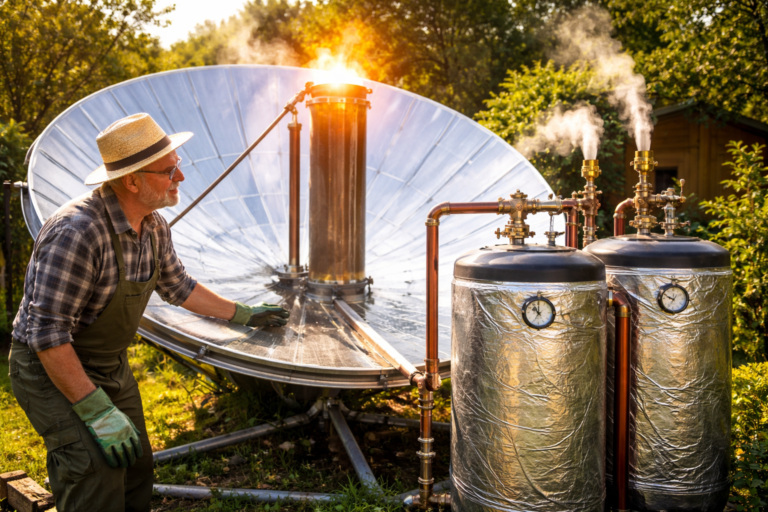
Imagine producing 3,000 liters of hot water every single day without spending a rupee on electricity, oil, or gas. This is no longer a futuristic concept—it is a real, practical innovation based on solar thermal technology that is transforming how households and small industries meet their hot water needs.
Across the world, DIY inventors and sustainable engineers are developing systems that rely entirely on sunlight and passive heat transfer, eliminating dependency on fossil fuels and grid electricity. These systems are not only cost-effective but also environmentally powerful, reducing carbon emissions while ensuring energy independence.
What Is This Zero-Energy Hot Water System?
The system is essentially a solar water heating setup that uses solar thermal collectors to capture sunlight and convert it directly into heat. Unlike solar panels that generate electricity, this technology focuses purely on heating water efficiently.
A well-designed system can heat up to 3,000 liters of water per day, depending on sunlight exposure and system size.
Solar water heating works by allowing sunlight to strike a dark absorber surface, which converts solar radiation into heat. This heat is then transferred to water stored in tanks or flowing through pipes.
How It Works Without Electricity or Fuel
Passive Solar Heating Principle
The key to this innovation is passive design, meaning no pumps, motors, or electrical components are required.
- Sunlight enters a glass-covered collector
- A black absorber plate captures heat
- Water circulates naturally via thermosiphon effect
- Hot water rises and is stored in a tank above the collector
Passive systems rely on natural convection, where hot water automatically moves upward while cooler water sinks—eliminating the need for external energy.
Key Components of the System
1. Solar Thermal Collector
- Flat plate or pipe-based design
- Absorbs solar radiation efficiently
- Can achieve 40–70% efficiency
2. Storage Tank
- Insulated tank to retain heat
- Larger tanks ensure supply even during cloudy conditions
3. Piping System
- Copper or metal pipes for heat transfer
- Durable and corrosion-resistant
4. Glass Cover (Glazing)
- Creates a greenhouse effect
- Traps heat inside the collector
Flat-plate collectors typically include an insulated box, absorber plate, and transparent cover to maximize heat retention.
System Performance and Capacity
Below is a breakdown of how such a system performs:
| Parameter | Details |
|---|---|
| Daily Output | Up to 3,000 liters |
| Energy Source | 100% solar energy |
| Operating Cost | Zero fuel cost |
| Efficiency | 40–70% thermal efficiency |
| Lifespan | 20–30 years |
| CO₂ Reduction | Up to 2.5 tons annually |
| Maintenance | Minimal |
A typical household system uses far less water, but scaling up collector area allows large outputs like 3,000 liters daily.
Why This System Is Revolutionary
1. Complete Energy Independence
This system works entirely off-grid, making it ideal for:
- Rural homes
- Farms
- Remote areas
- Disaster-prone regions
2. Massive Cost Savings
Solar water heaters can reduce water heating costs by 50–80% over time.
3. Environmentally Friendly
- No fossil fuels
- No emissions
- Sustainable long-term solution
4. Works During Power Outages
Because it is passive, the system continues functioning even when electricity is unavailable.
Real-World Applications
This technology is already being used in:
- Homes for bathing and kitchen use
- Hotels and hostels with high hot water demand
- Hospitals for sanitation
- Agriculture for cleaning and processing
- Small industries requiring heated water
Globally, over 200 million households already use solar thermal systems in some form.
Limitations and Challenges
While highly effective, the system has a few considerations:
Weather Dependency
- Output reduces during cloudy or rainy days
Initial Setup Space
- Requires roof or open area with sunlight
Temperature Control
- May need backup heating in colder climates
However, even with these limitations, the long-term benefits outweigh the drawbacks significantly.
Future Of Zero-Energy Heating Systems
The future of this technology is extremely promising. With rising energy costs and climate concerns:
- Governments are encouraging solar thermal adoption
- Hybrid systems are combining solar with backup heating
- Innovations are improving storage and efficiency
Global solar thermal capacity reached 560 GW thermal by 2023, showing rapid adoption worldwide.
In the coming years, systems capable of producing thousands of liters daily could become standard in both residential and commercial settings.
Conclusion
The idea of generating 3,000 liters of hot water daily without electricity, oil, or gas is not just impressive—it is a glimpse into the future of sustainable living. By harnessing the power of the sun through passive solar heating, this innovation eliminates energy bills, reduces environmental impact, and offers unmatched reliability.
As energy prices rise and sustainability becomes a global priority, such systems are no longer optional—they are becoming essential. Investing in solar thermal technology today could mean decades of free, clean, and reliable hot water tomorrow.