
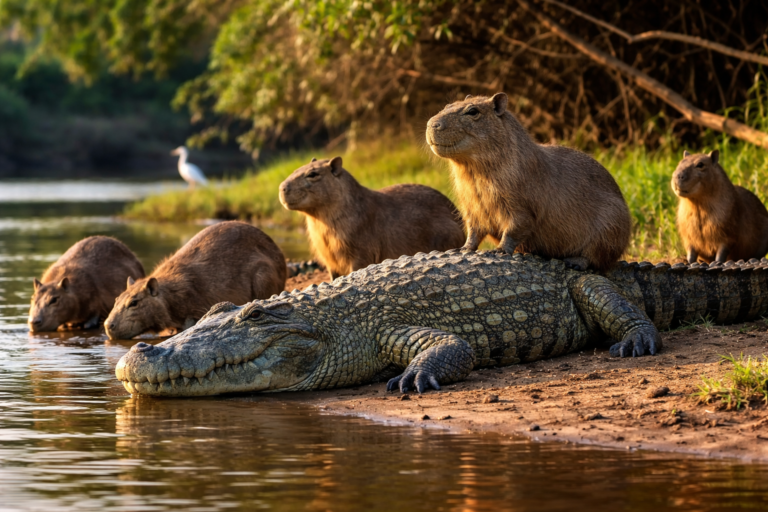
In the wild, where survival depends on hunting and avoiding being hunted, the relationship between crocodiles and capybaras stands out as one of the most fascinating mysteries. Videos often show these massive reptiles resting peacefully beside the world’s largest rodent. This raises an intriguing question: why do crocodiles not eat capybaras?
The truth is far more complex than simple “friendship.” It involves evolutionary behavior, risk assessment, ecological balance, and survival strategies. While crocodiles can eat capybaras, they usually choose not to—and here’s why.
Understanding Capybaras And Crocodiles
What Is A Capybara?
- The largest rodent in the world
- Native to South American wetlands
- Average weight: 35–65 kg
- Lives in groups of 10–100 individuals
What Is A Crocodile (Or Caiman)?
- An apex predator in aquatic ecosystems
- Feeds on fish, birds, and mammals
- Uses ambush hunting techniques
Despite being natural predators, crocodiles often ignore capybaras in shared habitats.
Key Reasons Crocodiles Rarely Eat Capybaras
1. Risk vs Reward Calculation
Crocodiles are strategic hunters, not reckless attackers. They prefer prey that offers maximum energy with minimal effort.
- Capybaras are large and strong
- They have sharp teeth capable of injury
- Attacking them carries risk of damage
Instead, crocodiles often choose:
- Fish
- Birds
- Smaller mammals
Because these are easier and safer to capture
2. Capybaras Are Highly Social And Alert
Capybaras live in large, organized groups, which gives them a huge survival advantage.
- Group sizes can reach 100 individuals
- They use alarm calls and vigilance
- Multiple eyes detect danger quickly
This “safety in numbers” effect makes ambush attacks difficult.
3. Excellent Escape Abilities
Capybaras are semi-aquatic animals, perfectly adapted to water.
- Can dive quickly to escape predators
- Strong swimmers
- Stay underwater for several minutes
When threatened, they instantly retreat into water, making it hard for crocodiles to strike successfully
4. Abundance Of Easier Prey
In wetland ecosystems, crocodiles have plenty of food options:
- Fish (low effort)
- Birds and eggs
- Amphibians
- Smaller mammals
Since food is readily available, crocodiles avoid high-risk prey like adult capybaras
5. Behavioral Adaptation And Coexistence
Over time, both species have developed mutual tolerance.
- Capybaras can assess when a crocodile is not a threat
- Crocodiles recognize capybaras as low-priority prey
This creates a “cold truce” rather than friendship
6. Energy Efficiency Matters
Crocodiles are energy-conserving predators.
- They may feed only occasionally
- Every attack must be worth the effort
A failed attempt wastes valuable energy, so they avoid:
- Fast-moving prey
- Alert prey
- Group-protected animals
7. Ecosystem Balance
The relationship contributes to wetland ecosystem stability.
- Capybaras control vegetation through grazing
- Crocodiles regulate smaller animal populations
This balance reduces unnecessary conflict between the two species
When Do Crocodiles Actually Eat Capybaras?
Although rare, predation does occur in certain situations:
- Young or weak capybaras
- Isolated individuals
- During drought or food scarcity
This shows that the relationship is situational, not absolute.
Quick Facts Table
| Factor | Capybara Advantage | Impact On Crocodile Behavior |
|---|---|---|
| Size | Large body (35–65 kg) | Higher risk of injury |
| Social Structure | Groups up to 100 | Harder to ambush |
| Speed & Escape | Fast swimmers | Reduced hunting success |
| Awareness | Constant vigilance | Low surprise factor |
| Habitat | Semi-aquatic | Easy escape routes |
| Food Availability | Not relevant | Crocodiles choose easier prey |
| Ecosystem Balance | Maintains vegetation | Reduces conflict |
Scientific Perspective: Not Friendship, But Strategy
Despite viral videos suggesting a peaceful friendship, scientists describe this interaction as:
- A strategic coexistence
- A balance of risk vs reward
- A behavioral adaptation over time
Even instances of capybaras sitting on crocodiles are likely due to:
- Confidence in safety
- Lack of immediate threat
- Shared environmental conditions
Future Research And Insights
Modern wildlife research continues to explore:
- Animal intelligence and risk assessment
- Non-aggressive coexistence between species
- Ecosystem-driven behavioral evolut
Conclusion
The idea that crocodiles and capybaras are “friends” is a fascinating but simplified interpretation of a much deeper ecological reality. In truth, their relationship is shaped by evolution, survival instincts, and environmental balance. Capybaras avoid becoming prey through group living, vigilance, and quick escape abilities, while crocodiles choose their targets wisely, favoring easier and safer meals.
This remarkable coexistence highlights how nature operates through efficiency and adaptation rather than constant conflict. As research continues, this unusual interaction may offer valuable insights into animal intelligence, ecosystem harmony, and the subtle strategies that govern life in the wild.