
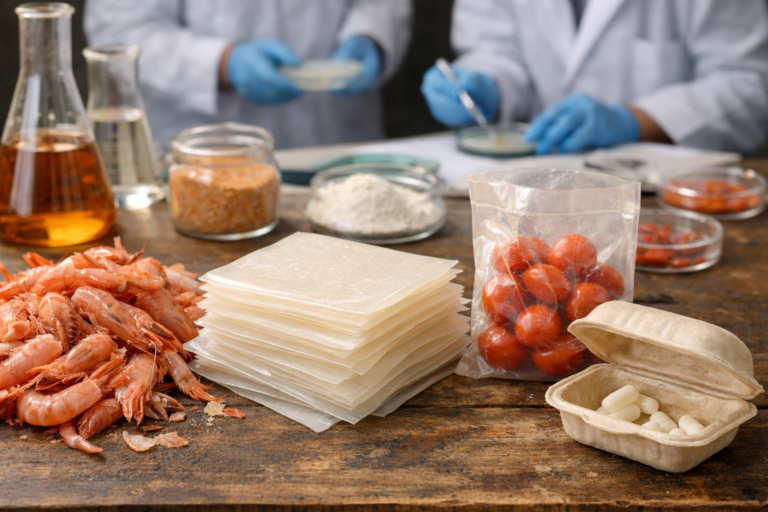
A remarkable scientific development from Spain is drawing global attention in the fight against plastic pollution. Researchers have successfully developed a biodegradable plastic alternative derived from prawn shells, marking a significant milestone in sustainable materials science. This innovation transforms seafood waste into an eco-friendly polymer capable of replacing conventional plastics in multiple industries.
Traditional plastics are largely derived from petroleum and can persist in the environment for hundreds of years, contributing heavily to global pollution. In contrast, the newly developed material is made from natural compounds found in prawn shells, offering a sustainable and biodegradable solution.
The breakthrough demonstrates how marine waste can be transformed into high-value materials that help reduce plastic dependency and environmental damage.
The Global Plastic Pollution Crisis
Plastic pollution has become one of the most pressing environmental problems worldwide. Millions of tons of plastic waste enter oceans each year, harming marine ecosystems and wildlife.
Traditional plastics are designed for durability, but that same durability means they remain in nature for decades or centuries. When plastics degrade, they often break into microplastics, tiny particles that contaminate soil, water, and even the food chain.
Scientists have been searching for biodegradable alternatives that can match plastic’s performance while minimizing environmental harm. The Spanish research provides a promising solution by converting prawn shell waste into a high-performance bioplastic.
How Prawn Shells Are Turned Into Plastic
The key ingredient in this innovation is chitin, a natural polymer found in the shells of crustaceans such as prawns, shrimp, and crabs.
Chitin is the second most abundant natural polymer on Earth, produced in enormous quantities by marine organisms and insects.
Scientists extract chitin from prawn shells and chemically process it into chitosan, a closely related compound that can be molded into films, coatings, and other plastic-like materials.
The Process
- Collection of prawn shell waste from seafood processing facilities
- Extraction of chitin, the structural polymer within the shells
- Chemical conversion to chitosan through a deacetylation process
- Blending with natural additives or plasticizers for flexibility
- Formation of films, coatings, or molded materials
This process produces a material that behaves similarly to conventional plastics but remains biodegradable and environmentally friendly.
Key Properties Of The Prawn Shell Bioplastic
Researchers discovered that the chitosan-based material can mimic many characteristics of petroleum-based plastics.
Important Characteristics
- Flexible and transparent
- Strong and durable
- Biodegradable
- Non-toxic
- Odorless after processing
Even though it originates from seafood shells, the final product does not smell like seafood because proteins and residues are removed during processing.
Additionally, the material breaks down naturally into water, carbon dioxide, and organic matter under suitable environmental conditions instead of creating persistent microplastics.
Why Prawn Shells Are Ideal For Sustainable Plastic
One of the biggest challenges with many bioplastics is that they rely on crops such as corn or sugarcane, which require agricultural land, water, and energy.
Prawn-shell bioplastics offer a major advantage because they use existing food waste instead of agricultural resources.
Environmental Advantages
- Uses seafood industry waste
- Reduces landfill disposal of shell waste
- Avoids competition with food production
- Biodegrades naturally in soil and marine environments
Researchers also highlight that marine microorganisms can easily recognize and break down this material, making it safer if it enters the ocean ecosystem.
Potential Applications Across Industries
The prawn-shell plastic alternative could transform multiple industries that rely heavily on traditional plastics.
Possible Applications
| Industry | Potential Uses |
|---|---|
| Packaging | Food wraps, biodegradable bags, containers |
| Agriculture | Mulch films and seed coatings |
| Medicine | Wound dressings, surgical materials |
| Textiles | Biodegradable fibers |
| Water Treatment | Filtration membranes |
Chitosan itself already has applications in water purification, medicine, and biotechnology, showing the versatility of this natural polymer.
If production becomes scalable, prawn-shell plastics could significantly reduce the global dependence on petroleum-based plastics.
Engineering A Plastic-Like Material
Scientists faced several challenges when transforming shell polymers into usable materials.
Chitin naturally forms rigid structures, so researchers needed to adjust its properties. By adding plasticizers such as glycerol and natural additives, they were able to create flexible films that resemble everyday plastic packaging.
These films can be transparent, grease-resistant, and mechanically strong—qualities essential for real-world use.
The balance between strength and biodegradability is critical. If the material becomes too durable, it may lose its environmental advantages.
Why This Breakthrough Matters
The significance of this research extends beyond a single new material.
Global plastic production exceeds hundreds of millions of tons each year, and most plastics are not biodegradable. Innovations like prawn-shell bioplastics could help shift the global materials economy toward circular and sustainable systems.
Key impacts include:
- Reducing plastic pollution
- Transforming seafood waste into valuable materials
- Supporting a circular economy
- Decreasing reliance on fossil fuels
By turning discarded prawn shells into useful materials, researchers demonstrate how biological resources can help solve modern environmental challenges.
Future Prospects And Challenges
While the discovery is promising, several hurdles remain before widespread adoption.
Challenges
- Scaling production to industrial levels
- Ensuring cost competitiveness with petroleum plastics
- Improving mechanical performance for demanding uses
- Developing infrastructure for biodegradable materials
However, researchers remain optimistic that continued innovation and investment will accelerate commercialization.
In the future, packaging, disposable products, and even durable goods could be made from marine-derived bioplastics rather than fossil fuels.
Conclusion
The creation of a plastic alternative from prawn shells represents a major scientific breakthrough in sustainable materials. By extracting natural polymers like chitin and converting them into chitosan-based bioplastics, Spanish researchers have demonstrated how seafood waste can become a valuable resource.
This innovation offers a promising path toward reducing plastic pollution, promoting circular economies, and protecting marine ecosystems. While further research and industrial scaling are needed, prawn-shell bioplastics could play a crucial role in the global transition toward environmentally responsible materials.
If successfully commercialized, this technology could reshape industries and help the world move closer to a plastic-free future.