
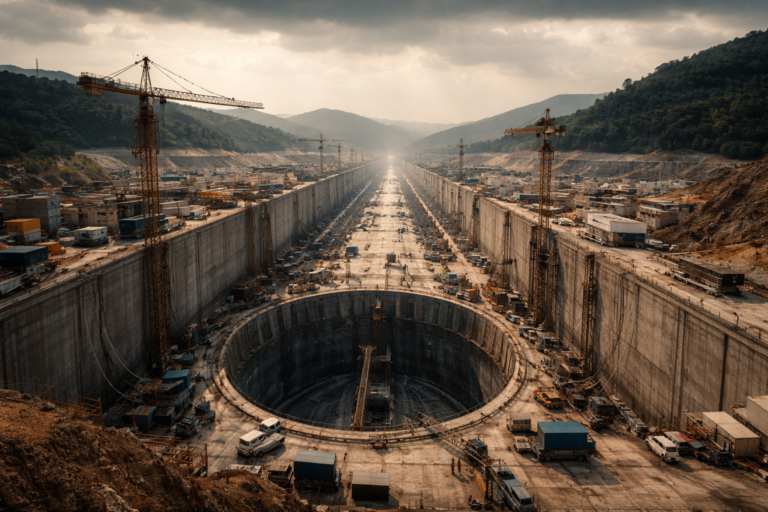
China’s plan to outpace Europe and build the world’s largest particle accelerator has hit a major snag. Too costly even for China: the nation pauses its ambitious race with Europe to construct the world’s largest particle accelerator — a move that reflects economic reality, shifting scientific priorities, and the complex geopolitics of big science.
What was on the drawing board
China had proposed a multi-decade program to construct a next-generation collider capable of probing fundamental particles at unprecedented energies. The project envisioned two main phases:
- A circular electron-positron collider to succeed experiments at CERN’s Large Hadron Collider (LHC) and explore precision Higgs physics.
- A future upgrade to a proton-proton collider in the same tunnel to push energy frontiers far beyond current limits.
If completed, the facility would have become the largest and most ambitious accelerator in the world, drawing international attention and talent.
Why the project was paused
Several clear factors combined to halt momentum. None of them is a single smoking gun; together they made the project politically and financially unpalatable for now.
Financial burdens
- Cost estimates for cutting-edge colliders run into the tens of billions of dollars, and depending on design choices and timescales, could scale even higher.
- With China facing slower economic growth and mounting domestic spending priorities, committing such a large, long-term budget became harder to justify.
Competing national priorities
- China is investing heavily in areas seen as immediate drivers of economic and strategic advantage: semiconductors, artificial intelligence, green energy, and infrastructure.
- These sectors offer nearer-term returns and clearer industrial benefits compared with the long, uncertain payoff of particle physics.
Scientific and technical challenges
- Building and operating a collider of unprecedented scale requires breakthroughs in superconducting magnets, power systems, and cryogenics — all expensive and risky.
- The global community is also debating the best path forward for particle physics: bigger colliders, precision machines, or diversified investments in complementary experiments.
Geopolitical and collaborative realities
- Big science is increasingly international. China’s leadership likely weighed the diplomatic and cooperation challenges of pursuing a solo mega-project versus partnering with established institutions like CERN.
- The pause creates space for diplomacy, joint planning, and shared funding models that could lower barriers for any future effort.
What this means for global particle physics
The pause doesn’t kill ambition — it reshapes it. Several immediate implications are worth noting:
- Europe’s own plans remain under scrutiny: proposals like a circular collider around CERN face similar cost and political hurdles.
- Short- and mid-term research will focus on maximizing science from existing facilities (LHC upgrades, neutrino experiments, precision measurements).
- Talent and funding may flow toward smaller-scale but high-impact projects, interdisciplinary research, or technologies with broader industrial applications.
Alternatives and opportunities
Rather than a single, massive collider, the field may diversify in ways that deliver strong science with lower upfront costs:
- International, modular projects that split cost and risk across countries.
- Investments in detector R&D, accelerator technology, and computing that benefit many experiments.
- Emphasis on complementary experiments — neutrino physics, dark matter searches, and precision atomic measurements — that can probe fundamental questions without a collider’s price tag.
For China specifically, the pause can be reframed as strategic recalibration: retaining the scientific vision while waiting for a more favorable fiscal and diplomatic environment.
Conclusion
Too costly even for China: the nation pauses its ambitious race with Europe to construct the world’s largest particle accelerator. That headline captures more than a budgetary decision; it marks a turning point in how the global scientific community will approach big, expensive dreams. The path forward is likely to be more collaborative, modular, and pragmatic — balancing awe-inspiring ambitions with fiscal realism and broader societal priorities. In the end, fundamental physics will continue to advance, but perhaps through a more distributed and diversified set of investments than the single mega-project model of the past.