
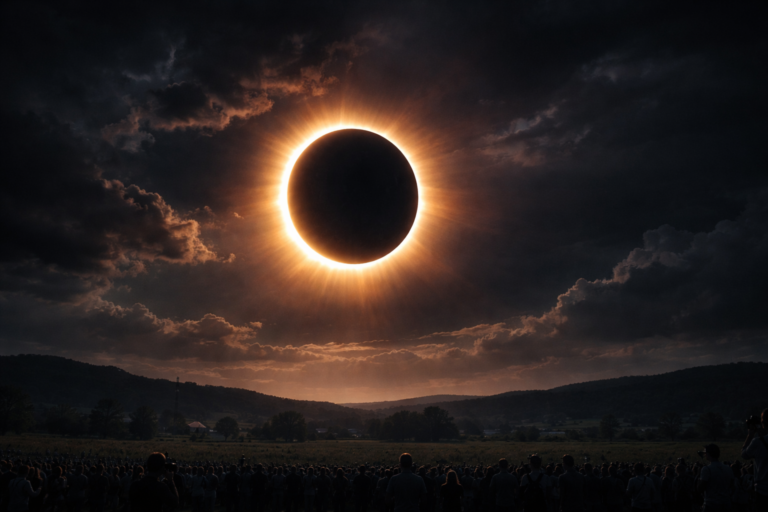
Imagine the sky dimming, birds falling silent, and a cool hush settling over the landscape. For a handful of lucky observers, that moment will last almost six minutes — long enough to feel like an otherworldly pause in time. The longest eclipse of the century is set to briefly turn day into night, and now is the time to prepare if you want to witness totality.
What makes this eclipse special?
A total solar eclipse occurs when the Moon moves directly between the Earth and the Sun, casting its darkest shadow — the umbra — across a narrow strip of Earth’s surface. During totality, the Moon completely blocks the Sun’s bright disk, revealing the faint solar corona and producing dramatic effects: the sky goes dark, temperature drops, and the horizon glows like a 360-degree sunset.
What sets this eclipse apart is its unusually long duration of totality — nearly six minutes at the centerline. Most total eclipses offer only a minute or two of full darkness, so nearly six minutes gives observers a rare stretch of uninterrupted celestial spectacle: more time to watch the corona evolve, better opportunities for photographs, and a deeper sense of the event’s grandeur.
Where and when to see it
Totality is only visible within a narrow “path of totality” that sweeps across specific regions. Observers outside that path will see a partial eclipse, where the Moon covers only part of the Sun, and daylight will never fully fade. If you want the full experience, you need to be geographically inside the path.
Because weather can make or break eclipse viewing, many eclipse-chasers plan travel well in advance and choose observing sites with historically clear skies. Expect roads, accommodations, and viewing areas to fill quickly as the event approaches.
What to expect during totality
- A rapid and noticeable drop in light and temperature.
- A 360-degree twilight along the horizon.
- The Sun’s corona: a pearly halo of plasma extending millions of kilometers.
- Transient features like Baily’s beads and the diamond ring effect at the start and end of totality.
- Unusual behavior from wildlife — birds may roost, insects can quiet, and nocturnal animals might stir.
The emotional impact can be profound. People often describe totality as eerie, beautiful, and humbling — a reminder of our place in the cosmos.
Safety first: how to view the eclipse
Never look directly at the Sun without proper protection except during the brief period of totality when the Sun is completely blocked. Permanent eye damage can occur from even a few seconds of direct viewing.
Essential safety tips:
- Use ISO-certified solar viewing glasses (ISO 12312-2) whenever any portion of the Sun is visible.
- Use solar filters on cameras, binoculars, and telescopes. Do not rely on eclipse glasses alone for magnified optics.
- Remove filters only during totality and replace them immediately once the bright Sun begins to reappear.
- If you can’t get glasses, create a pinhole projector to safely project the Sun’s image onto a surface.
Photography and viewing tips
If you plan to photograph the eclipse, practice ahead of time and prepare for changing light conditions. Key suggestions:
- Bring a sturdy tripod and a remote shutter or intervalometer.
- Use a solar filter for all images taken before and after totality.
- During totality, remove the filter to capture the corona; bracket exposures to capture the high dynamic range.
- Consider wide-angle shots for landscape-plus-corona images, and longer focal lengths for close-ups of the Sun.
- Bring binoculars with solar filters for a closer look (but never look through unfiltered optics).
Plan ahead: logistics and packing list
- Book travel and lodging as early as possible.
- Check long-term cloud cover statistics for potential observing sites.
- Pack eclipse glasses for everyone in your group.
- Bring layers of clothing for temperature swings, sunscreen, water, snacks, and a comfortable chair.
- Have a backup viewing location in case weather forces a last-minute move.
Why it’s worth it
Total solar eclipses are fleeting, awe-inspiring, and rare for any given location. For those inside the path of totality, nearly six minutes of darkness is an unusually generous window to watch cosmic mechanics unfold. Whether you’re a seasoned eclipse-chaser or a first-time observer, the sensory and emotional experience is unforgettable — a brief moment when the ordinary rules of daytime give way to a spectacular celestial performance.
Prepare early, stay safe, and don’t miss your chance to be part of one of this century’s most remarkable astronomical events.