
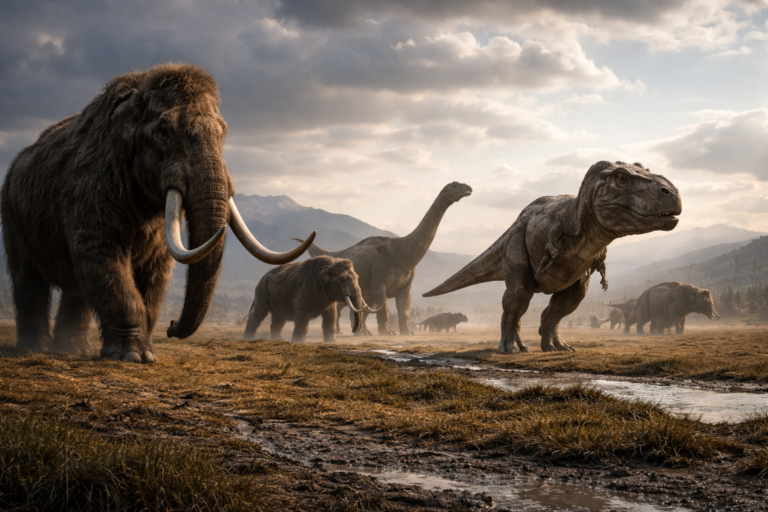
Recent work from teams in Spain is reshaping how we imagine the movement of Earth’s largest land animals. Long romanticized as thunderous sprinters or nimble charging beasts, giant mammals like mammoths and many dinosaurs may actually have been considerably slower than popular reconstructions suggest. Using a combination of biomechanical modeling, fossil trackway analysis, and modern comparative anatomy, these studies challenge long-held beliefs about speed and mobility in prehistoric megafauna.
How scientists measure prehistoric speed
We can’t time a sprint from 10,000 years ago, but researchers use several indirect methods to estimate how fast extinct animals could move:
- Biomechanical models: Computer simulations reconstruct muscle forces, joint ranges, and whole-body dynamics based on bone shape and estimated soft tissues.
- Trackways: Fossilized footprints preserve stride length and pace, offering direct clues about gait and average speed.
- Bone microstructure and scaling laws: The size and structure of limb bones indicate how much stress they could handle. Allometric scaling shows muscle power doesn’t increase as fast as animal mass.
- Comparisons with living animals: Modern elephants, rhinos, and large birds provide real-world data that serve as analogues for extinct giants.
Spanish teams have combined these approaches, building detailed 3D reconstructions from museum specimens and field discoveries. By validating models against living analogues, they increase confidence in estimates for extinct species.
Why big usually means slower
Intuition might suggest bigger animals have longer strides and therefore should be faster. But physics and biology place strict limits:
- Square-cube constraint: Mass increases faster than muscle cross-sectional area, so relative muscle power declines with size.
- Bone stress limits: Skeletons must avoid forces that would fracture them; high speeds dramatically increase impact forces.
- Energetic cost: Running requires more energy per kilogram in larger bodies, making sustained high speeds costly or impractical.
- Limb posture and joint range: Many giant animals evolved columnar limbs to support weight, which reduces agility and maximal stride frequency.
Spanish researchers’ models often show that while giant animals could achieve moderate speeds suitable for migration or short bursts, top-end sprinting like that depicted in movies was unlikely for the largest species.
Key findings and surprises
Some of the notable conclusions emerging from this work include:
- Mammoths and other Pleistocene megafauna likely had top speeds comparable to or lower than modern elephants, constrained by similar biomechanical limits.
- Some large theropod dinosaurs previously shown as fast predators are more plausibly modeled as capable of steady pursuit or ambush, rather than high-speed chases.
- Fossil trackways interpreted as evidence of rapid galloping sometimes reflect substrate effects or post-depositional distortion; when corrected, stride lengths imply slower gaits.
- Muscle reconstruction and tendon elasticity analyses indicate limited capacity for sustained high-frequency limb motion in the largest species.
These results don’t imply that extinct giants were lethargic. Instead, many appear optimized for energy-efficient travel, stability, and load-bearing rather than explosive speed.
Ecological and cultural implications
Rethinking how fast mammoths and dinosaurs moved changes more than just our mental pictures:
- Predator–prey dynamics: Slower prey and predators shift reconstructions of hunting strategies toward ambush, pack tactics, or scavenging.
- Habitat use and migration: Energy-efficient gaits support long-distance migration hypotheses, altering views on seasonal movements and population distribution.
- Paleontological displays and media: Museums, documentaries, and paleoartists may need to update reconstructions to reflect more realistic postures and movement speeds.
- Conservation lessons: Understanding constraints on large-bodied animals helps when analogizing to modern megafauna and planning for their protection.
Where research goes next
The Spanish studies highlight the value of interdisciplinary approaches. Future work is likely to:
- Integrate more soft-tissue data from exceptionally preserved fossils.
- Use high-resolution finite element analysis to refine bone stress estimates.
- Expand comparative datasets from large living animals across different terrains.
- Reanalyze fossil trackways with improved sedimentological context.
Conclusion
Spanish researchers challenge long-held beliefs, showing mammoths and dinosaurs were likely slower than we once thought, and their work nudges both science and popular culture toward more nuanced reconstructions. These giants were products of evolutionary trade-offs: built for endurance, stability, and sheer power rather than for the blistering speeds often imagined. As methods improve, our picture of the ancient past will continue to shift — not toward dullness, but toward a richer understanding of how form, function, and environment shaped the lives of Earth’s largest land animals.