
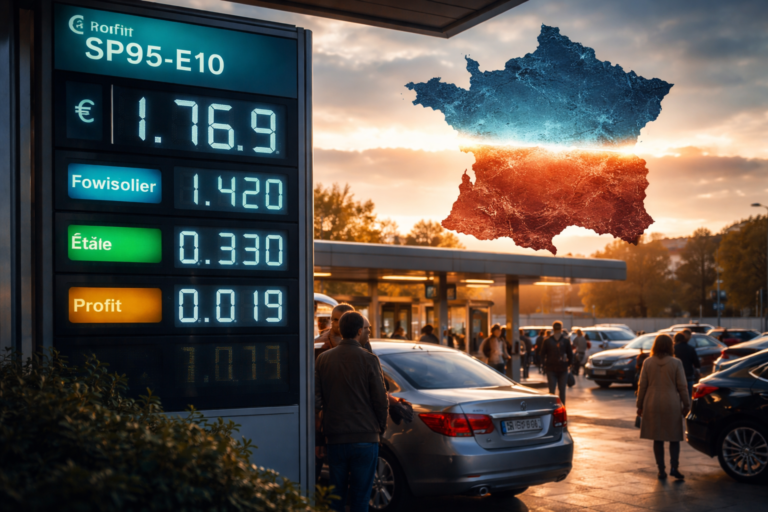
From February 12, a new transparency rule will force gas stations to show how much profit they make on each liter sold. The announcement has reignited a heated debate across France: is this a genuine victory for consumers, or a political stunt that masks the real drivers of price rises?
What exactly is changing?
Under the new measure, fuel retailers must display — alongside the pump price — the margin they earn per liter. This aims to separate the tax component, wholesale cost, and retailer markup so drivers can see where their money goes.
The idea is simple: more information should translate into more accountability. But the simplicity of the reform hides a more complex reality. Margins fluctuate, contracts vary, and “profit” can be defined in different ways.
Why many call it good news
Transparency supporters list several potential benefits:
- Empowered consumers: Seeing a breakdown can help motorists understand price swings and choose stations that apply the smallest markup.
- Political pressure: Publicly visible margins can push retailers to tighten markups, especially when headlines highlight outliers.
- Informed debate: Clearer data could refocus discussions from vague accusations to concrete figures about taxes, refinery costs, and distribution.
- Support for competition: Independent stations and cooperatives may use transparent margins to distinguish themselves from vertically integrated oil companies.
Consumer associations and some local politicians welcomed the measure, arguing it shifts power back toward buyers. In rural areas where fuel is a necessity, any tool that encourages fairer pricing is seen as a win.
Why others call it a deceptive maneuver
Critics warn the rule could be more about optics than outcomes. Key objections include:
- Accounting gymnastics: Retailers can display gross margins while excluding overheads (rent, staff, maintenance), making “profit per liter” look artificially high or low depending on the message they want to send.
- Wholesale price volatility: Fuel wholesalers set prices frequently. A snapshot margin at the pump doesn’t capture time-lag effects between purchases and sales, potentially misleading consumers.
- Shift to other revenues: Stations may compensate by raising prices in the convenience store, service charges, or by charging for services previously free.
- Political scapegoating: Blaming local stations diverts attention from upstream factors — international oil prices, refinery margins, and state fuel taxes — that have a bigger influence on pump prices.
Some industry groups argue the measure creates administrative burdens and could harm smaller stations forced to reveal commercially sensitive information.
How France is divided
The reaction maps onto familiar political and social lines. Consumer activists, left-leaning local leaders, and parts of the media celebrate transparency as a corrective tool. On the other hand, business associations, some right-leaning politicians, and parts of the retail sector see it as an unnecessary intervention that politicizes everyday commerce.
Geographically, the debate also splits urban and rural perspectives. Urban consumers have more station choices and can shop for the best margin; rural drivers fear that greater scrutiny could push marginal stations to close if forced into price wars.
What to watch next
If you want to follow the real impact, keep an eye on:
- Data consistency: Are margins presented uniformly, or do stations use different definitions?
- Price behavior: Do pump prices actually fall where margins are exposed, or do retailers shift costs elsewhere?
- Market response: Will independent stations use this as a competitive advantage, or will major groups roll out national strategies to neutralize the effect?
- Legal challenges: Watch for industry pushback claiming the requirement breaches commercial confidentiality or competition law.
Practical tips for drivers
- Compare total costs, not just margins. A low-margin station might still sell at a higher total price because of higher wholesale costs or location premiums.
- Use apps and price comparison sites that aggregate pump prices; margin displays are useful, but they’re one piece of the puzzle.
- Support community stations if transparency helps them compete fairly; in some areas, cooperative stations are the most resilient option.
Conclusion
The February 12 requirement for gas stations to reveal the real profit on each liter at the pump is a classic transparency reform: promising in theory, complicated in practice. It can help expose unfair practices and inform consumers, but it risks becoming a symbolic gesture unless accompanied by standardized reporting, consumer education, and attention to upstream price drivers. France’s division reflects these trade-offs — many hope for genuine gains, while skeptics fear a clever maneuver that won’t solve the deeper causes of expensive fuel.