
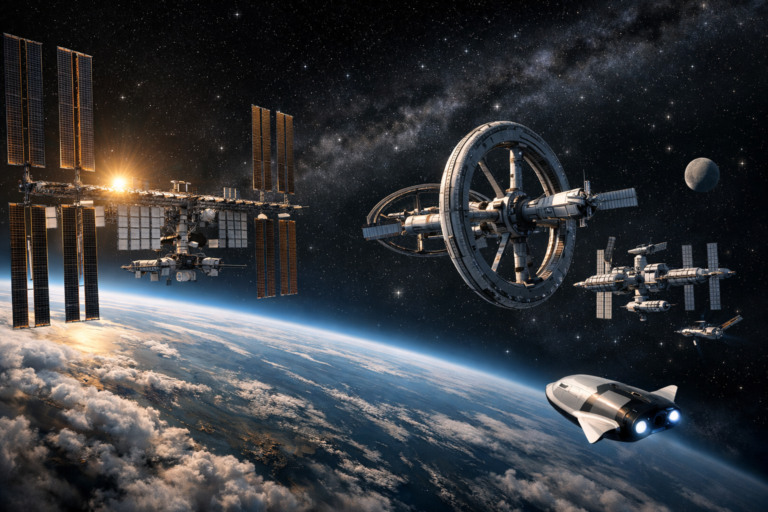
The era of continuous human presence in low Earth orbit that began with the International Space Station (ISS) is entering a planned transition. NASA will say goodbye to the International Space Station in 2030 and welcome commercial space stations as the lead platforms for research, industry, and human spaceflight in low Earth orbit. This shift reflects decades of scientific achievement and a new strategy to grow a vibrant, private-sector-led space economy.
Why the transition is happening
The ISS has been an engineering and diplomatic triumph, hosting experiments, astronauts, and international cooperation since the late 1990s. But the station is aging. Maintaining and operating a multi-modular, decades-old orbital complex is increasingly costly and technically challenging. NASA’s decision to retire the ISS by 2030 rests on several factors:
- Structural aging and increasing maintenance demands
- High operational costs borne largely by governments
- A strategic move to stimulate private investment in low Earth orbit
- The emergence of private companies ready to offer commercial platforms
By transitioning responsibilities to commercial providers, NASA aims to free resources for deep-space exploration while ensuring continued access to orbital research.
What comes next: commercial space stations
Commercial space stations will take on roles long held by the ISS: scientific research, life sciences, technology demonstration, manufacturing, and astronaut training. Private companies are designing modular habitats and platforms that can be tailored to diverse customers — universities, biotech firms, manufacturers, and space tourism operators.
Key expected features of commercial stations:
- Scalable, modular designs that can be expanded or reconfigured
- Focused research facilities for microgravity experiments
- Private astronaut accommodations and hospitality for visitors
- Business-friendly models that sell time, services, and payload capacity
NASA plans to be a major customer for these commercial stations rather than the sole operator. That market approach intends to encourage cost-sharing, innovation, and a competitive ecosystem.
Benefits for science, industry, and the public
Shifting to commercial stations offers several advantages:
- Greater access: More institutions and companies could afford orbital research through service contracts and ride-share opportunities.
- Faster innovation: Private-sector design cycles and competition can accelerate new capabilities and reduce costs.
- Economic growth: A commercial low Earth orbit economy could create new industries and jobs on Earth.
- Mission focus: NASA can redirect funding toward Artemis missions, lunar bases, and Mars preparation while still conducting essential microgravity research through partners.
For researchers, this model could mean more flexible experiment schedules and specialized lab environments. For entrepreneurs, it opens opportunities in manufacturing, materials research, and space-based services.
International and safety considerations
The ISS has been a symbol of international cooperation; transitioning away from it will require careful coordination. NASA will work with partners and private companies to manage asset transfers, crew rotations, and ongoing collaborative research. Safety and regulatory frameworks will also need to evolve:
- International agreements to manage partnership roles and data sharing
- Updated standards for crew health, emergency response, and orbital traffic
- Environmental and debris-mitigation policies for station operations and deorbiting
A carefully managed transition aims to preserve scientific continuity while addressing geopolitical and technical challenges.
The final chapter: deorbiting and legacy
When NASA will say goodbye to the International Space Station in 2030 and welcome commercial space stations, the retirement of the ISS will be conducted as a controlled deorbit. Engine burns will target a remote ocean area to minimize risk from reentry debris. Before that final maneuver, there will be an orderly transfer or conclusion of experiments, relocation of hardware where feasible, and documentation of decades of research.
The ISS legacy will endure in many forms: scientific results, trained astronauts, technological developments spun out to Earth industries, and a blueprint for international and commercial cooperation in space.
Looking forward
The planned transition marks both an end and a beginning. NASA will say goodbye to the International Space Station in 2030 and welcome commercial space stations — but human presence in low Earth orbit will continue, transformed by commercial innovation. If executed well, this shift can broaden access to space, accelerate scientific discovery, and build a sustainable economy above our planet while NASA pursues bold exploration farther afield.