
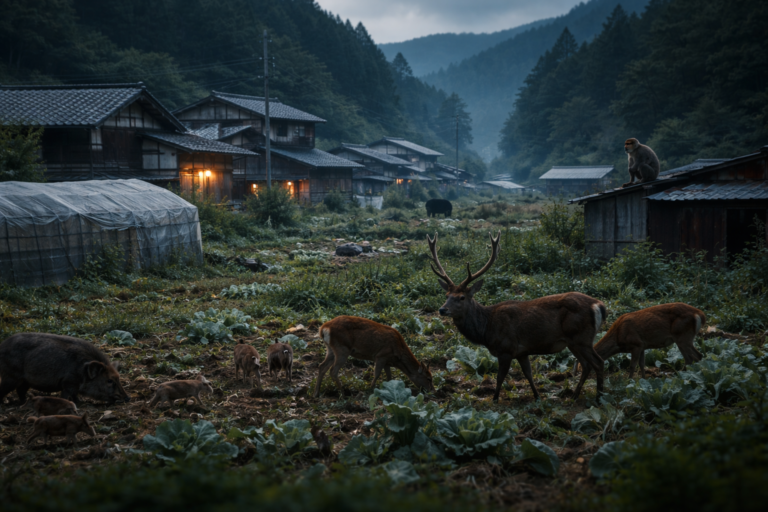
Many people assume that fewer people means more space for nature, and therefore a simple rebound for wildlife. But the experience of rural Japan over the last few decades shows that a declining human population is not an automatic recipe for biodiversity recovery. The story there highlights how conservation success often depends on active stewardship, not just absence.
The myth of automatic recovery
It’s tempting to picture abandoned villages returning to pristine forest and wildlife flourishing unchecked. In some respects that happens: fields are reclaimed by shrubs and trees, and forest cover can expand. Yet this “rewilding” is often incomplete and sometimes harmful to biodiversity.
Why? Because many species depend on the mosaic of habitats created by traditional human activities—rice paddies, managed woodlands, irrigation ponds, coppiced forests and hedgerows. Remove the people who maintain those features and you remove the habitats many plants and animals rely on.
What happened in rural Japan
Japan offers clear, well-documented examples. Postwar rural depopulation, an aging agricultural population, and urban migration left many landscapes unattended. The consequences include:
- Abandoned rice paddies and irrigation networks falling into disrepair, reducing wetland habitats for amphibians, pond insects and waterbirds.
- Satoyama (traditional semi-natural woodlands shaped by low-intensity farming and coppicing) reverting to closed-canopy forest. While tree cover increases, understory plants and sun-loving species decline.
- Populations of sika deer and wild boar exploding where hunting and farming declined, causing forest understory loss, reduced regeneration of native trees and increased crop damage near remaining villages.
- Growing human–wildlife conflict as bears and boar expand into former farmland and settlements.
- Loss of cultural aquatic habitats—ponds and irrigation channels—depriving fish, frogs and aquatic invertebrates of breeding sites.
- Occasional spread of invasive species in abandoned fields and roadside verges, altering community composition.
A notable counterpoint is the crested ibis (Toki). Its recovery required hands-on conservation: habitat restoration, active rice-field management tailored to the species, and captive-breeding releases. That success was achieved because people intervened—showing that wildlife often benefits from purposeful human action, not simply from human absence.
Why some species decline despite more “wild” land
Several ecological and social mechanisms explain why fewer people doesn’t mean healthier ecosystems:
- Loss of habitat heterogeneity: Traditional agriculture produced a patchwork of habitat types. Abandonment tends to homogenize landscapes into uniform forests or shrublands.
- Disruption of disturbance regimes: Many species evolved with regular disturbances—mowing, grazing, coppicing—that maintain open habitats. Without them, specialists decline.
- Trophic imbalances: Reduced hunting and changes in predator populations can lead to herbivore overabundance (deer, boar), which in turn suppresses plant and insect diversity.
- Fragmentation and isolation: Small pockets of remaining habitat can become isolated as surrounding lands change, preventing recolonization.
- Decline of cultural practices: Techniques like rotational burning, pond cleaning, and hedge trimming are forms of ecological management; their loss is ecological loss.
- Socioeconomic feedbacks: Aging populations have less labor to maintain habitats, and economic incentives for conservation are often weak.
Practical lessons for conservation policy
Rural Japan’s experience points to actionable strategies that acknowledge the role of people in maintaining biodiversity:
- Recognize cultural landscapes: Protect and manage satoyama and other semi-natural systems as conservation priorities, not as relics to be abandoned.
- Support active stewardship: Create incentives—payments for ecosystem services, agri-environment schemes, subsidies for traditional practices—that keep habitats in favorable condition.
- Combine rewilding with management: Allow natural processes to operate where appropriate, but plan active interventions (controlled grazing, coppicing, pond restoration) where species depend on them.
- Promote community-based conservation: Empower local residents, elder farmers and cooperatives to steward landscapes, blending traditional knowledge with modern ecology.
- Monitor and adapt: Track species and ecological processes to adjust management; prevent runaway herbivore populations and invasive species spread before crises emerge.
- Integrate human well-being: Align conservation with livelihoods by supporting eco-tourism, specialty agriculture (e.g., wildlife-friendly rice), and landscape-scale planning.
Conclusion
A shrinking human population can create opportunities for nature, but it is not an automatic cure for biodiversity loss. Rural Japan shows that many species depend on the cultural landscapes shaped by people. If humanity’s footprint is to shrink in ways that actually benefit wildlife, we must plan for active, adaptive stewardship—combining rewilding with the preservation and restoration of the human practices that once made these ecosystems richly diverse.